
Garage Door Spring Keeps Breaking? Five Causes to Rule Out
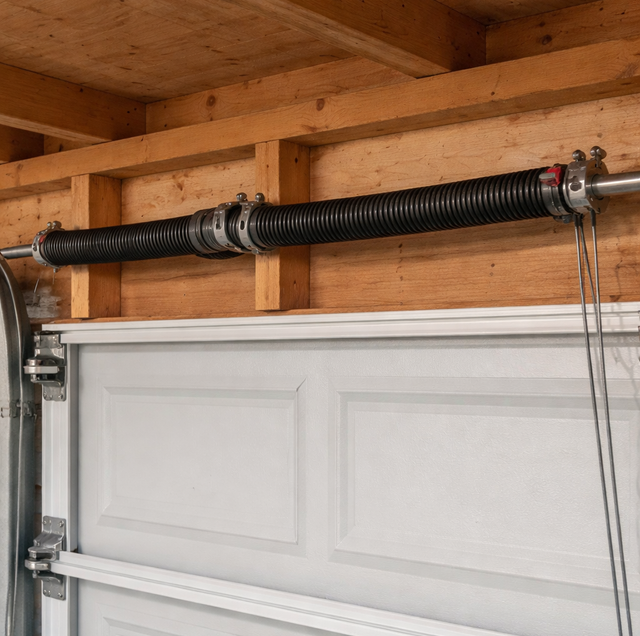
That flat bang out of the garage is a sound you recognize the second time instantly. You press the wall button, the opener grinds and quits, and up on the shaft sits a torsion spring split into two coiled halves with a few inches of bare steel between them. The part that stings is that you paid for this exact repair a year or two ago.
A spring that breaks once is ordinary wear. One that breaks again soon after a replacement is telling you something, and it usually isn't bad luck or a defective part. Torsion springs fail on a fairly predictable fatigue curve, so when a new one comes up short, the reason is normally sitting in plain sight on the door.
Possibility One: The Spring Was Rated for Fewer Cycles Than Your Door Gets
One cycle is one trip up and one trip back down. Springs are rated against a cycle rating, and the standard spring on most builder-grade doors is rated for near 10,000 cycles.
A household leaving and returning twice a day puts roughly 1,500 cycles a year on the door, which lands that spring around the six- or seven-year mark. Add a second driver, a teenager, or the habit of using the garage as the family's front door, and 10 to 15 cycles a day are not unusual. The same spring is finished in under three years. It did what it was rated to do; the rating just assumed a quieter house.
A rushed replacement misses this: the new spring gets matched to the old spring, not to the household. Higher cycle-rated springs earn their life from geometry, not better steel: thicker wire, a larger inside diameter, and a longer body make the same torque while each coil flexes less per turn.
Possibility Two: The Door Is Out of Balance, and the Spring Absorbs the Difference
A torsion spring is sized to counterweight one specific door weight. When the match is right, the door feels nearly weightless and holds position roughly wherever it stops. When it is off, the spring spends every cycle fighting the gap.
Imbalance often has nothing to do with the spring. Cables wind unevenly on the drums, so one side lifts ahead of the other and the door racks diagonally in the opening. A drum set screw creeps on the shaft, changing how much cable spools on that side. Seasonal ground movement shifts a slab and pulls the opening out of square until the track binds. Weight gets added, too: an insulation kit, a heavier replacement section, or a glass panel in a door sprung for solid steel. Any of those means the new spring started work already overloaded.
Possibility Three: Corrosion Is Quietly Shortening the Fatigue Life
Spring steel under constant torsional load is unforgiving about surface flaws, and rust does not have to eat through the wire to matter. Shallow pitting creates stress risers, small notches where a crack starts and then walks around the coil with every cycle. A pitted spring carries the load fine for months, then lets go with no warning.
Garages that stay humid, house a water heater or a washer, or sit open in wet weather move a spring along this path faster, since warm, moist air condenses on cold steel overnight and leaves the coils damp for hours. It is also why the first hard freeze of the season is the most predictable spring-breaking day on the calendar: cold steel is less forgiving of a flaw already there. Standard oil-tempered springs run bare and black, while galvanized and powder-coated springs shed moisture better in a damp garage.
Possibility Four: One Spring Is Carrying a Two-Spring Door's Load
Wide, heavy double doors are normally sprung as a matched pair, one on each side of the center bracket, splitting the torque. Two problems show up on these doors.
The first is a single-spring fix on a door built for two. A lone spring can be sized to carry the whole load on paper, but every coil then works near its limit on every cycle, and it fails sooner than either half of a matched pair would. There is no redundancy either: when it goes, nothing is holding the door.
The second is the partial repair. Both springs on a two-spring door have logged identical cycles since the day they went up, so replacing only the broken one leaves a fresh spring bolted alongside one already at the end of its fatigue life. The old one usually gives out within months, and while it limps along it isn't carrying its full share of the torque, which overloads the new spring.
Possibility Five: The Sizing or Winding Was Off From the Start
Four measurements define a torsion spring: wire diameter, inside diameter, overall length, and wind direction. Get one wrong, and the door is either under-sprung or over-sprung from the first cycle.
An under-sprung door is heavy. The opener labors, the door drops the last few inches instead of settling, and the spring runs closer to its stress limit on every turn. An over-sprung door is just as hard on the hardware: it floats up too fast and leaves the cables slack at the drums when it sits on the floor, which is how cables jump their grooves.
Winding turns follow from door height and spring geometry rather than from feel. Set screws on the winding cones are important, since they hold each cone to the shaft by friction alone. If they never bit into the steel, the cone creeps, tension bleeds off, and the door drifts back out of balance over the following weeks.
What You Can Notice From the Ground
Watch a full cycle from a safe distance and note whether one side lags behind the other, or the top section leans diagonally in the opening. Look for a cable hanging slack at the drum with the door down, or stacked on itself instead of lying in its grooves. A motor that strains or changes pitch partway through the travel is reacting to something. Orange dust on the coils or on the floor beneath them points to corrosion. And keep a rough count of how many times a day the door runs, because that one number is the most useful thing you can hand a technician.
What a Second Opinion Actually Checks
A proper second look starts with the door, not the spring. The door gets weighed on a scale rather than estimated from its size and material. Two doors of identical dimensions can differ greatly.
From there, the existing spring gets measured instead of matched by eye: wire diameter taken across twenty coils and divided out, inside diameter off the cone, relaxed length, and the wind. Those numbers get compared against what the weighed door and drum size call for, the step that exposes an undersized or wrong-handed spring from an earlier repair.
The rest is the door around the spring: the opener disconnected and the door checked for balance through its travel, tracks checked for plumb and spacing, the opening for square, rollers and hinges for drag, cables for equal wind on both drums, the shaft for straightness, and the bearing plates for wobble.
Then comes the conversation nobody had the first time: how often the door runs, and whether your household needs a higher cycle rating than standard. Most repeat failures trace back to that one conversation never happening the first time around.
Frequently Asked Questions
The rating isn't printed on it. Cycle life gets calculated backward from the spring's measurements plus the door's weight, since it depends on how far each coil flexes per turn. Some suppliers stamp or color-code the cones by wire size, but the reliable method is to measure 20 coils with a caliper and divide by 20.
They indicate the spring's hand, not its strength. By common convention, a black cone marks a right-wound spring and a red cone a left-wound one, and each belongs on a specific side of the center bracket. Cones turn up in both colors from different suppliers, so the hand is confirmed by the direction the coils spiral.
Yes, and this one catches people. A full insulation retrofit kit typically adds about 15 to 25 pounds to a double door, and a glass-panel swap can add more, depending on pane thickness. That is enough to shift a torsion spring's ideal turn count by a half turn or more, which is why the adjustment is not optional after either change, even though the door looks and moves the same at first.
Partly. Extension springs stretch along the horizontal tracks rather than twisting on a shaft, and the same weight, corrosion, and usage factors apply. They add failure points of their own: the pulleys they run through seize and bind, and each spring needs a safety containment cable threaded through it so a break doesn't send the spring across the garage.
They can mask one for a while. An opener with its force turned up keeps muscling a heavy or binding door through its travel, so the imbalance never announces itself until something breaks. The opener isn't reducing load on the spring, only overpowering the symptom, and the strain wears its gear and sprocket at the same time.
More than the shelf label suggests. Wire from a mill running tighter tolerances maintains a more consistent temper along its length, so two springs cut to the same wire diameter, inside diameter, and length can still end up with different real-world cycle counts. A big-box or online spring is frequently sold by size alone, with no cycle rating printed on it, which puts you back at Possibility One with no way to check it. A technician working from a supplier with published cycle data can at least tell you what you are installing.
Get a second opinion on a spring that failed early — a weighed door and a proper balance check show whether the replacement was ever sized right. Arnold's Garage Door & Gates serves Fort Worth, Alvarado, and the DFW metroplex. Call Arnold: 682-337-7220.
