
What an Extension Spring Safety Cable Stops From Happening
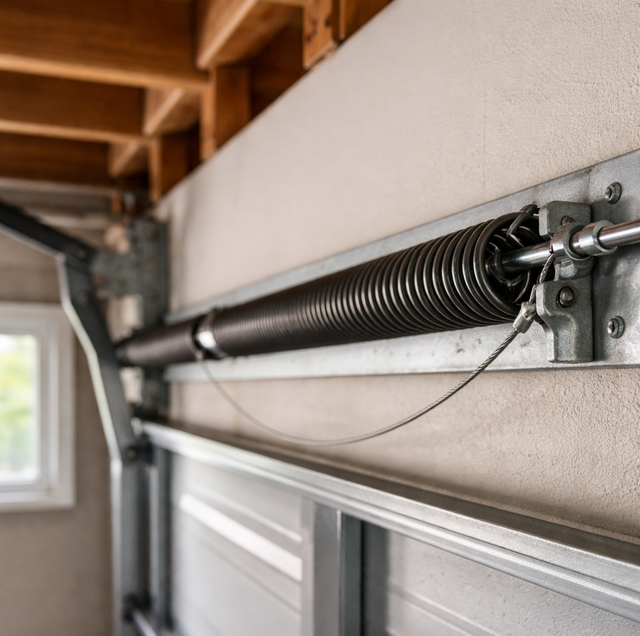
Stand inside the garage with the door closed and look up toward the back wall. On a door built with extension springs, a long steel coil runs alongside each horizontal track, stretched tight while the door sits down. Threaded through the hollow center of that coil, end to end, is a thin steel cable most people take for part of the spring. It isn't. It does nothing while the door works normally, and everything on the day the spring lets go. A missing one looks exactly like a working door right up until that day.
What an Extension Spring Setup Actually Looks Like
Extension springs and torsion springs are not two versions of the same part, so the first thing to sort out is which type is over your head.
A torsion system uses a horizontal shaft mounted above the opening, with the springs wound around it. An extension system has no shaft there at all. Instead, a spring is mounted alongside each horizontal track up near the ceiling, running back toward the rear of the garage. Two springs, one per side, are typical, and the setup is common on older doors and lighter single-car doors.
Trace one spring back to front, and you can name every piece:
The rear anchor: The spring's back end hooks to a fixed bracket at the rear track hanger, the perforated angle iron dropping from the ceiling framing to hold the back of the horizontal track. That connection is usually an eye bolt, sometimes with an S-hook or clevis between it and the spring's end loop.
The spring body: A long coil of round spring wire with an open eye or clipped end at each end. Unlike a torsion spring, it is hollow through the middle.
The pulley end: The front end connects to a pulley, also called a sheave, riding in a small metal fork. The lift cable runs over that pulley, forward along the track, then down the side of the door to the bottom bracket.
Close the door, and its weight pulls the lift cable; the cable pulls the pulley, and the pulley stretches the spring long. That stretch is the stored energy that lifts it back up.
Where the Safety Cable Runs and What Holds It
The safety cable is a separate piece of wire rope from the lift cable and serves a different purpose. The lift cable carries the door's weight. The safety cable carries nothing, most of the time.
It runs through the hollow center of the spring, coil end to coil end, and both ends fasten to fixed structure: usually the rear track hanger at the back, and a bracket or angle at the front of the horizontal track assembly. What matters is that both anchors are bolted in place. Not the spring, not the pulley, not the lift cable. Anything that moves is the wrong anchor point.
It is also left with a little slack on purpose. It is not meant to be taut or to share load. It passes through the coil like a wire through a straw, waiting.
What Happens the Instant a Spring Breaks
An extension spring under full stretch holds a large amount of energy in a straight line. When the wire fatigues through and the coil separates, that energy releases at once and both halves snap back toward their ends.
Without a cable through the middle, nothing controls where those pieces go. The break comes with a bang loud enough to hear from inside the house, and the loose section can cross a two-car garage before it hits something: drywall, the hood of whatever is parked underneath, a car window. It does not fall. It flies.
Never stand or park directly beneath an extension spring that is missing its safety cable. An uncontained break can send a piece of the coil across a two-car garage with enough force to crack drywall or a windshield.
With the cable in place, the same break happens, and the same bang goes off, but the two halves stay strung on the cable like beads on a wire. They drop a few inches, swing, and hang there. The noise is identical. The outcome is not.
Springs break for ordinary reasons: they carry a rated cycle life, and every trip up and down spends a little of it. Cold is the accelerator, since steel loses ductility as temperature drops, so a spring already carrying fatigue cracks is far likelier to finish breaking on the first hard freeze of the season.
Why Extension Springs Need Containment and Torsion Springs Don't
A torsion spring is wound around a steel shaft running through its entire length, so when it breaks it stays captive on that shaft. The halves unwind fast and make a tremendous noise, but the shaft keeps the pieces at the wall. That containment is built into the geometry.
An extension spring has no shaft. It is held only at its two ends, and its middle hangs unsupported in open air above your car. The safety cable restores the containment that the torsion design gets for free.
Why Older Doors Are Often Missing Theirs
Some doors were installed long enough ago that cables were never fitted. Others had them and lost them during a later repair: replacing a spring means the cable has to come off, get threaded through the new spring, and go back on its anchors, and when that step gets skipped, the cable ends up in the rafters or in the trash with the old spring. Track work does the same, since loosening the rear hangers means disconnecting cable ends that do not always reconnect.
The pattern worth watching for is one side with a cable and one side without. That points to a past repair on the bare side rather than to how the door was originally built.
What a Technician Checks on an Extension Spring System
Presence is the first item checked on each side independently. Attention then goes to the anchor points, because a cable fastened to the wrong thing restrains nothing: one clipped to the pulley fork or looped around the spring's own end coil just travels with the spring at the moment it matters.
The cable itself is inspected for broken strands, rust, kinks, or a crushed spot from a bad clamp, since one that parts under a shock load is no better than a missing one. Eye bolts, S-hooks, and clamps should be seated and intact, not spread open or backed off.
The rest of the check covers the spring and the parts sharing its load: gaps opening between coils while the door is up, pitting on the wire, a pulley that wobbles or has a worn groove, fraying on the lift cable near the bottom bracket, and springs of different lengths or gauges side to side, since a mismatched pair pulls unevenly.
Adding Safety Cables to an Older Door That Never Had Them
Retrofitting works on essentially any extension spring door, and it is small work compared to almost anything else on the assembly. The anchor points the cable needs usually already exist as part of the track hangers and brackets holding your springs now.
The natural time to do it is alongside a spring replacement, since the spring has to come off its anchors anyway for a cable to be threaded through it. If your springs are original and the door has cycled for many years, that job is likely coming regardless.
This is not a job to knock out solo between other chores. An extension spring carries significant tension even with the door fully open, and threading a cable through it means putting your hands around the part that stores the energy. That is the same reason the cable is worth having.
Frequently Asked Questions
No, and that is the most common misunderstanding about the part. It contains the broken spring only. Your door's weight rides on the lift cables running from the pulleys down to the bottom brackets, and a broken spring leaves the door without its counterbalance and very heavy by hand.
Yes. Each spring is its own assembly with its own anchors, so a cable through the left spring does nothing for the right one. Some heavy or oversized doors run a second spring doubled up on each side, and each of those needs its own cable.
Galvanized steel wire rope, thinner than the lift cable, commonly about an eighth of an inch. It is normally terminated with a thimble and a cable clamp, or a loop crimped into a sleeve. A knot tied in the wire is not correct hardware.
It can. A cable with generous slack will tick against the inside of the coils as the spring stretches and relaxes, which is usually harmless. A scraping sound near the pulley is different, and more often points to a worn sheave or a lift cable jumping its groove.
Not as a safety cable, since the shaft already handles containment. If someone recommends a safety cable for a torsion door, ask which part they mean, because torsion systems carry their own separate safety hardware in the anchor brackets and cable drums.
An annual look is reasonable, best folded into a tune-up while the springs, pulleys, rollers, and lift cables are inspected anyway. Rust at the anchor ends, where moisture collects, is what usually shows up first.
Call Arnold for an extension spring inspection if your door's springs run along the ceiling tracks and you cannot see a cable through them. Arnold's Garage Door & Gates serves Fort Worth, Alvarado, and the DFW metroplex. Call Arnold: 682-337-7220.
