
Garage Door Emergency Release Cord: When Not to Pull It
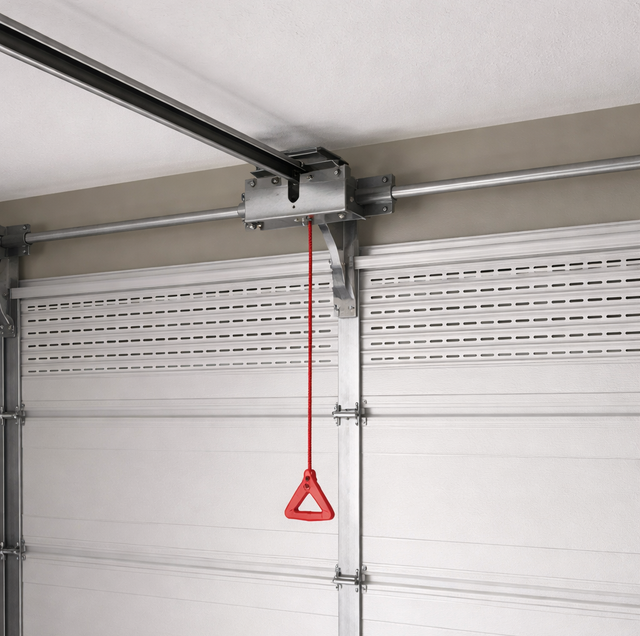
A car is trapped inside, and the opener will not run. Someone reaches for the red cord hanging from the rail, because that is what the cord is for, and pulls it without a second thought.
Sometimes that is exactly the right move. Sometimes it turns a stuck door into a falling one. The difference comes down to knowing what that cord actually does, and which parts of your door it never touches.
What the Cord Is Physically Attached To
Follow the rail from the motor toward the wall above the door. Inside or alongside that rail runs the drive: a chain on most openers, a rubber-toothed belt on quieter ones, a threaded steel rod on screw-drive units. Riding on the rail and coupled to that drive is a block of plastic and metal called the trolley, or the carriage. A steel arm runs from the trolley down and forward to a bracket bolted across the top section of the door. Everything the opener does to your door passes through that single arm.
Inside the trolley sits a spring-loaded latch locking the trolley body to the drive. The red cord pulls a lever on that latch. When the latch lets go, the trolley stays on the rail but stops traveling with the chain or belt, so the arm and the door are free of the motor. Run the opener after that, and the chain sweeps its full length while the door does not move.
That is the whole mechanism. A latch inside a plastic housing at ceiling height, released by a rope.
What the Cord Leaves Completely Alone
Nothing in that description mentioned springs, and the omission is the point.
Your door's weight is carried by the counterbalance: a torsion spring wound on a steel shaft above the opening, or extension springs stretched alongside the horizontal tracks, working through cables, drums, and bearings. That system mounts to the wall and the ceiling framing and shares no linkage, cable, or fastener with the trolley, rail, or cord. Pulling the handle does not release spring tension, unwind a shaft, slacken a cable, or change the weight the door presents by any amount.
The release cord is a tool used to remove the motor from a door. It does not touch, relieve, or affect the weight the door carries.
So the door's weight, the instant after you pull, goes wherever it was already going. Healthy springs keep carrying it. A broken spring was already carrying nothing, which leaves the opener as the last part with any grip on the panel.
The One Rule That Decides Safe From Dangerous
Before the handle moves, answer one question. With the opener disconnected, what will be holding this door?
There are three honest answers. The concrete floor, but only if the door is fully closed and the springs are known good. The counterbalance, if the springs are intact and the door sits up in its travel. Or nothing at all, if a spring or cable has failed, whether the door is up, down, or stopped partway. A closed door with a failed spring is not the safe case; it is the third answer sitting still. That one does not announce itself, which is how people get hurt.
What you are judging is whether the counterbalance is doing its job right now, and whether the door has anywhere to fall if it is not.
The Case Where Pulling It Is Routine
Door fully closed, flat on the concrete, springs known good, and the door ran normally the last time anyone used it. That combination is what the cord was built for.
The everyday version is a power outage. The opener is dead, you need the car, and the door has to move by hand. Pull the cord, the trolley uncouples, and the door lifts under hand pressure because the springs are still carrying the panel weight for you. A balanced door feels light going up and stays roughly where you leave it. Lower it the same way, hand on the door, fingers off the section joints.
Try the release once on a calm afternoon, with the door closed and working properly. Learning where the handle is and how the door feels by hand is easier in daylight than during a storm outage.
The Cases Where Pulling It Turns the Door Into Dead Weight
A spring broke while the door was open: the panel sits up in the tracks with no counterbalance beneath it, and the trolley and drive are the only things holding it in that position. Pulling the cord removes them, leaving the door a clear path to the floor with its full weight behind it.
A spring broke while the door was closed: the more stable version, since a door on the concrete has nowhere to drop. It is still not a door to cycle by hand. Releasing the trolley puts the full panel weight on whoever lifts it, with nothing to assist and nothing to catch it if a grip slips. A car parked behind that door stays parked until the spring is replaced.
The door stopped partway for a reason nobody can name: maybe it strained and quit, maybe it lifted crooked and jammed. Whatever stopped it, the trolley may be the only thing holding the door at that height, and the cord releases exactly that.
Somebody already pulled the release and the door is sitting open: it hangs free of the motor with an unknown counterbalance behind it, and re-latching the trolley by hand pulls the door back into powered range before anyone has checked what is actually holding it up. Leave it disconnected until a technician looks at it.
Pulling the cord never makes a broken-spring door liftable, so it is in no way a way to free a trapped vehicle. Leave the door and the car where until a technician has the door secured.
What People Get Wrong About the Cord
The most common mistake treats the cord as a general-purpose override, the garage door version of an emergency stop. It removes exactly one connection: the trolley from the drive.
The second assumes the cord relieves tension somewhere. Homeowners who have heard that springs are dangerous sometimes reach for the red handle first, believing it disarms the system. The springs remain wound exactly as they were, and the one part that was still restraining the door has now been removed.
The third is pulling it while the door is moving, which drops the door onto whatever is below while the drive keeps running.
Before You Reach for the Handle
Two conditions clear the cord for use: the door is fully closed against the concrete, and you have no reason to doubt the springs. Meet both and pulling the cord is ordinary homeowner work. Miss either one and the smarter move is the phone.
If the door is up, the springs are known good, and the opener still runs, close it under power first. That step converts a hazardous situation into the safe case at the cost of one button press. If there is any doubt about the springs, that button press is not safe either; leave the door up, unplug the opener, and call for service.
Frequently Asked Questions
The cord is usually braided nylon or polypropylene rope, red so it reads as a hazard-related control, tied through a molded plastic handle about the size of a bike grip. Older units sometimes have bare rope with a knot, or a handle faded to pink. Identify it by where it goes: the correct cord runs up to a small housing riding on the rail, never to the door, a track, or anything on the wall.
Most openers reconnect themselves. Close the door fully by hand, then run the opener; the drive carries the coupling along the rail until it meets the released trolley and the latch clicks back in. Other designs require the handle to be pulled a second time, or pulled toward the door, to reset the latch first. Either way, reconnect with the door closed, and watch one full cycle to confirm the arm is actually moving the door, and the chain is not simply traveling alone.
The door may hold, but it is still not a move worth making. A healthy counterbalance is tuned to hold the door at every height, not just where you happened to test it, so a good spring should not drift once fully open. What changes the calculation at full open is wind: an open bay puts moving air against a large flat panel now held by spring torque alone, and a gust can move a door that would otherwise sit still. Reconnecting also means bringing the door down by hand, underneath it.
Do not try to force the trolley back onto the drive by hand. A door left disconnected on the concrete, fully closed, generally is not going anywhere on its own and can be left as is until a technician arrives. A door left disconnected up in its travel is a different problem: locking pliers clamped onto the track just above a roller on each side, snug against the roller itself, will keep it from sliding down while it waits, but that is a stopgap for a technician's first minutes on site, not a substitute for calling one.
Cords snap, handles crack off, and latches seize with age or corrosion. On a high-lift or cathedral-ceiling installation, the handle can sit well above reach. Neither problem is solved with a ladder and a pull from an awkward angle, because a released trolley behaves the same whether the pull was controlled or not. A technician can uncouple the trolley with the door secured, replace the cord and handle, and free a latch that has stopped resetting.
No, and applying residential habits to them causes trouble. Rolling steel and heavy sectional commercial doors usually run a chain hoist, a hand crank, or a floor-level chain, and the disconnect lives on the operator as a lever or clutch. The counterbalance sits inside the barrel where its condition stays out of sight. Manual operation is specific to the operator model, so those doors belong to commercial service.
Call for after-hours help — if your door is stuck open, stopped partway, or disconnected with a spring you do not trust. Arnold's Garage Door & Gates serves Fort Worth, Alvarado, and the DFW metroplex. Call Arnold: 682-337-7220.
