
Will Your Old Remote Work with a New Garage Door Opener?
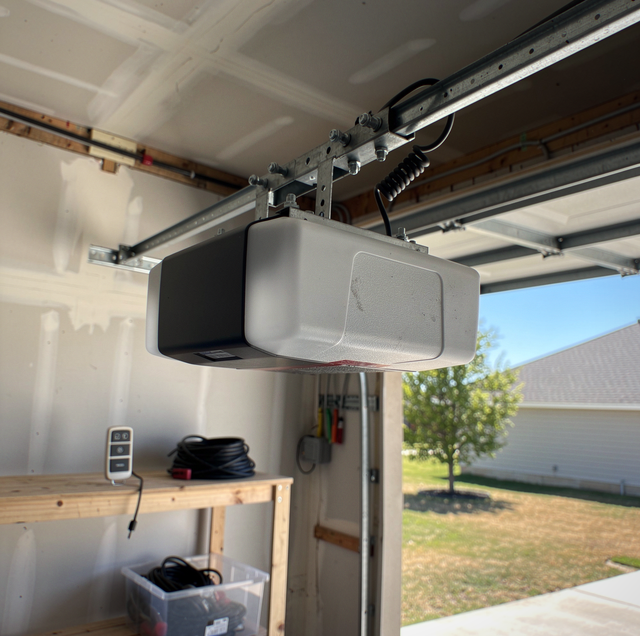
The part being replaced is the receiver, and every control in the house is a transmitter talking to it. Press the button on a visor at the end of the driveway, and that button does exactly one thing: it broadcasts an identity. Whether the door lifts is determined by a board inside the unit on the ceiling, which listens for identities it already recognizes. Put a different board up in its place, and every transmitter around it is suddenly speaking to something that has never heard of it.
That is why "will my old remote still work" resolves differently for each control you own. A handheld remote, a wall keypad, a factory in-car button, and a phone app are four device classes that reach the opener along different paths, and the new receiver handles each on its own terms.
The Receiver Keeps the List, Not the Transmitters
Everything that decides whether a transmitter works sits on the far side of the radio link. The receiver keeps a memory of the transmitter identities it has agreed to accept, and each entry is a record of one specific transmitter rather than a copy of anything stored inside the remote. The remote broadcasts. The receiver checks that broadcast against its list and either acts on it or ignores it.
That memory belongs to the board it lives on. Replace the powerhead and the list goes with the old board, because nothing on the transmitter side ever held a record the new board could read. Receivers also hold a limited number of entries, a count set by the model rather than by the household.
It also explains a symptom that confuses people on install day. A remote with a fresh battery still lights its indicator and still broadcasts, because broadcasting is all it ever does. Silence from the door is not evidence the remote is broken, only that nothing on the ceiling recognizes it.
Your Handheld Remote Follows the New Receiver's Protocol
A handheld remote and the receiver have to agree on the same radio language before that list ever comes into it. The language is two things: the frequency band the transmitter broadcasts on, and the code scheme it uses to identify itself. Openers built in recent decades rely on a rolling code, in which the transmitter and receiver step through a shared sequence so that the code sent never repeats. That scheme is generational. A receiver built to a newer stage of the sequence usually will not accept a remote still speaking an older stage of it, no matter how healthy the remote is.
Manufacturer family is the practical shorthand for predicting this. A remote built for one maker's ecosystem, meeting a same-brand receiver of a compatible generation, has a real chance of being accepted again, and some brand families share enough lineage that a remote from one line is still recognized by a newer board in the same family. A remote from a different family starts from a different radio conversation, and a working button is no guarantee it can join that one.
A remote that seems dead is worth testing with a fresh battery before writing it off as incompatible. A remote that's simply out of sync with the new receiver's protocol won't work no matter how many batteries you put in it.
A Keypad Holds the PIN and the Receiver Holds the Keypad
Two separate things get confused about outdoor keypads, and pulling them apart answers most of what people want to know. The number a person punches in lives in the keypad. The keypad stores that PIN in its memory, compares whatever is typed against it, and does nothing until the two match.
What happens after they match is a radio transmission, and that transmission carries the keypad's own identity. The receiver never sees the PIN and never stores it. What the receiver stores is the keypad's identity, the same way it stores a remote's. A keypad is a transmitter that refuses to transmit until the right number is entered, and to the board on the ceiling it is one more entry on the list.
The consequence is clean. Replacing the opener never touches the PIN, because the PIN was never in the opener. What gets re-established is the keypad's standing with the new receiver, exactly as for any remote, and the same number goes back to working.
An older wired keypad sits on a different physical path entirely. It runs a low-voltage line back to the powerhead and lands on a dedicated terminal pair, so no radio identity is involved. Some current control boards keep that terminal pair. Others support wireless keypads only and have nowhere for that wire to land, whoever made the old keypad or the new opener. That is as much a wiring question as a compatibility one; better raised before install day than discovered after.
The In-Car Button Re-Learns Rather than Transfers
A factory in-car button, the kind molded into the visor or the headliner rather than clipped on as an accessory, does not carry a manufacturer's code of its own the way a handheld remote does. It holds whatever it learned from a transmitter at some earlier point and rebroadcasts that. Replace the opener and what it holds no longer matches anything the new board listens for, so the in-car system learns the new signal from scratch, the same as any transmitter that has never been used on that door.
Factory systems hold several learned codes at once, in separate slots that do not depend on one another. That is why a single row of buttons can run a garage door, a second door and a gate operator without any of the three interfering. An opener swap only stales the slot tied to that opener; everything else the system has learned stays exactly as it was.
A Universal Remote Reaches the Door Command and Little Else
An aftermarket universal transmitter is designed to communicate with more than one manufacturer's rolling-code format. Set to the format the new receiver uses, it can carry the plain open-and-close command across a brand boundary a factory remote from the old opener cannot cross.
What it does not do is bridge the other device classes, because none of them ride on that radio link. A wired wall console is not a radio device at all; it communicates over the low-voltage pair running up to the powerhead, and no handheld transmitter serves as a substitute. A keypad's stored PIN lives inside the keypad and offers a universal remote nothing to adopt. App control lives on the manufacturer's platform and on an account, well past where any transmitter has a say.
Being universal also changes what a transmitter can say, not its standing with the receiver. It still has to be accepted onto the same list every other transmitter sits on before the door moves for it, which is work a technician handles on install day. Ecosystem extras follow that rule as well: light control, lock functions, and accessory triggers built into one manufacturer's control scheme stay out of reach even after the door command works.
Check a universal remote's listed compatibility against the new opener's brand and code generation, not against the old one. Coverage is published per receiver family, and a unit that covers the outgoing opener may not cover the incoming one.
A Phone App Belongs to Whichever Unit Is Installed
App control is the one item on this list that is not a transmitter. Nothing in the phone broadcasts to the ceiling. The command leaves the phone, travels out to the manufacturer's platform over the internet, and comes back down to the opener through the house network, a different path entirely from the radio link every other control uses.
That path belongs to whichever unit is installed. An app tied to the old opener has nothing left to reach once that unit comes off the ceiling; it stays on the phone pointed at hardware that no longer exists, its account holding history for a device that is gone. A new opener with app control talks to its own platform, and access there gets set up fresh rather than inherited. Household members who had shared access under the old account are invited again under the new one, and any automation or voice assistant configured for the old device is redirected to the new one.
What the app can do is set by the platform rather than by the door. Door status (open and closed) from away, an alert when the door moves at an hour nobody expected, and time-limited access for a one-time visitor are all platform features. The same physical door gains or loses any of them purely on which opener ends up bolted above it, which is why app functionality belongs in the model-tier conversation rather than being assumed.
One practical difference is worth carrying out of all this. Every radio-controlled device in the house keeps working during an internet outage because the transmitter and the receiver are talking to each other and to nothing else. App control is the only one that stops, since its path runs out to a platform that has to answer. A household that has quietly stopped carrying remotes tends to discover that the first time the connection drops.
Frequently Asked Questions
Many wireless keypads hold several independent codes at once, so a house cleaner, a teenager, and a neighbor watering plants can each have a different number rather than sharing one. Those codes are managed in the keypad itself, so a single code can be removed without disturbing the others. A keypad limited to one code is usually an older or entry-tier unit.
No. A gate operator, whether it runs a swing arm or a slide track, has its own control board and transmitter memory, entirely separate from whatever controls the garage door. Replacing the garage opener has no effect on gate remotes or the gate's own keypad; those stay programmed exactly as they were before the garage work started.
Often, yes, though not because of anything the old opener did. Factory in-car systems are typically built to learn from a wide range of radio-frequency transmitters rather than one manufacturer's protocol, which is why the button is usually no harder to re-teach than any other remote even when the new opener is a different brand.
No. App control is tied to a specific tier of opener rather than being standard equipment, and some units connect to the internet only via a separate accessory connected to the powerhead, which can be fitted later rather than at install. A base-tier replacement can leave a household with less app functionality than the unit it replaced.
Almost always, yes. A wall console and a control board are a matched pair: beyond the door command, the extra functions on a multi-button console travel as data over the same two low-voltage wires, and one manufacturer's board does not read another's data. The wire can fit fine, and the console still will not work, which is why a new opener ships with its own.
Yes, and safely so. A wireless keypad left out of that process sits dead on the wall, running on its own battery and never connected to line voltage, so there is no hazard in leaving it there. It stays inert until someone deliberately adds it to the new receiver's memory, which can happen any time afterward rather than only on install day.
Ask which remotes, keypads, and car buttons will pair with the new opener before you decide what to replace — a technician can test every transmitter in the house on install day. Arnold's Garage Door & Gates serves Fort Worth, Alvarado, and the DFW metroplex. Call Arnold: 682-337-7220.
