
Garage Door Closes but Won't Open: What Direction Tells You
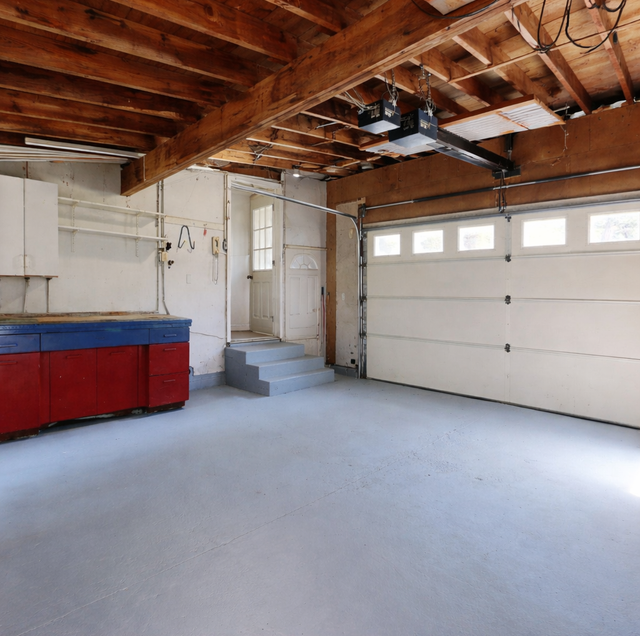
The door went down last night without a hint of trouble. Smooth run, clean landing on the concrete, motor shutting off right on schedule. This morning, you sent it the other way, and nothing useful happened. Maybe the opener runs its whole cycle overhead while the door sits flat on the floor. Maybe the door lurches an inch and settles back. Whatever version you got, the same door that handled one direction fine a few hours ago now refuses the other one.
That asymmetry is the most useful clue you have. A garage door that closes but won't open points to where the failure lies, because the two directions do not ask the same thing of the same parts.
Why Down Costs Almost Nothing and Up Costs Everything
A sectional door weighs a couple hundred pounds once you add insulation, glass, and hardware, and nothing about the opener overhead was built to carry that. Its rated pulling force is a small fraction of the door's weight, and it works only because the counterbalance has already made the door feel nearly weightless.
Going down, the door has an ally. Gravity does the moving, the springs are asked for very little, and the opener mostly paces the descent so the panel does not run away from itself.
Going up, the arrangement reverses. Every pound has to be lifted, and the springs supply almost all of that lift by unwinding stored energy through the cables and drums. The opener contributes direction and a nudge. Take the counterbalance away, and the closing stroke barely notices, while the opening stroke loses the only thing that made it possible. A failure showing up on one stroke and not the other lives in the part that only one stroke depends on.
What a Normal Close Already Rules Out
Track problems affect both directions equally. A bent rail, a flattened roller, or a section walking out of alignment binds whichever way the door travels, so a door that ran the full length of the track cleanly is telling you the track guided it the whole distance. The signal path is the same story: if the wall control moved the door last night, button, receiver, and logic board all did their jobs.
Photo eyes only supervise the closing direction. Their purpose is protecting whatever might be under a door coming down, so their reversal logic applies to the down-stroke alone, and a misaligned eye leaves the open command untouched.
One up-only culprit sits outside the counterbalance, and it costs nothing to check: a manual slide lock or a keyed lock on the inside of the door. Those latch after the door is down, which matches the sequence you saw. Look along the inside edge of the bottom section for a bar seated into its slot.
Reading the Specific Up-Stroke Failures
The way the door refuses to open narrows things further. Match what you saw and heard to the list below.
- The opener runs its full cycle overhead, and the door never moves: The motor is driving something no longer connected to the door. That pattern has its own diagnostic path, pointing at the trolley, the drive gear, or the link between them.
- The opener strains audibly, the chain or belt tightens, and the door does not rise: The motor is applying everything it has and losing. On a balanced door, that force is plenty; here it is the sound of the system loading up against dead weight.
- The door lifts an inch or two, hesitates, then settles back down: The force limit tripped. The opener learned how hard the job should be when the counterbalance was healthy, met far more resistance, and read the difference as an obstruction.
- The door starts up, climbs partway, and stops where it is: Some assist remains, just not enough to finish. A two-spring door with one failed spring behaves this way, as does a spring that has lost tension without visibly breaking.
- One bottom corner rises while the other stays down, and the door wedges: A cable has broken or jumped its drum, so one side gets lifted, and the other does not. The door binds inside the first foot of travel.
- The door opens if you help it with your hands while the opener pulls: The clearest confirmation on the list. Your arms are supplying the assist the springs are supposed to supply.
Nearly every item there traces back to the same place: lost counterbalance is the default explanation for a door that only fails going up.
Every additional press after the door refuses to lift only adds damage. The motor drives the trolley into a stationary door, stripping the drive gear and loosening the header bracket. One repair becomes three.
How a Door With No Lift Left Still Managed to Close
The sequence that puzzles people makes the most mechanical sense. Springs commonly fail while the door is closed or during a close, because closing is when the coils wind back toward their most loaded state and work hardest against fatigue. The last motion the door completed successfully was a close, and the failure landed at the end of it. There is often a hint in that final close, if you were watching: a door losing counterbalance comes down faster through the last stretch and lands harder than it should.
Confirming It From Inside the Garage
Stand inside with the door down and look up at the wall above the opening. On a torsion setup, the spring sits on a shaft across the header, and a break shows as a visible gap in an otherwise continuous coil. On a door with springs along the horizontal tracks, look for one gone slack or come apart at its hook.
Then follow the cables. Each runs from a bottom bracket up to a drum at the end of the shaft. A cable pooled on the floor, hanging off its drum, or wrapped over itself tells you the lifting path is broken even when the spring looks intact. Lifting the door yourself is the part worth skipping, since a door with no counterbalance puts its full weight in your hands.
Frequently Asked Questions
In one narrow way. The motor relies on a start capacitor to begin turning under load, and a weak capacitor leaves it humming and struggling to get moving. Because opening requires real work and closing requires very little, a tired capacitor shows itself on the up command first. Sound separates it from a spring failure: a capacitor-limited motor buzzes without the trolley advancing, while a door that has lost counterbalance lets the motor run at speed against a door that will not follow.
It can. The drive gear inside a chain-drive opener is nylon, and its teeth shear off on the loaded side first. The tell is sound: the motor spins freely and fast, often with a grinding note, while the chain and trolley stay still. A gear rarely strips on a healthy door. It strips after weeks of the motor fighting a counterbalance that was already fading, so a stripped gear frequently arrives alongside a spring problem.
Rarely, and it is easy to rule out. A failing button, receiver, or remote battery tends to produce no response at all, or an inconsistent one, from every input alike rather than a clean pattern that only affects one direction. If the keypad, the remote, and the wall button all send the door the same short distance before it stalls or refuses, the fault sits downstream of the controls, in the motor, the drive train, or the counterbalance, not in how the command reaches the opener.
Balance, before touching a single setting. The opener gets disconnected, and the door is moved by hand to determine what it actually weighs and where it wants to sit. That one test separates a counterbalance failure from everything else, and it comes first because adjusting force or travel limits around a badly balanced door buries the real condition under a heavier motor load. Springs, cables, drums, and the trolley connection follow.
Beyond the mechanical damage, repeated attempts erase the diagnostic picture a technician would otherwise read off the door. A cable that jumped one groove on the first try can wrap itself several times deep by the tenth, a stripped gear tooth becomes a stripped section of gear, and what started as a clean single-point failure turns into a tangle of secondary damage where cause and effect are hard to separate. Most residential openers also carry a thermal cutout that shuts the motor down after enough repeated strain, so a unit that stops responding to the button entirely partway through this may simply be protecting its own windings rather than failing outright.
Usually within the same visit, but not always at full speed on the very first cycle. A door that has been fighting a lost counterbalance for even a short time can leave a chain or belt with extra slack, since the trolley was straining against a dead stop rather than driving smoothly, and that slack often gets taken up automatically on the first couple of powered cycles after the repair. If the door still hesitates or strains after that, the issue has moved to the drive train rather than back to the spring.
Schedule a broken spring diagnosis for a door that closes but will not lift. A technician tests balance by hand, inspects springs, cables, and drums, and restores the counterbalance the opener depends on. Arnold's Garage Door & Gates serves Fort Worth, Alvarado, and the DFW metroplex. Call Arnold: 682-337-7220.
