
Garage Door Opener Power Surge Damage — What Breaks First
The storm came through before dawn and took the power with it. By the time the coffee was on, the house had woken back up on its own, the microwave clock blinking and asking to be reset. Everything that had been dark for a few hours was running.
Then the wall button in the garage did nothing. Or it did something, just not the thing it normally does.
That asymmetry is the part worth sitting with. A house full of electronics rode out the same night on the same service, and the opener is the one that came back wrong. There is a reason the opener is a plausible casualty when the toaster is not, and a second reason that matters more: an opener that survived a surge and an opener that is fine are two different things.
A Surge and an Outage Are Opposite Failures
An outage is the absence of power. The supply goes away, everything sits idle, and when it returns, the equipment starts up again none the worse for the pause. Nothing about sitting without voltage harms an appliance.
A surge is the opposite condition: a brief transient at a voltage far above what the line normally carries, gone in a small fraction of a second. Equipment is not damaged by how long it lasts. It is damaged by how high it goes, because insulation and semiconductor junctions have a ceiling on the voltage they can stand off, and a transient that clears that ceiling does its work instantly.
Three sources account for most of them. A lightning strike does not have to hit the house: a strike to a utility line, a tree, or the ground nearby couples energy into the wiring serving the neighborhood. Utility switching does it too, when protective equipment clears a fault on a line and the system re-energizes. So does a large motor elsewhere on the supply dropping off load. A surge and an outage so often arrive together because the same event causes both, which is why the timeline lines up so neatly the next morning.
The Sensor Wiring Gives a Surge a Second Way In
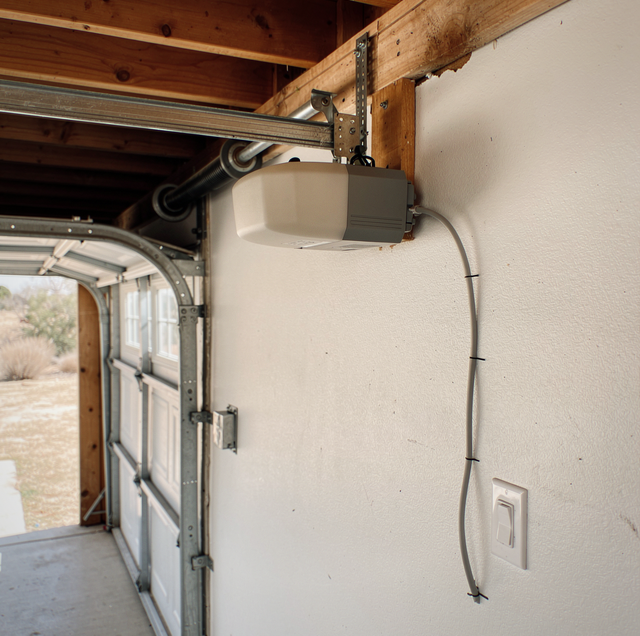
Line voltage reaches the powerhead through the cord, and a step-down supply that feeds the electronics beyond it, and that path absorbs a fair share of what a storm sends down the line. A powerhead that is completely dark the morning after a storm has often failed exactly there.
The photo eyes near the bottom of the door tracks connect to the powerhead via a long, thin, low-voltage run stapled along the wall and across the ceiling, and that run behaves like an antenna in its own right. A nearby strike can induce a transient on it directly, arriving at the board's sensor input from a direction the supply section never sees and bypassing it entirely. A sensor pair that will not confirm alignment after a storm is a genuine presentation, and the damage lies either in the eyes themselves or in the input they report to the board. The wall control run threads the same walls and carries the same exposure, which is easy to forget when the cord is the only path that comes to mind.
What a Surge Destroys Outright Announces Itself Immediately
Three places account for most outright failures.
The supply section is the first. When it goes, the powerhead is silent: no light, no relay click, no hum. Failures at the front of the unit sometimes leave something you can notice from the floor, since scorched electronics have a sharp, acrid smell that lingers for days in a closed garage, and discoloration sometimes shows through the vents or around the cord entry on the outside of the housing. Neither observation requires opening anything, and either is worth reporting.
The board's input stage is the second. Boards carry components at the low-voltage entry whose function is to clamp or divert whatever arrives above a certain level, and those components fail by design when they are overrun. The result is a dark board, even though the supply feeding it is intact.
The radio receiver is the third and produces the most recognizable signature in the category. The receiver section connects to the antenna wire hanging from the powerhead, and that wire is intended to collect radio energy, so it collects the wrong kind just as willingly. A receiver killed by a surge leaves an opener that works perfectly from the hardwired wall button and ignores every remote and keypad you own. That combination is worth recognizing because it directs a technician to one section of the board rather than the whole unit.
An opener that has never responded to anything at all, a breaker that will not hold, and a fault that comes and goes on its own each point to something other than a storm night.
Write down the date of the outage and what else in the house failed that night: the television, the garage refrigerator, an outdoor fixture. That list is the most useful thing you can hand a technician months later.
What Survives Degraded Says Nothing at All
Semiconductors and capacitors do not only fail open or shorted. A transient can puncture a small area of a junction, or break down part of a capacitor's dielectric, and leave behind a component that still does its job with less margin than it had the day before. Nothing about that shows up on the morning after. The door goes up, the door goes down, the light comes on, and the household files the storm away as a near miss.
The fault that follows arrives later, looking like something else. A relay that begins to chatter. A receiver whose usable range has fallen off. An opener that misses a command now and then, or resets itself when the motor starts pulling current. Every one of those symptoms has ordinary causes unrelated to weather, which is precisely why the storm is no longer a suspect by the time the symptom appears.
There is no way to look at a weakened part and see the weakness. It behaves identically to a healthy one until the day it is asked for slightly more than it can still give. What can be established is the sequence of events, and the sequence is the only thing connecting the two halves of the story.
Protection Against the Next One Belongs to an Electrician
Two levels of protection exist as a category. One is a surge protective device at the receptacle that serves the opener. The other is whole-home protection installed at the electrical panel, covering everything downstream of it. Both are electrical work, both are an electrician's scope rather than a garage door technician's, and the choice between them is a conversation to have with the person who will be doing it.
Two honest limits are worth stating. Protection on the line path does nothing for a transient induced on the sensor run or the wall control run, since those conductors do not pass through it. And nothing at a panel or a receptacle addresses a direct strike to the structure. Protection reduces exposure to the common case, and any description of it that sounds like a guarantee is overselling it.
An opener behaving erratically after a surge is not merely annoying. Keep children and pets clear of the doorway, and do not use the door until someone has confirmed the safety reversal and that the photo eyes still function correctly.
An Opener That Survived a Surge Is a Different Problem from One That Died
A dead unit is, oddly, the easier outcome. The diagnosis is short, the decision is close to binary, and when the work is finished nobody has to wonder whether it worked. The opener runs, or it does not.
A survivor puts a question mark over everything that follows. Replace the failed receiver; the unit works again, but the transient did not restrict itself to one section, and the other places it passed through are still sitting there with less margin than they had. Judged one at a time, each repair is reasonable. Judged as a sequence, they are a single event unfolding in installments.
That changes the shape of the decision. With a dead opener, the question is what to replace. With a survivor, the question is the condition of the whole unit: how old it is, what else has gone wrong since the storm, and whether it makes sense to keep chasing sections of a board that all took the same hit. A unit that has turned in a stretch of normal service since the storm has earned some confidence.
The household supplies the history, and the technician supplies the diagnosis. What the opener has done since the storm, including the small things that seemed too minor to mention, is what turns an isolated symptom into a pattern, and the pattern is what makes the difference between guessing and knowing.
Frequently Asked Questions
They will work, but not until they are paired to the new receiver, because the pairing lives in the receiver rather than in the remotes. That means every handheld remote, the outside keypad if there is one, and the in-car HomeLink buttons all have to be set up again. Gathering all of them in one place before the visit is what keeps it to a single trip.
It can, though not every opener has one, since backup inclusion depends on the model tier rather than the motor type. On units that do have it, the battery and its charging circuit sit on the same low-voltage side as everything else, so a transient that reaches the board can affect the charging circuit as well. An opener that carried the household through the outage on battery and then reports a backup fault days later is showing that pattern.
Quite possibly. On a Wi-Fi-capable opener, the network module is a separate section from the radio receiver that listens to your remotes, and the two fail independently. Losing the app while the remotes and the wall button carry on normally is consistent with damage confined to the network side, and it is one of the few surge symptoms that costs you nothing in daily use.
Usually not, because surge damage is neither a manufacturing defect nor a workmanship error, which is what warranty coverage is written to address. This company's installation warranty runs one year on labor and three years on parts, and its workmanship coverage on a repair is measured in weeks, but a transient arriving from outside the house sits outside all of it.
Unplugging at the ceiling outlet removes the line path, which is the main way a transient gets in, so it does help. It is not full isolation, though: the sensor run and the wall control run still tie the powerhead to wiring stretched across the garage, and those conductors stay connected. Plan to keep the door closed before you unplug, since an unplugged opener means working the door by hand.
No. Springs, cables, drums, rollers, hinges and track carry no current and have no electrical connection to anything, so a transient has no path to them. The only electrical parts of the whole assembly are the powerhead, the wall control, the photo eyes and the wiring between them. A door that starts binding the morning after a storm is a mechanical matter whose timing is coincidence.
Have the opener checked after a storm that took out other equipment in the house — a unit that came through a surge and now behaves oddly is a different problem from one that died outright. Arnold's Garage Door & Gates serves Fort Worth, Alvarado, and the DFW metroplex. Call Arnold: 682-337-7220.
