
Operating a Garage Door With a Broken Spring: The Damage It Does
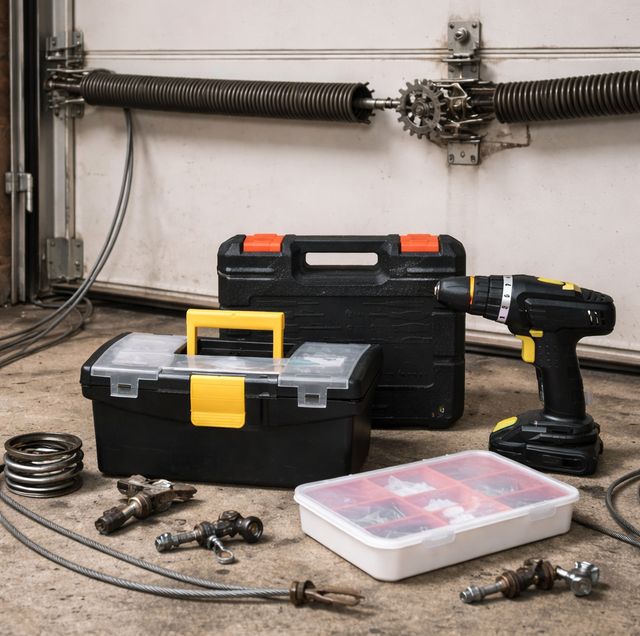
A technician looking at a door that has been run for a week on a broken spring can usually read the whole story off the hardware: a cable wound over itself at the drum, a rounded gear tooth still meshing but barely, a panel creased where the opener arm pulls hardest. None of that damage happened when the spring broke. It happened on every attempt after.
The spring failed once. Everything that followed was the door being asked to run without it.
Why One Broken Spring Turns Into Several Repairs
A sectional door carries its weight on the counterbalance, and every other part was sized around that arrangement. The opener supplies a nudge. The cables deliver lift the spring is already producing. The hinges hold sections in line; they carry almost none of the door's weight.
When the spring quits, the weight does not go anywhere. It redistributes to whichever parts are in the load path the next time the button is pressed, and those parts are far weaker than the one that failed. A press that produces no visible movement still drives the motor to its stall against a fixed load, and every part between the gear and the header takes that reaction force.
Intermittent success keeps people pressing. A door that comes up on the fourth try is borrowing capacity from parts that deform slightly to supply it. A cable seats deeper into a wrap than it should. A gear tooth rounds off gradually under repeated overload. Each change makes the next attempt harder, which is why a door that worked Monday refuses entirely by Thursday.
What Repeated Attempts Do to the Opener
The drive gear goes first on most chain-drive units. It is nylon, sized for a balanced door, and its teeth shear on the loaded side when the motor spins against a load that will not follow. A week of strained cycles turns a few damaged teeth into a stripped section. Belt drives fail no less completely, slipping at the sprocket, fraying, and stretching until the trolley stops reaching its travel limits.
The rail and trolley take the rest. The trolley is plastic on many residential units, and driving it repeatedly into a door that will not move cracks the body or elongates the hole where the door arm pins in. Above the opening, the header bracket anchoring the rail loosens its lag screws in the framing, which later surfaces as a sagging rail.
A unit that stops responding partway through a bad week has often simply tripped its own thermal cutout, and the wear from every earlier attempt remains once it cools.
What Repeated Attempts Do to the Door, Cables, and Track
Cables cause more of the follow-on work than anything else. With the door stationary and the spring gone, the lift cables go slack on their drums, and slack cable is free to leave its groove. The first attempt might move it one groove out of place. The tenth can wrap it over itself or wedge it against the end bearing plate, and a cable crushed flat under load is beyond rewinding and has to be replaced.
Once one cable is off and the other is not, the door lifts unevenly. That racking drives the rollers on the low side into the track, and steel flares open at the curve where the vertical run meets the horizontal. A flared section will not hold a roller correctly afterward.
The panels absorb the twist. Hinges bend where sections are forced out of square, and the holes elongate until the pins sit loose. The opener arm bolts to the top section, so every strained pull lands hardest at that one bracket and creases the panel around the mounting. Panel replacement depends on matching the original profile and color, which older doors often no longer offer.
The Injury Risk That Grows With Each Attempt
The risk here is not only what a compromised door does on its own. It is what it does while someone stands beside it, steadies it, or reaches under it to see why it stopped.
A door that has been run several times sits in a different condition than the one that broke. Its cables may be holding by friction rather than by seating, and a section may be square only because roller stems press against the track walls. Those arrangements can let go without warning.
A cable wound over itself at the drum is held only by pinch friction and can let go without warning. A corner then drops while the opener arm still holds the top, folding the seam fast enough to catch fingers.
Habits build around a door that mostly works, and those habits put people in the path: walking under a partly raised door to reach the wall button, or holding the bottom edge to help it start.
What Stopping Early Actually Saves You From
A spring failure caught before the door gets cycled is generally one repair with known parts. The same failure after days of attempts can pull in cable repair, off-track work, hinge and roller replacement, a panel, and an opener that no longer holds its settings.
Take the door out of service instead. Unplug the opener at the ceiling outlet, or kill the breaker if that outlet is out of reach, and say why out loud to the rest of the house. Leave a closed door closed, keep the bay clear if the door is stuck partway or open, and leave the emergency release cord alone.
A door that came up crooked or made a new grinding noise on a later attempt is worth mentioning specifically. Those two symptoms point to a jumped cable and a stripped gear tooth, two different repairs.
Frequently Asked Questions
Often, and this is the version people skip. A door that finished its travel did so by overloading parts that flex before they fail outright, and flexing leaves marks invisible from the driveway: a cable sitting one groove off, a gear with rounded teeth still meshing, header lags backed out a turn. All of it shortens the life of a new spring installation, because the door goes back into service already out of square.
Attempt count matters less than what changed between attempts. The line worth watching is any press after the door has shown you something structural: it came up crooked, made a grinding or popping noise, moved and dropped back, or lifted unevenly at the bottom corners. After any of those, the next attempt is the one that adds new parts to the repair. A press that produces no movement is not a harmless one. The motor still drives to its stall, and that reaction force lands on the same gear and header hardware every time.
They change who is likely to be in the opening and when. A wall button within reach, a keypad outside, and an app on a phone all mean the door can be commanded by someone who has no idea it is broken. Cutting power removes that risk without relying on everyone nearby to remember to be careful. Pets are harder, since a dog treats a partly open door as a gap and a cat settles against the bottom section. Photo eyes only supervise a powered close, so distance is the protection to rely on.
It can reach the building. Yes. The straps hanging the opener from the ceiling joists anchor into wood the same way the header bracket does, and repeated overload works those fasteners loose or splits the framing around them. A fresh gap around a lag screw head or a rail that visibly moves when the opener runs is the tell, and reanchoring into sound framing becomes part of the repair.
A cable damaged by continued running looks different from one that simply went slack, so that distinction is usually the first thing checked. From there the read is less about sequence than about matching wear to cause: a stripped gear tooth with a fresh, bright break versus one worn smooth points to a single bad event against months of gradual use, and the same logic separates a bracket loosened this week from one that has been creeping for years.
Usually, yes, if you know where to look. The bracket bolts the arm to the top section at two or three points, and repeated strained pulls elongate those bolt holes before the panel itself deforms. A section that has started to crease there is close to needing panel replacement, and matching the original profile and color gets harder the older the door is, which is worth knowing before deciding whether to keep pressing the button.
Take the door out of service and schedule a broken spring repair — before the damage spreads beyond the spring — with after-hours emergency service when the door has already been run hard. Arnold's Garage Door & Gates serves Fort Worth, Alvarado, and the DFW metroplex. Call Arnold: 682-337-7220.
