
Loud Bang in the Garage and Now the Door Won't Lift — It's Almost Always a Broken Spring
It usually happens on an ordinary morning. You hit the wall button on your way out. There is a bang from the garage, like someone dropped a bowling ball on concrete, and the door lurches and stops. Now the opener hums, the door sits there, and your car is stuck behind it.
That noise was not a break-in, and it was not the opener dying. Nine times out of ten, it was a torsion spring snapping, and everything that happens next depends on what you do in the next few minutes.
What That Bang Actually Was
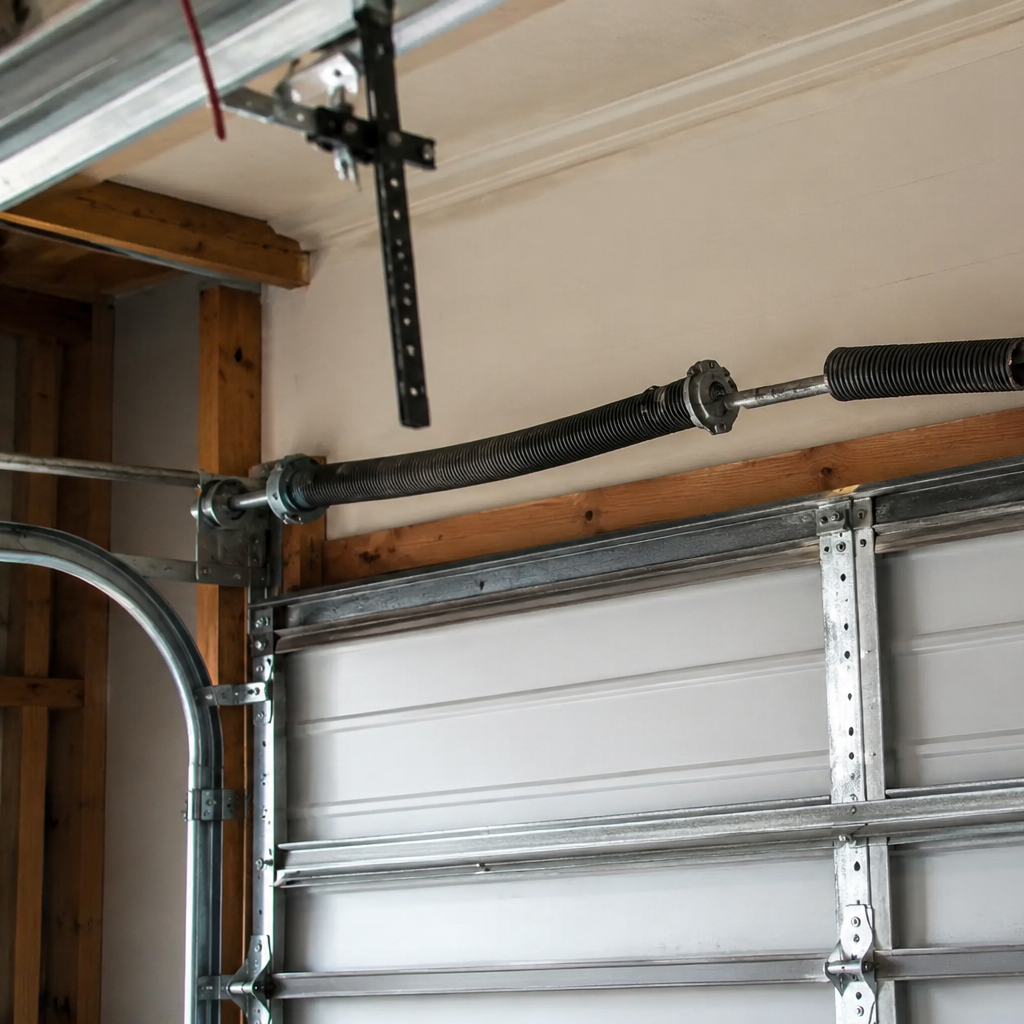
Look at the metal bar mounted horizontally above the door. Wound around it is one heavy spring, sometimes two. That is the torsion spring, and it is doing almost all the work every time the door moves. A double garage door weighs between 150 and 350 pounds, depending on whether it is single-layer steel or insulated. The opener on the ceiling is not built to lift that. It is a roughly half-horsepower motor whose real job is to nudge a balanced door along its track. The spring is what carries the weight.
Here is the mechanism. When the door is down, that spring is wound tight and loaded with energy, the way a drawn bow holds your pull. As the door rises, the spring unwinds and hands its stored energy to the door through a pair of cables running down each side. When the spring is sized right, the door is nearly weightless in your hands. When the spring breaks, all of that stored tension releases at once, and the two cut ends whip against the bar. That is the bang you heard.
Walk out and look at the spring, but do not touch it. A broken torsion spring shows a clean gap of one to two inches where the coil separated, like a link cut out of a chain. Once you see that gap, you have your answer. A few doors, usually older or lighter single-car ones, use extension springs stretched along the tracks above each side instead of a torsion bar. They fail with the same bang and follow the same rules below.
What You Noticed, and What It Usually Means
Most people do not see the spring first. They notice the symptoms. Here is how the common ones line up.
| What you noticed | What it usually means | What to do |
|---|---|---|
| Loud bang, then the door won't lift | A torsion spring snapped and released its tension | Stop using the opener; call for spring replacement |
| Opener runs but the door barely moves | Motor is trying to lift the full door weight alone | Do not keep cycling it; you can burn out the motor |
| Door lifts a few inches and stops | Broken spring or a cable that jumped its drum | Leave it; forcing it can pull the door off track |
| Door slammed down hard and fast | The spring failed and the door lost its counterbalance | Keep people and pets clear until it is repaired |
| Gap in the spring coil above the door | Confirmed broken spring | Spring replacement, not a new door |
Why the Spring Broke When It Did
The real clock on a spring is its cycle count, not the calendar. Most standard springs are rated for about 10,000 cycles, and one cycle is a single open and a single close. A household that comes and goes three or four times a day burns through those cycles in roughly seven years. Around here, where a two-car family treats the garage as the front door, and the door runs all summer long, that number comes faster than most people expect.
So the break rarely comes out of nowhere. The spring was already near the end of a long life, and the next cycle found the weak point. Temperature swings tend to be the final straw. Cold is the classic trigger, since steel turns brittle in a hard freeze, which is why so many springs let go on the first cold morning of the year. But a worn spring is just as happy to snap on a blazing July morning, when the metal has been baking, and the door has been working overtime. The season sets the stage. The cycle count writes the ending.
Rust plays a quiet part too. A spring that lives in a damp garage corrodes in tiny pits between the coils, and each pit gives a fatigue crack somewhere to start. That is why a dry, rusty spring often gives out earlier than its cycle count alone would predict.
Why Your Opener Can't Lift the Door Alone
Your first instinct is to keep pressing the button, hoping the door will find the strength on the next try. It will not, and each attempt makes things worse. With the spring gone, the opener is dragging the door's full dead weight on a motor and a plastic drive gear never designed for it. You can strip that gear, burn out the motor, or bend the top section of the door. A repair that was a spring can turn into a spring and an opener.
There is also the door itself to think about. When a spring fails, the counterbalance is gone, so the door wants to drop. If a cable is still holding on one side and slack on the other, forcing the opener can pull the door crooked and walk it right off its track. Now you have three problems instead of one.
If your car is trapped inside, there is a safe move. Pull the emergency release, the red cord hanging from the opener rail. That disconnects the door from the opener, allowing you to lift it by hand. Just know that with a broken spring, the door will feel every bit of its full weight, so get a second set of hands, lift with your legs, and prop it fully open before you drive out. If it feels like more than you can safely hold, leave it down and wait for the repair.
One Spring Broke, but You Likely Need Two
If your door runs on a pair of springs and one snapped, the honest recommendation is to replace both. This is not an upsell; it is math. Both springs were installed on the same day, carried the same load, and racked up the same cycle count. The second spring has the same wear as the one that just failed and is usually only weeks or months behind it. Replacing a single spring means paying for a second service call the moment the other one goes, and it leaves the door unbalanced in the meantime, which wears the opener and the new spring unevenly.
What a Correct Spring Replacement Involves
Sizing a spring is where experience actually shows. A spring is matched to the door by its wire diameter, its inside diameter, and its wound length, and those have to line up with the exact weight and height of your door. Guessing here is what causes early failures and a door that never feels quite right.
A proper job starts by weighing the door or measuring it precisely, so the replacement springs are truly matched to the load. From there, it is unwinding and removing the failed spring, fitting the correctly sized replacements, rewinding them to the right tension, and then testing the balance by hand. A balanced door will hold still when you stop it halfway, neither creeping up nor sliding down. That balance check is the difference between a door that lasts and one that chews through its next set of springs early.
How to Get More Life From the Next Set
You can't make a spring last forever, but you can keep it from dying young. The enemy is friction and rust. A light coat of garage-door lubricant on the coils a couple of times a year lets the spring flex cleanly instead of grinding against its own corrosion. It is the cheapest thing you can do for it, and it takes five minutes.
The bigger move is an annual tune-up. A technician who balances the door and checks the spring tension can feel a spring losing its strength long before it snaps. That turns a surprise breakdown into a planned swap on your own schedule. And if your household runs the door hard, ask about high-cycle springs when you replace them, because a higher rating buys years, not months.
Frequently Asked Questions
Can I still open my garage door with a broken spring?
You can lift it by hand after pulling the red emergency release, but be ready for the full weight of the door, which can be well over 150 pounds with no spring to help. Use two people if you can, and prop it open before walking away. Do not keep running the opener, because the motor is not built to lift that weight, and you can damage it.
How long does a garage door spring replacement take?
For a technician with the right springs on the truck, most single-door spring jobs run about an hour, give or take. A double door with two springs is not much longer. The time-consuming part is sizing the springs correctly, not swapping them, which is exactly why a proper diagnosis up front matters.
Can a garage door spring break in hot weather?
Yes. Springs fail from cycle fatigue, and a worn one snaps whenever the next open or close finds its weak point, summer mornings included. Heavy warm-weather use gets a tired spring there faster. Cold snaps are the more famous trigger because brittle steel gives out easily, but heat and constant cycling do the same job the rest of the year.
Is it cheaper to just buy a new garage door?
No. A broken spring is a repair, not a reason to replace the whole door. The door itself is almost always fine; the counterbalance system is what failed. Unless the door has other serious problems, such as cracked sections or rusted-through panels, replacing the springs restores it to full working order.
Should I replace both springs if only one broke?
On a two-spring door, yes. The surviving spring is the same age and has the same cycle wear as the one that broke and is usually close behind it. Replacing both at once saves you a second trip charge and keeps the door balanced, which protects the opener and the new springs.
What happens if I keep using the opener after the spring breaks?
You risk turning one repair into several. The opener can strip its drive gear or burn out its motor trying to lift a door it was never meant to carry alone, and the unbalanced door can pull off its track. Stopping as soon as you hear the bang is the cheapest thing you can do.
Getting Your Door Moving Again
A broken spring is loud, sudden, and alarming, but it is also one of the most routine repairs there is. The door is fine. The opener is usually fine. One worn part reached the end of a long life, and it needs to be sized and replaced correctly by someone with the right tools. The worst outcomes come from the few minutes after the bang, when a homeowner keeps pressing the button or tries to wrestle the spring themselves. Resist both, and a scary morning stays a simple fix.
