
Left-Wind vs. Right-Wind Springs: When a Pair Gets Crossed
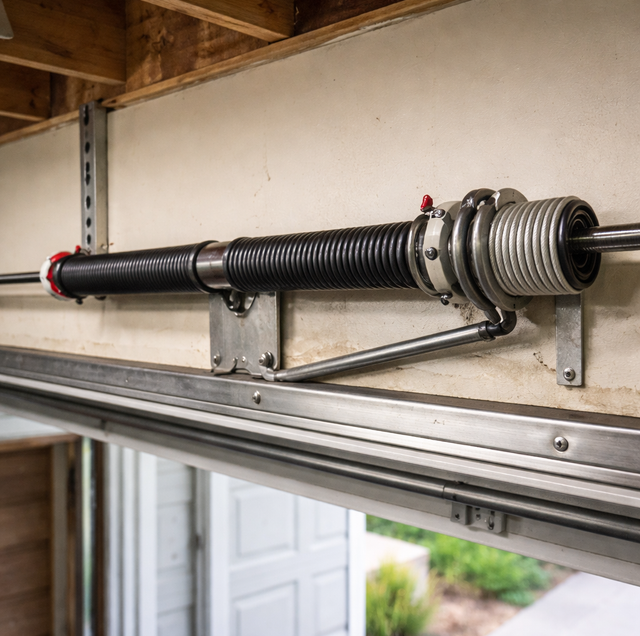
The door ran fine the week before the service visit. Now one corner climbs a foot into the opening while the other barely lifts off the concrete, and the opener labors through every cycle like it is dragging something uphill. Nothing about the hardware looks wrong from the floor. What changed is which way one of the springs was told to turn.
A torsion spring stores energy only when it is twisted in the direction that pulls its coils tighter against each other, and which direction that is was decided at the factory when the wire was coiled. Put a spring on a shaft that turns it the other way, and it does the opposite of its job.
Two versions of this error show up on real doors: a spring with the wrong hand goes on because nobody read the coils, or a matched pair gets mounted with each spring on the other's end of the shaft.
What Makes a Spring Left-Wound or Right-Wound
A torsion spring is steel wire wrapped around a mandrel into a helix, and a helix has a direction the same way a bolt thread does. Coil the wire one way, and you get a right-hand spiral; coil it the other, and you get its mirror twin. Nothing else has to differ: wire diameter, inside diameter, and overall length can match to the thousandth.
Stand a spring on a bench with the bore horizontal and look at the coils facing you. On the one hand, they rise to the right; on the other, they rise to the left. Winding cones are also color-coded by convention: black marks a right-wound spring, red marks a left-wound one. That convention is common enough to check on sight, though the coils are still what to trust when a cone has been swapped or repainted.
The cones do more than mark the hand. The stationary cone bolts to the center bracket and never turns; the winding cone sits at the outer end and clamps to the shaft with two set screws.
Why a Two-Spring Door Runs Opposite Winds
On a standard torsion setup, a steel shaft spans the opening with a grooved cable drum at each end, and cables run down the jambs to brackets at the bottom corners. The door's weight, roughly 150 to 250 pounds on a typical double, pulls those cables and turns the shaft. Both springs anchor at the center bracket and reach out toward the drums.
Because they hang off opposite ends of one shaft and are anchored in the middle, one has to be a left-wind and the other a right-wind for both to tighten during the same shaft rotation. That mirror geometry lets both feed torque into the shaft in the lifting direction at once, and their reaction torque on the center bracket adds, which is why that one bracket carries the whole counterbalance load.
Convention on standard-lift residential doors puts the right-wind spring to the left of the center bracket and the left-wind spring to the right. The naming reads backward at a glance, and that is where the mix-up begins.
What Happens When the Wrong Wind Goes On
Picture one spring with the wrong hand clamped to the shaft. It can be tensioned two ways, and each fails in its own direction.
Wound the way that closes its coils, the way the steel wants to go, it stores torque that pushes the shaft the wrong way around. It now helps the door close and fights it open, so the door turns heavy and runs down hard at the end of travel.
Wound the way the door needs it, it does the opposite, and the coils separate. Gaps open between them; the body shortens and widens until it no longer sits snugly on the shaft, and it holds a fraction of the tension it was given. Set screws on the winding cone are driven the way that unloads them, so the cone creeps and what is left bleeds off.
On a wrong-hand spring, the set screws are already driven in the unloading direction, so a winding bar seated in the cone can spin free the instant tension releases, a different failure than a bar simply slipping. Professional-only work.
Crossing a Matched Pair Left for Right
This version starts with the right parts. A proper left-and-right pair comes out of the box, and the two go on the ends of the shaft that belong to each other. Both are backward at once, so whichever way they get wound, the door gets the full version of one problem above: it fights every lift, or it carries almost no counterbalance.
The half-crossed door turns up more often, usually on a repair where only one spring was replaced. One is correct, and the new one is reversed. During the same shaft rotation, one winds while the other unwinds, so their torques cancel rather than add, and the shaft delivers only a fraction of the door's weight.
The center bracket does not escape it either. With torque canceling at the shaft, the two springs are pulling unevenly against hardware built for a matched, balanced load, and that imbalance shows up in the door's uneven lift well before it becomes a bracket problem of its own.
What a Mis-Wound Spring Looks Like in Motion
The clearest sign shows up in how the door behaves, not in the coils themselves; a close-wound spring does not show a visible gap change worth watching from the floor. What separates the two corners is direction of effort: the corner with the correct wind eases down and lifts freely, while the corner with the reversed wind fights the lift and drops fast, since it is helping the door close when it should be helping it open.
Uneven lift comes next. A door under unbalanced torque climbs at one corner while the other hangs, the top edge tilting across the opening, and the opener strains through travel it used to make quietly. Noise follows: a spring that has grown loose on the shaft walks back and forth as the cone creeps under its set screws, giving a rhythmic clack or a low grind that shifts pitch with door speed.
Cable behavior is what pushes the door out of service. Slack cable stops seating in the drum groove, climbs the flange, and rolls off. Once a cable jumps its drum, that corner drops, a roller leaves the track, and the door goes off track in one cycle.
Cable Drums Have a Hand of Their Own
Drums are handed as well, which is why crossed springs so often arrive with crossed drums. Outboard of each winding cone sits the cable drum, and past that the end bearing plate. The grooves spiral in opposite directions, and each casting is stamped with its side.
A drum with the wrong hand pays cable off the wrong face entirely, so that corner fails to lift on the very first cycle; it does not wear in gradually. A drum with the correct hand sitting at the wrong position on the shaft is the gradual failure instead: the cable leaves at the wrong angle to the jamb, never tracks cleanly into its groove, and abrades against the flange until strands fray.
Why This Reads Differently Than a Worn-Out Spring
A fatigued spring tells a story you can trace. It gradually reaches the end of a long working life, and the door grows slower and heavier over weeks before something lets go with a bang.
A wind error has no such history. It is wrong from the first cycle, and the symptoms arrive together. The useful tell is timing: the door was fine one week and wrong the next, with a service visit in between. That is why a technician asks when the springs were last touched, and why a door wearing brand-new steel can still be the one with the spring problem.
Frequently Asked Questions
Most spring suppliers build hand directly into the part number, alongside the wire-size and length codes. Reading that code off an old spring's tag, or matching it against a supplier's chart, is more reliable than reading the coils on a spring that is already partially wound down and harder to judge by eye.
It does. A one-spring door still anchors at a center bracket, and the hand has to match the side of the bracket it occupies. A single spring that shows up with the opposite wind can often be moved to the other side of the bracket and re-anchored there, which sometimes means relocating the spring anchor bracket itself to accommodate the coil length.
Extension springs are not handed. They stretch along the horizontal tracks, and either spring of a matched pair works on either side as long as both carry the same lift rating. What gets mismatched there is the end fitting: machine-loop, clipped-end, and double-looped ends each need their own hardware, and the wrong one works loose at the eye bolt or the pulley fork.
Yes. This is where the usual convention stops applying. On a low-headroom door with double horizontal tracks, the drum mounts outside the end bearing plate and the cable leaves the drum on the face toward the inside of the garage, the opposite of a standard system. That flips the arrangement: the left-wound spring belongs to the left of the center bracket, the right-wound to the right, and the springs get wound down.
Hand is the one spec that does not come off a caliper or a tape measure, so it depends entirely on someone reading the coils correctly before the order goes in. When a matched pair ships, both hands arrive in the same box together, which is exactly when the mix-up moves from a paperwork error to a hardware one.
The parts downstream took the punishment. A coil that opened up scores the shaft where it rubbed, set screws leave dimples in the wrong places, cable that stacked against a drum flange develops crushed strands and broken wires, and the end bearing plate can carry side load if the spring crept outward. A scored shaft or kinked cable sends a correct new set right back into trouble.
Have a spring installation verified by a technician who reads the hardware — wind direction, drum side, and cable seating all get confirmed before the door runs again. Arnold's Garage Door & Gates serves Fort Worth, Alvarado, and the DFW metroplex. Call Arnold: 682-337-7220.
