
Garage Door Spring Bracket Pulling Away? Stop Using the Door
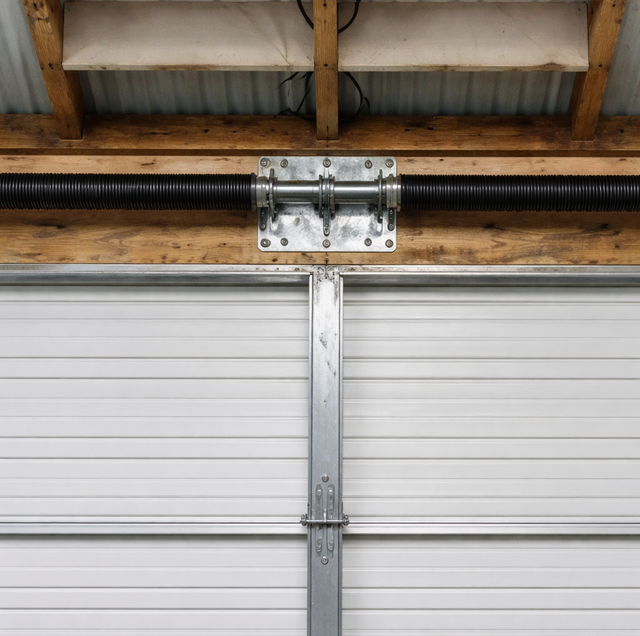
For years, the paint on the header above your garage door ran right up to the edge of the steel bracket bolted in the middle of it. Now a pale outline of bare wood shows along the top of that bracket, and the bracket stands a little proud of the wall. Nobody loosened anything. It moved on its own.
That piece of steel is the spring anchor bracket, and it holds the fixed end of your torsion spring against every bit of torque the spring carries. A gap behind it means the wood or the fasteners have started letting go while the spring is still fully wound. That is a structural failure in progress, on hardware loaded every hour of the day.
What the Spring Anchor Bracket Actually Holds
Above a torsion-spring door, a steel shaft called the torsion tube runs the width of the opening, and the springs slide over it. At the outer end of each spring sits a winding cone, the part a technician's bars go into. At the inner end sits the stationary cone, and that cone bolts to the spring anchor bracket at the center of the header. The same bracket usually carries the center bearing the shaft turns in.
Wind a spring, and you create torque, and that torque has to be counteracted by something solid, or the assembly spins. The bracket does the job your thumb does when you hold one end of a rubber band and wind the other: nothing clever, just refusing to move, for the life of the door.
How Spring Torque Peels a Bracket Away From the Wall
Spring torque does not pull the bracket straight off the wall. It tries to rotate the bracket around the shaft, and that rotation reaches the lag screws as a couple: the fasteners on one side get dragged outward while the ones opposite press into the wood.
Lag screws are strong in shear when the load runs across the shank, and much weaker in withdrawal when the load pulls the threads back out of the grain. Half the fasteners in that bracket carry a withdrawal load every hour the spring is wound.
So the gap does not open evenly. One edge, usually the top, lifts first while the opposite edge stays tight. That tilt lengthens the lever the spring works on and loads the remaining threads more heavily, and every cycle of the door adds another pulse to the joint.
The Wood Behind the Bracket Usually Fails First
The bracket itself is heavy formed steel and rarely tears. The wood it is lagged into is what gives up.
Most openings have a spring pad, a board fastened flat across the header to receive that hardware. If the pad was set against drywall and sheathing with only a couple of lags reaching real framing, it was living on borrowed grip from the first day. Other openings hide a void behind the pad, so lags that felt tight at install were biting mostly air and paper.
Water finishes what poor blocking starts. A leak at the door head keeps that board damp, and damp wood holds a lag by friction on soft fiber. Soft fiber crushes. Splits work faster: a lag driven hard into a dry board with no pilot hole opens a crack along the grain, and a split board has little left to grip. Seasonal ground movement in soil with high clay content racks the framing around an opening and loosens those fasteners.
What the Gap Behind the Bracket Tells You
Look at the bracket with the door closed. Hold a straightedge or a torpedo level flat across the face of the bracket and the wall beside it; a gap wide enough to slide a business card under one edge means the bracket has already lifted off the wall there.
Read the whole joint. Screw heads standing proud, with clean, bright threads behind them, have traveled because that thread was buried in wood a while ago. Wood dust on the top section of the door comes from threads chewing their way out. A bracket sitting out of square, so the shaft is no longer parallel to the header, has already rotated under load.
A strip of painter's tape run across the gap, half on the bracket and half on the wall, tears cleanly the next time the bracket moves even a little. It is a five-second way to catch motion between visits without guessing.
Sound counts too. A hard pop as the opener takes up the load, on a door that used to start quietly, can be a bracket shifting and settling back.
Treat a bracket that has moved as live hardware. Keep people and vehicles out from under the opening, leave the door down, and do not run the opener until a technician has taken the tension off the shaft.
Why Retightening the Lags Makes Things Worse
The instinct is a socket and some muscle. It is the wrong move, for three reasons.
A lag backs out because its threads no longer have sound wood around them, so driving it into the same stripped hole spins it and polishes what little is left.
The gap cannot be closed under load anyway. Pulling the bracket flat means overcoming the full spring reaction with the fastener itself, so the effort lands on the last few good threads.
Backing a lag out of a loaded bracket is the real hazard. Every fastener removed shifts more of the spring's reaction onto the ones still holding. If the bracket lets go with the spring wound, the stationary cone spins with nothing to stop it, the shaft whips, and the spring releases its stored energy in a fraction of a second, at roughly the height of your head.
How a Failing Anchor Bracket Gets Repaired Safely
The order matters more than the parts. Spring tension comes off first, under control, with winding bars sized to the cone and the shaft supported. Only then is the bracket dead hardware anyone can unbolt.
Then the wood gets read. A technician probes the pad for soft fiber, looks for splits running out of the old holes, and finds where the real framing sits. What comes next depends on what is back there: a new spring pad in sound stock, solid blocking added so the lags land in framing, through-bolts with a backing plate where the wall is open enough to reach, or relocating the anchor points into wood that never got wet. Where rot has reached the structural header itself, that framing repair belongs to a carpenter before any hardware goes back on.
Remounting is the short part. Springs go back on wound to the count the door's measured weight calls for, and the shaft gets checked for level and easy rotation in the center bearing. The balance test and the opener's force settings come last.
One Board Holds More Than the Spring
The spring anchor bracket is the loudest thing mounted to that header. The opener's front rail bracket lands on the same wall and pulls on it every cycle, and the flag angles at each jamb tie into framing with the same water history. So when the wood behind an anchor bracket is soft, the next question is how far the soft wood runs. Re-lagging one bracket into a tired board is a repair that only looks finished; the rest of the header carries the same water history and the same age.
Frequently Asked Questions
Yes, with a different signature. The end bearing plates bolt to the flag angle at the top of each vertical track, so their load path runs into the jamb framing beside the opening. When one loosens, the shaft walks toward that side, the cable stops seating in its drum grooves, and one side of the door lags. A loose plate also squeals as the shaft rides on a worn bearing race.
It raises the load one bracket has to hold. A single-car door usually runs 100 to 150 pounds and a two-car door 150 to 250 pounds, and the springs produce torque to match. A two-car door often carries two springs whose stationary cones both anchor to the same center bracket, so the whole counterbalance reaction lands on one small patch of wood.
The anchoring method changes and so does the way it fails. On block or brick the bracket is set with expansion or wedge anchors, and the failure is an anchor spinning in a hollow cell or crumbling out of a soft mortar joint, with none of the wood-fiber warning that gives you a shadow line first. On a steel-framed opening, the bracket bolts through an angle or channel, where elongated bolt holes and missing lock washers replace stripped threads.
It changes what a lag actually grips. Engineered headers, like an LVL or a built-up beam, hold fasteners differently than solid sawn lumber; they resist splitting better along the grain but can shed screw-holding power fast once the outer laminations delaminate from moisture. A technician checks which type is behind the pad before deciding whether to add blocking, relocate the anchor points, or through-bolt with a backing plate, since the fix that works on solid framing does not always hold in engineered stock.
Closed, with no one parking under it and the opener unplugged in case anyone hits a button. One wrinkle matters here: a torsion spring sits at maximum wind with the door closed and nearly unwound with the door fully open, so a closed door puts the highest torque on the anchor bracket. It is still the safer position: a closed door has nowhere to fall and nothing underneath it.
It should, because a technician looks straight at hardware you never see from the floor. The early tells are rust bleed at the lag heads, a bright ring of scuffed paint around a washer where the bracket has been rocking, and a lag that turns without gaining resistance. With the shaft supported and tension off during other work, a bracket can be tested for movement by hand, long before spring torque opens a visible gap.
Have a shifting spring anchor bracket looked at before the door runs again — a technician takes the spring tension off under control, remounts the bracket into sound blocking, and rebalances the door. Arnold's Garage Door & Gates serves Fort Worth, Alvarado, and the DFW metroplex. Call Arnold: 682-337-7220.
