
Garage Door Slams Shut or Drops Fast: The Danger Below
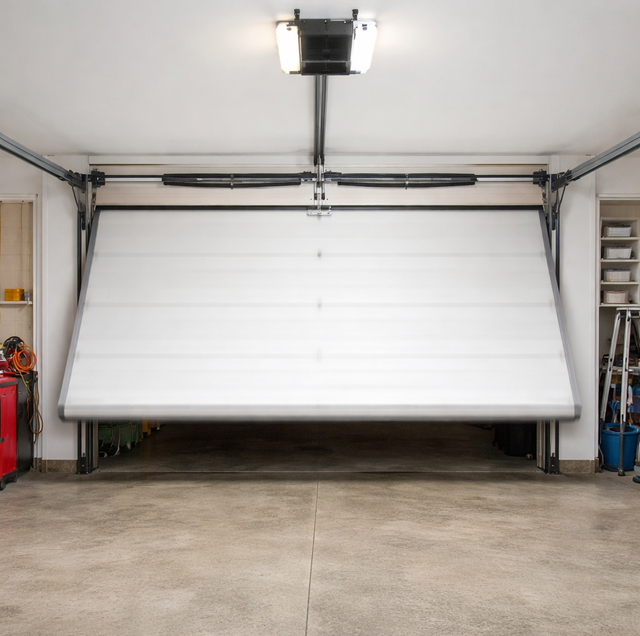
You press the button on your way to the car and turn back to watch the door come down. The first few feet look ordinary. Then the last stretch arrives all at once. The bottom section outruns the travel, the panel meets the concrete flat, and the sound rolls out into the street. Dust lifts off the floor while the opener chain slaps loose against the rail above it.
A door easing down and settling an inch low is running short on counterbalance. A door covering the last few feet in under a second has lost it. The fast version is the one that damages something.
What Carries Your Door's Weight While It Moves
A single-car steel door often weighs 100 to 150 pounds, a double door 150 to 250 pounds, with insulation, wood facing, or glass inserts pushing it higher. None of that weight rides on the opener. It rides on the spring.
On a torsion system, the spring sits on a steel shaft above the opening. A cable drum mounts at each end of that shaft, and a lift cable runs from each drum down to a bracket at the bottom corner of the door. As the door closes, its own weight pays out the cable from the drums, turns the shaft, and winds the spring tighter, while the stored torque pushes back the whole time and carries nearly all of the weight through the cables.
Sized correctly, the two forces almost cancel. A balanced door, lifted by hand, feels like ten pounds and holds its position wherever you stop it. The opener only has to guide that small remainder through its travel.
Why the Door Falls the Instant the Counterbalance Goes
The moment the spring stops pushing back on the shaft, the cables are no longer resisted. The drums spin free, cable pays out as fast as gravity pulls it, and the whole weight of the door goes into the fall.
Gravity needs little runway. A door in true free fall would cover a seven-foot opening in roughly two-thirds of a second, arriving near fifteen miles an hour. Friction in the rollers, drums, and track keeps most real drops somewhat slower than that, but a door with no counterbalance left is still coming down far faster than it was ever built to move.
Partial losses land in between. On a door with a matched pair of springs, if one breaks mid-close, the survivor supplies about half the torque, so the door comes down hard rather than truly free-falling. A winding cone slipping on the shaft or a cable jumping its grooves removes the holding force on one side only, and the door drops and racks at once. Slower versions of the same loss show up as a door that tracks normally and then runs away over the last foot, or one landing a little louder each week.
Why This Happens on the Way Down
Timing follows the load. A torsion spring reaches its tightest wind, and its highest stress, when the door is fully closed. Springs finish failing where the stress peaks, which puts many of them at the bottom of travel or in the last few feet of a close.
Direction does the rest. A spring breaks while the door remains closed, leaving the door on the floor. One breaking on the way up leaves it stopped short and straining. One breaking on the way down puts the failure and the fall in the same instant, because gravity is already pointed where the door was headed.
Cold sharpens the pattern, which is why the first hard freeze of the season brings a run of these calls. Steel loses ductility as temperature drops, and a spring already carrying a fatigue crack is likelier to finish breaking then.
Why the Opener Cannot Catch It
Your opener connects to the door through a single arm bolted to the top section, and that arm rides a trolley on the rail. The motor drives the trolley at one fixed speed, near six to eight inches per second on most units. A falling door moves many times faster. It outruns its own trolley, so the arm tears at its mounting while the chain or belt goes slack behind it.
Force settings and travel limits work by watching motor current and rail position, and neither reads a door that has stopped taking direction from the motor. A chain drive does resist backdriving, and that resistance is what gets mistaken for a brake. It is measured in a few pounds, against a load measured in hundreds.
Keep people, pets, and vehicles out of the opening after a door has dropped, even once it's on the floor. The bottom bracket at each corner remains under full cable tension and is the part most likely to crack during a hard landing.
What Breaks in That One Second
The fall rarely stays a spring problem. The bottom section takes the impact across its full width and can bow or split at a joint, rollers pop out of their tracks, and hinges bend along the same line.
Cables cause the most trouble afterward. With the drums spinning free, cable keeps unspooling after the door lands and jumps its grooves. Winding a new spring on a door whose cable sits wrong pulls it crooked on the next cycle. A door caught before it drops usually needs the spring alone, while one that has already dropped often needs cable repair, off-track work, or a panel with it.
What to Do With a Door That Has Already Dropped
Leave your door closed and stop cycling it. Every additional run risks the same drop with a car, a bike, or a person in the opening, and grinds a jumped cable further out of place.
Keep your bay clear until the repair happens, especially if the garage doubles as the household's main entrance, since that is where the door cycles most often with people underneath it.
Skip the emergency release cord on a door stuck in a raised position. Pulling it hands the full weight of the door to whatever is left of the spring system, which is the moment the rest of it comes down.
What Gets Checked After a Door Slams Shut
A visit like this starts on the scale. The door gets weighed so the new spring matches what is actually hanging there, since two doors of identical size can differ once insulation or glass is involved.
From there, the inspection follows the load path. Springs get measured for wire diameter, inside diameter, length, and wind. Cables get checked for fraying, kinks, and seating in the drum grooves, and the drums for set screws that bit into the shaft. The shaft gets checked for straightness and the end bearings for wobble, since a fall can move both.
The door body comes next: bottom brackets, bottom section, hinges, rollers, and track alignment, then the opener arm, rail, and trolley. With the new spring wound to the correct number of turns, the door is tested by hand at several heights to confirm the counterbalance holds throughout the entire travel.
Frequently Asked Questions
No. A spring can hold its shape with no visible gap between the coils and still fall short of its rated torque. Set screws on a winding cone grip the shaft by friction alone, and if they never bit into the steel, the cone creeps, and tension bleeds off over weeks. A spring left a turn short during a past repair behaves the same way from day one.
It can, for specific reasons. A drum set screw tightened onto a shaft without seating into it creeps under the first heavy cycles, and a cable seated a groove off the drum unspools early. A door that drops within days of spring or cable work should be treated as an installation issue before it runs again.
No. The photo eyes near the floor interrupt a powered close by telling the opener to stop and reverse the motor. A door falling under its own weight is no longer driven by the motor, so reversing it changes nothing about where the door is going. The same limit applies to the contact reversal built into force sensing.
Yes. Extension spring doors lose counterbalance the same way and add failure points of their own. The lift cable runs over a pulley at the front of each spring, and a seized or broken pulley releases tension as fast as a snapped coil. Those doors should also carry a safety cable through each spring, but the spring is broken and does nothing to hold the door.
Not while it is overhead and unrepaired. Once a technician has secured the door in the open position and confirmed what is holding it, getting a car out is fine. The riskier habit in the meantime is staging a vehicle half in the opening while loading it, which puts the car and often a person directly in the door's path for the minutes it takes to load up.
Often, yes. The bottom section absorbs the impact, and a bow of even a quarter inch across a sixteen-foot door leaves daylight at the corners. The rubber astragal along the bottom edge can split or pull out of its retainer, and those gaps invite water and rodents.
Schedule broken spring repair for a door that slammed shut or dropped fast, and leave it closed until it has been inspected. Arnold's Garage Door & Gates serves Fort Worth, Alvarado, and the DFW metroplex. Call Arnold: 682-337-7220.
