
What a Failing Center Bearing Does to Your Garage Door
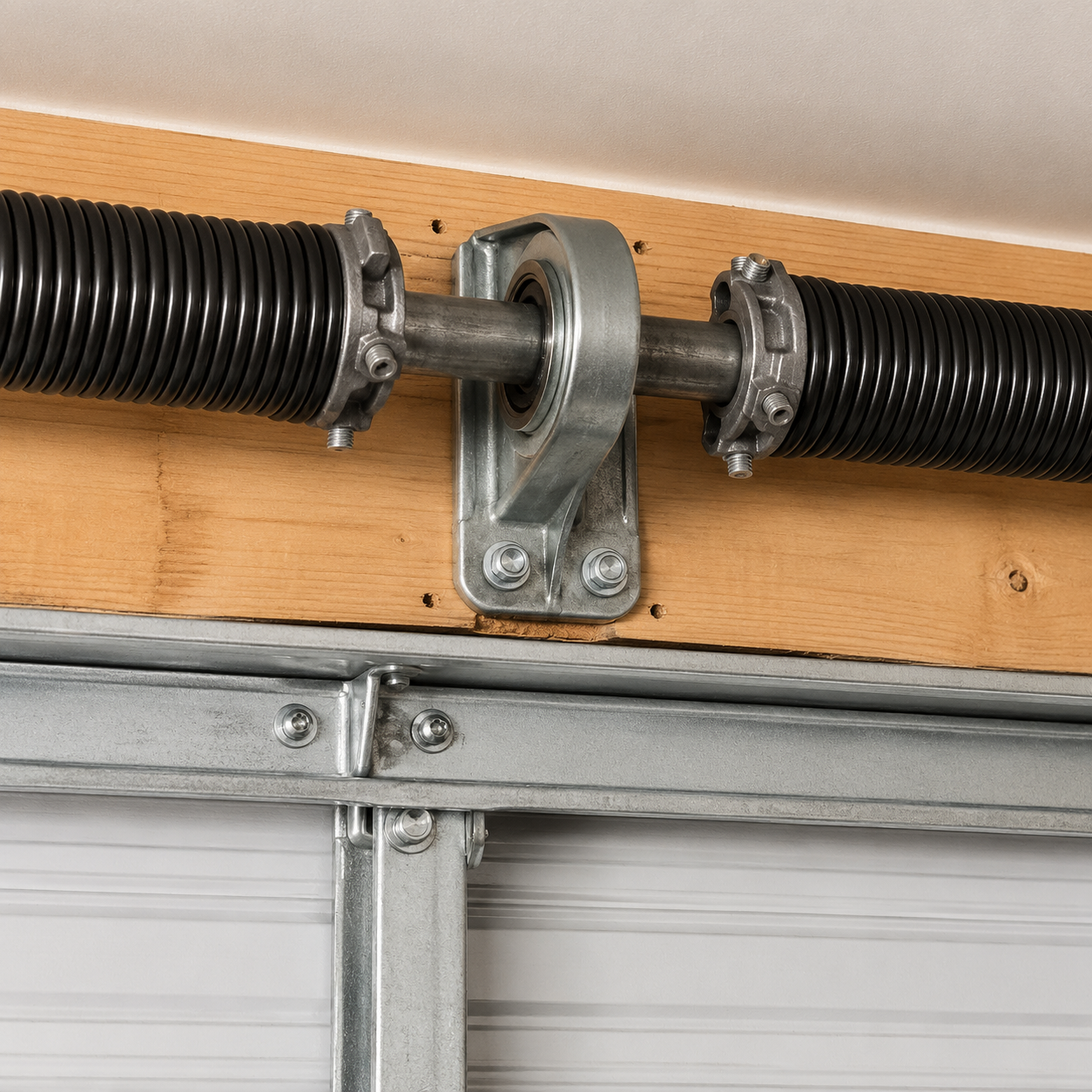
Look up into the space above a raised garage door and, right at the midpoint of the horizontal shaft, there's a bracket about the size of your palm bolted to the header. Almost no homeowner can name it, and most technicians rarely get asked about it, yet it does more than just hold the shaft in place: it's the anchor point all of that spring tension reacts against, which is exactly why a small amount of wear there causes damage well out of proportion to the part's size.
That's what makes this part worth understanding. It sits at a pressure point next to the springs, and problems there get pushed onto the hardware around it long before the door stops working.
Where the Center Bearing Sits and What It Actually Does
A standard torsion system uses a single horizontal shaft running above the opening, and that shaft has to stay perfectly straight while it spins thousands of times a year. On a two-spring setup, typical for a wider or heavier double door, the shaft is supported at three points: an end bearing plate at each side where the shaft meets the vertical track, and a center bearing plate in the middle, between the two torsion springs. On a single-spring setup, common on narrower one-car openings, there's still a bracket at the header where that spring's stationary end anchors; it just isn't doing double duty between two springs the way the center bracket on a two-spring door is.
End bearing plate: the bracket at each end of the shaft, mounted on the header directly above each vertical track, where the cable drum sits.
Center bearing plate: the bracket at the shaft's midpoint on a two-spring door, holding the shaft steady and anchoring the stationary end of each spring on either side of it.
Winding cones: the fittings at the outer end of each spring where it locks onto the shaft, held in place by set screws that bite into the shaft itself.
The center bearing does the shaft-support job with a bushing or a small sealed bearing that the shaft spins inside of, day after day, for years. But it isn't just a passive steady-rest: it's both the bearing the shaft turns in and the point where the stationary end of each spring bolts down, which means all the torque those springs hold reacts through this one bracket into the header.
What a Worn Center Bearing Sounds and Feels Like
A failing center bearing has a distinct signature once you know to listen for it. Instead of a squeak tied to the door's travel along the track, you get a grinding or squealing that repeats on a steady rhythm matched to the shaft's rotation. It happens continuously as the door cycles, not just when a particular panel passes a particular roller, because the noise is coming from something the shaft is dragging against with every single turn.
Look up at the shaft itself while the door runs and you may catch a visible clue: a slight sag or side-to-side wobble right at the middle, where the bracket has stopped holding the shaft on a true, straight line. A healthy shaft spins on a fixed axis and looks rock solid even under full spring tension. A shaft riding on a worn bearing can appear to flex or dip slightly at that midpoint each time it turns, which is the bracket no longer doing its one job.
Why the Bearing Wears Out or Works Loose
Two separate things tend to go wrong here, and they often show up together. The bushing or sealed bearing inside the plate can simply wear out from years of metal spinning against it, especially once the factory grease dries out and isn't replenished. Once that happens, the shaft is no longer riding on a smooth, low-friction surface, and it starts to bind slightly instead of turning freely.
The other failure point is the bracket itself. It's lag-bolted into the wood or metal header above the door, and thousands of cycles of vibration over the years can work those bolts loose. When that happens, the whole plate can shift out of position, even if the bushing inside it is still fine, and the shaft loses its center support all the same.
What Happens If You Ignore It
A wobbling or binding center bearing doesn't stay a small problem, because a torsion shaft is only as stable as its weakest support point. Once the middle stops holding the shaft true, the two end bearing plates start absorbing load they weren't built to carry alone, wearing faster than they normally would on a well-supported shaft.
The winding cones take a hit too. They're held onto the shaft by set screws alone, a simple friction fit rather than anything welded or keyed in place, and a wobbling shaft puts side load on that connection that it was never designed to handle. Over time, the set screws can work loose under that added stress, which is its own separate problem on top of the bearing wearing out.
Left long enough, the shaft can develop a rough, worn groove right at the bearing point, called galling, or in more severe cases take on a slight permanent bend. Once the shaft itself is no longer true, the two springs on either side of it no longer wind and unwind evenly, and the door can start lifting unevenly from side to side even though the springs themselves are otherwise fine. What began as a bracket problem ends up as a shaft and balance problem.
How This Differs From the Usual Door Noises
Rollers, hinges, and worn cables all have their own noises, and most of them only sound off when the specific part they're attached to is doing something, like passing through the curved section of track. A center bearing is different because it's tied to shaft rotation itself, which is happening across almost the entire trip of the door, not just at one spot. If the sound tracks with every turn of the shaft rather than with a specific panel or a specific point in the door's travel, the center bearing is a much more likely source than the parts homeowners usually suspect first.
Treating the Center Bearing as Part of Routine Care
The center bearing plate rarely gets checked on its own, mostly because it sits above the springs where nobody thinks to look until something else starts acting up. That's exactly why it tends to cause collateral wear before anyone notices it directly: the shaft keeps turning, the end bearings keep absorbing the extra load, and the set screws keep taking side stress they weren't built for, all quietly, all before the original bracket ever gets blamed. Folding a look at the shaft's center support into a routine inspection catches it while it's still just a worn bushing or a loose bolt, rather than after it's dragged three or four other parts down with it.
Frequently Asked Questions
No, and the different names can matter when you're trying to describe the part to a parts counter or a technician over the phone. It's also called a center bracket or a spring anchor bracket depending on the supplier. One name that does NOT apply here: "spider," which in this trade usually refers to the internal support castings inside a commercial rolling steel door's barrel, a different part entirely on a different type of door.
It isn't a do-it-yourself swap, and not just because it sits overhead. The stationary end of each spring bolts directly to that bracket, so it can't come off until the spring tension is fully released. Removing it with the springs still wound risks the shaft shifting suddenly while under load.
Yes, essentially every two-spring torsion setup has one, since it's what both springs anchor to. Extra-wide, heavy, or higher-cycle doors sometimes use a longer shaft with an additional intermediate support bearing beyond the center one, which spreads the load across more points.
Older or lighter-duty setups often use a nylon or sintered bronze bushing, a simple sleeve the shaft spins inside. Newer or heavier-duty hardware more often uses a sealed ball-bearing unit, which runs quieter and typically holds up longer before it needs attention.
Not directly, but indirectly it can add strain. If the shaft binds enough at that midpoint, the opener's motor and drive gear have to work harder to force the door through that tight spot on every cycle, which adds wear to the opener on top of whatever the bearing itself is causing.
Rather than the hand-lift balance test used for suspected spring issues, a technician disconnects the opener and watches or gently feels the shaft specifically at its midpoint while cycling the door by hand, checking for wobble, side play, or a rough spot that a healthy, properly supported shaft won't show.
Have a technician take a look if your door's shaft seems to sag, wobble, or grind at the midpoint — catching a worn center bearing early protects the hardware around it. Arnold's Garage Door & Gates serves Fort Worth, Alvarado, and the DFW metroplex. Call Arnold: 682-337-7220.
