
New Insulated Garage Door? Why the Spring Gets Bigger
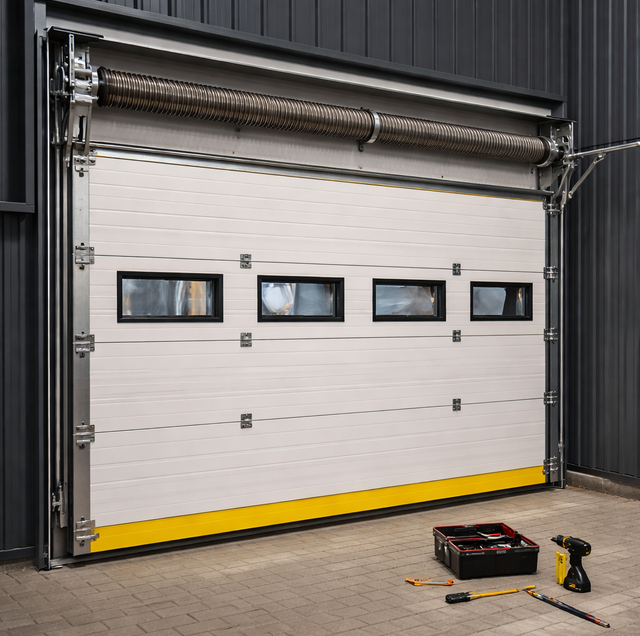
The spec sheet taped to the display door lists R-value, color options, window layout, and a warranty term in a tidy column. Weight never gets a line of its own, even though it is the biggest structural difference between this door and the single-layer steel door beside it: foam core and a second steel skin, where the single-layer door carries one thin sheet with ribs stamped in and open air behind it.
Multiply that difference across roughly a hundred square feet of finished door. It stops being a spec-sheet footnote and becomes the weight the counterbalance above the opening answers for, every cycle, for years.
An insulated door is a sound choice for a garage that bakes in part of the year and loses heat the rest of the year. What comes with it is a different spring specification, decided on install day whether anyone brings it up or not.
What Puts the Extra Weight in an Insulated Door
Three constructions cover most residential steel doors. A single-layer, or pan, door is one sheet of steel, commonly 24 through 27 gauge, with ribs stamped in for stiffness and nothing behind it. A two-layer door adds a board of expanded polystyrene against the back of that skin, held by a vinyl or thin backer. A three-layer door sandwiches the core between the outer skin and a full steel inner one.
The cores differ in how they get there. Polyurethane enters as a liquid, expands within the section, and bonds to both skins as it cures, stiffening and insulating the section. Polystyrene arrives as a pre-cut board set into the cavity. Manufacturers publish R-values for both, measured at the panel center, so read them as a comparison between models from one maker.
The surprise is which layer does the weighing. Rigid foam weighs almost nothing by volume. The steel inner skin covering the entire back face of the door accounts for most of the weight.
How Much Heavier the Insulated Version Runs
A 16-by-7 double door in bare single-layer steel sits at the light end of the 150- to 250-pound band doors that size occupies. The same opening in three-layer insulated construction sits well up that band, close to its top end. A single-car door has less area to gain on, so the gap is smaller in absolute pounds, though it still moves the door from the light end of the 100 to 150 pound band toward the heavy end.
The spring picked for the bare door will not cover the insulated one. That is why the door gets weighed on-site once it is hanging. A catalog number does not do that job for you.
Why the Model Number Cannot Set the Spring
Two doors can share a model, a width, and a height and still leave the plant at different weights. Glass inserts and their frames add pounds to whichever section carries them. A wind-load version of the same model uses thicker steel and more struts. An upgraded bottom section, a U-bar across the top, a different hardware package: each is a few pounds, all landing on the same shaft.
So the door is weighed on site once it is hanging, and the spring is chosen based on that reading. The number deciding the spring is the door's measured weight, not the width printed on the order.
Manufacturer weight charts are a fair starting point for ordering parts ahead of the appointment. They describe a door built to catalog spec; the door on your opening gets verified.
What Changes in the Spring Itself
More weight means more torque, and torque depends on the spring's dimensions. The usual answer is heavier wire. Stepping from .225 to .243 inches is a small change on a caliper and a large change in what the coil delivers per turn. Length and inside diameter move with it, since the spring still has to fit the shaft, clear the headroom, and take the turns the door's travel requires.
Turn count follows door height and cable drum size. A heavier door gets a spring producing more torque at the same number of turns, and adding turns to an already-correct spring is no fix for a heavy door.
Some doors move from a single spring to a matched pair once the required torque outgrows what one coil can deliver in the headroom available. A pair splits the load and lands closer to the target.
When an Old Spring Gets Reused on a New Door
Here is where a good door purchase goes sideways. The new sections go up on the existing track and torsion assembly, because the spring on the shaft is only two years old and looks fine.
That spring was matched to a door that no longer exists. Hang a heavier one on it, and the counterbalance comes up short from the first cycle. The door feels heavy near the floor, where every section still hangs on the cables, and it runs down quicker than it should and seats hard. The opener, a motor built to overcome friction and a few pounds of imbalance, now covers dozens.
The spring pays too. Carrying a load past what its wire diameter was chosen for, it works closer to its stress limit on every cycle and reaches its breaking point years early. A door that eats springs in short order is often wearing one sized for something lighter.
A spring too light for the door works harder every cycle and can reach its breaking point years early. If a cable or the spring lets go, little holds the door back. Stop cycling it and call a technician.
The Hardware Around the Spring Carries It Too
Each lift cable carries roughly half the door's weight, so a heavier door raises cable tension and the pressure on the drums, the end bearing plates, and the center bearing. Torsion shafts come in more than one diameter, and a door at the heavy end of residential can call for the sturdier one, along with a spring anchor pad fastened into solid framing.
The opener's travel limits and force settings then get dialed in against a door already in balance.
Ordering the Door and the Spring as One Decision
Weight is a specification on an insulated door, and it belongs in the conversation alongside R-value, color, and window layout.
The question worth asking an installer is which spring goes on with the door and how that was arrived at. Ordered as a door alone, the counterbalance becomes an afterthought someone sorts out on the ladder. Ordered as a system, the spring arrives matched to what gets hung on the shaft, and the door you spent weeks choosing works right from day one.
Ask for the spring's wire diameter, length, inside diameter, and wind direction in writing when the new door goes in. Years later, that spec tells a technician what the door was sized for and whether anything changed since.
Frequently Asked Questions
At the same section thickness, usually. Injected polyurethane cures into a denser foam and fills the cavity, working around the struts and stiles, while a polystyrene board is cut slightly undersized to slide in, leaving thin air gaps the liquid foam does not.
The opener does not lift a properly counterbalanced door, so weight alone does not demand a bigger motor. What often changes is the top section. Many wide or insulated doors call for a U-bar strut or a reinforcement bracket where the opener arm attaches, so the arm's pull spreads across the section width. That bracket ships in the opener carton and is easy to leave in the box.
It depends on section thickness and on the track itself. Insulated sections are commonly 1 3/8 or 2 inches thick, and the hinges, brackets, and clearance behind the opening are matched to that dimension. Track comes in different steel gauges and radii, with 12-inch and 15-inch the common residential curves. Track carried over from a thinner door tends to announce itself as rubbing at the section joints.
Not by much on its own. Section thickness, commonly 1 3/8 or 2 inches on an insulated door versus 2 inches or less on many pan doors, is a clearance dimension for hinges and track, not a weight driver, since foam adds almost nothing by volume. What changes the scale reading is whether that thickness comes with a second steel skin. A thick section with only a vinyl backer weighs close to a thin one; a thick section with a full steel back weighs measurably more.
The same cycle count as any correctly sized spring, since a heavier door does not use up cycles faster on its own, only the extra torque it demands if the spring is undersized. Where the insulated door's weight does change the conversation is at order time: a heavier wire diameter on a matched pair already uses more of the shaft's clear length, so a high-cycle upgrade on that door more often means a longer shaft than it would on a lighter one.
Not necessarily, and sometimes the opposite. A heavy wood door can outweigh a steel insulated replacement, so the direction of the change depends on what is coming off the shaft, not just what is going up. Either way, the new door gets weighed as built rather than assumed from the old one.
Talk through a new insulated door and the counterbalance that goes with it — the door gets weighed as built, and the spring matched to what it actually carries. Arnold's Garage Door & Gates serves Fort Worth, Alvarado, and the DFW metroplex. Call Arnold: 682-337-7220.
