
New Garage Door Opener, Door Still Heavy? Blame the Spring
You replaced the opener. The door is still heavy.
Maybe it crawls up slower than a new machine should allow, shudders, stalls partway, or lands hard on the concrete. The door behaves about the way it did last month, because the part that got replaced was never the part doing the heavy work.
A new opener paired with a still-heavy door is a combination that narrows the list quickly, since the second half of that pairing rules out most causes tied to the first.
Why the Opener Takes the Blame
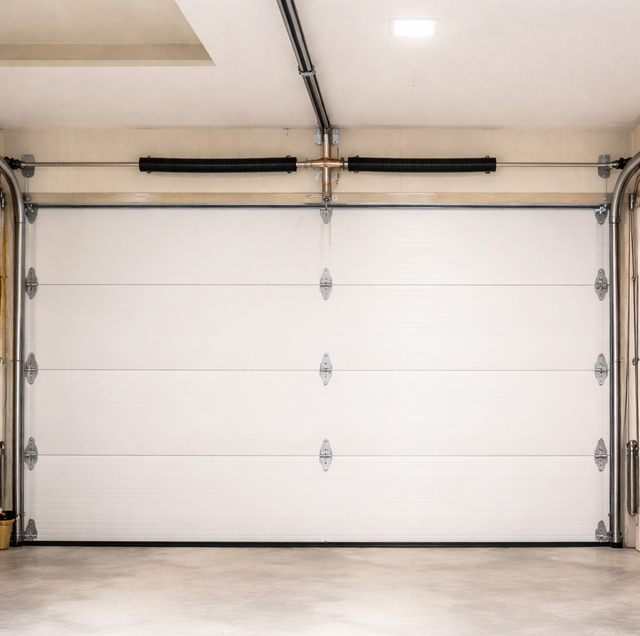
The opener is the piece of the system you interact with: a brand name, a light, a remote in the car, an app, a wall button you touch twice a day. The counterbalance above the opening offers none of that. It is a steel shaft, two cable drums, and one or two torsion springs, or a pair of extension springs along the horizontal tracks. No lights, no brand you would recognize, no error code when it goes bad.
The mistake is easy to make for a second reason. A fatigued spring and a worn opener produce nearly identical symptoms from the floor: slow travel, straining sounds, a door that stops short or reverses. Both look like a motor running out of strength. Only one of them actually is.
What the Opener Does, and What the Spring Does
Your door weighs roughly 150 to 250 pounds depending on width, material, and insulation. Nothing on a residential opener is built to lift that.
The springs carry it. A torsion spring winds up as the door comes down, storing energy in the steel, and unwinds as the door rises, feeding that energy back through the cables and drums. Sized correctly, it offsets nearly the entire weight of the door, which is why a properly sprung door lifts with one hand and stays put wherever you stop it.
The opener moves and controls what is left over: it starts the door, guides it along the rail, sets the pace, stops it at each end of travel, and reverses it when the photo eyes or force detection say something is wrong. Residential openers are rated in fractions of a horsepower because that leftover load is small.
When a spring loses torque, the weight it stops carrying does not disappear. It transfers into the cables, the rail, and the motor. The opener did not get weaker; it got handed a job it was never sized for.
What Changes When You Swap the Opener and Nothing Else
A new opener arrives with its force settings at a factory default. During installation, those settings get turned up until the door finishes its travel without stopping, because an opener that keeps reversing looks like a botched install.
So a heavy door gets a fresh motor with the force dialed up to match it. The door moves, and for a few days it may even seem improved, since the new drive is tight where the old one had worn slack. Then the old symptoms return. The spring keeps traveling the direction it was already traveling, handing a little more of the door's weight to the machine bolted to your ceiling joists on every cycle.
A new opener with its force turned up can push a badly sprung door for months. Raising the force threshold to overcome an unbalanced door also raises it for everything else, including whatever is under the door when it closes.
What the New Opener Pays for That Fight
An opener is built around a small motor, a gear reduction with plastic teeth on the drive gear, and a chain or belt pulling a trolley along a rail. A door tens of pounds out of balance keeps every one of those parts near the top of its tolerable load on every cycle.
The drive gear rounds its teeth off sooner. Chains stretch, and belts elongate, so trolley engagement changes and travel limits drift. The motor runs longer under load and runs hotter, and heat ages windings and control boards. The rail and header bracket absorb the reaction load, which is why struggling doors work the lag bolts loose above the opening. None of that fails dramatically in month one. It produces a three-year-old opener behaving like a ten-year-old one, on a door with its original fault intact.
What Points at the Spring Before You Buy Anything
The most useful evidence is already in hand: the symptom did not change when the opener did. Two different machines, same behavior. That points above the opening.
From the floor, with the door closed, look up at the shaft. A broken torsion spring shows a visible gap of bare shaft between two separated coil halves. Where a matched pair is fitted, only one may have let go, and the survivor holds enough tension to make the door move badly instead of not at all. On extension springs, look for one hanging noticeably looser than its twin.
Watch a full cycle from a safe distance and note where the strain happens. A weak counterbalance labors most in the first foot off the concrete, where the spring is supposed to be doing its hardest work. Note whether one side climbs ahead of the other, and whether a cable hangs slack at its drum.
The check that settles it is the first thing a technician runs: disconnecting the opener at the emergency release, with the door fully closed, and moving the door by hand to see what it actually weighs. A healthy spring lets the door rise with light effort and hold position around chest height. A fatigued one makes the door feel like furniture, sinking back the moment it is let go. On a door already showing the symptoms this article describes, that check is worth leaving to the visit rather than trying it yourself, since a disconnected door with a compromised counterbalance can come down at full weight the moment a grip lets go.
What Order the Work Goes In
Springs first. Then the opener, which frequently turns out to need nothing.
Once the counterbalance matches the door's measured weight, the door needs almost no effort to move. Only then can travel limits and force settings be set against a normal load, and only then does the opener's own condition become readable: whether the gear is worn, the chain or belt stretched, the board still holding its settings. Plenty of openers that seemed finished were only being asked to do a spring's work. If a replacement is warranted anyway, the new one at least starts life on a balanced door.
Frequently Asked Questions
It will move the door, which is what makes the idea tempting. What changes is where the load ends up. The extra output travels through the rail, the trolley, the header bracket, the top section, and the door's hardware, none of it sized for an uncounterbalanced door. Openers strong enough to keep pulling after a door stops cooperating have torn top sections loose from their brackets. More motor only relocates the next failure.
Mechanically, yes, well before any warranty question comes up. Manufacturer installation guides commonly call for the door to move freely by hand before the opener is connected, precisely because the gear train and motor are sized around a door that carries almost none of its own weight. A unit fighting an unbalanced door every cycle is working outside that assumption from day one, which turns a part rated for many years into one that wears out in a few.
By testing each alone. The trolley gets disconnected so the door runs its travel by hand, and that reading reports on the counterbalance and hardware only, saying nothing about the motor. A door that fails it has a balance problem no matter what the opener is doing. Then the opener runs by itself, trolley traveling the empty rail, while the technician listens at the motor head for gear noise. When the door hand-lifts well, and the opener runs clean unloaded, the answer sits in the settings between them.
Not in the way the packaging implies. Both use the same motor and gear-reduction setup, and the load applied to that motor is set by the door, not by what connects to the trolley. A chain engages metal-to-metal, tolerates shock loading, and gets louder as it stretches. A belt reads a heavy door as constant tension along its length, elongates, and leaves slack at the trolley. The belt version fails more quietly, delaying discovery.
Openers do wear out on their own, and the tell is a door that moves fine by hand while the machine falls short. A motor that hums or runs a full cycle with nothing moving usually indicates a stripped drive gear or a broken trolley. An operation that works from the wall button but not from a remote or keypad points to the receiver or its programming. Grinding at the motor head that continues with the door disconnected is inside the unit.
Yes, and it is worth checking before anything gets purchased. Rollers with seized bearings drag in the track. A track knocked out of alignment or pinched at a splice binds them at a single point in their travel. Dry end bearings on the torsion shaft add friction the spring must overcome. A hand-lift check feels different in these cases: the door is heavy at specific points and freer elsewhere, while a spring problem feels heavy from the concrete up.
Get the door's balance checked before you buy a second opener — a weighed door and a spring sized to match it show whether the opener was ever the issue. Arnold's Garage Door & Gates serves Fort Worth, Alvarado, and the DFW metroplex. Call Arnold: 682-337-7220.
