
Why Taller Garage Doors Need More Than a Standard Spring
The door on a detached shop usually got built tall on purpose. A fifth-wheel with the air conditioner on the roof, a boat on a trailer that clears the header by inches. Somebody specified an opening taller than the seven feet on the front of the house, and that door has run fine for years.
Then the spring lets go, and the replacement turns into a different conversation than it would be on a standard door.
A taller door weighs more. Most people expect that part. What gets missed is that it also travels farther, and travel distance drives torsion spring sizing every bit as hard as weight does.
Travel Distance Drives Spring Sizing
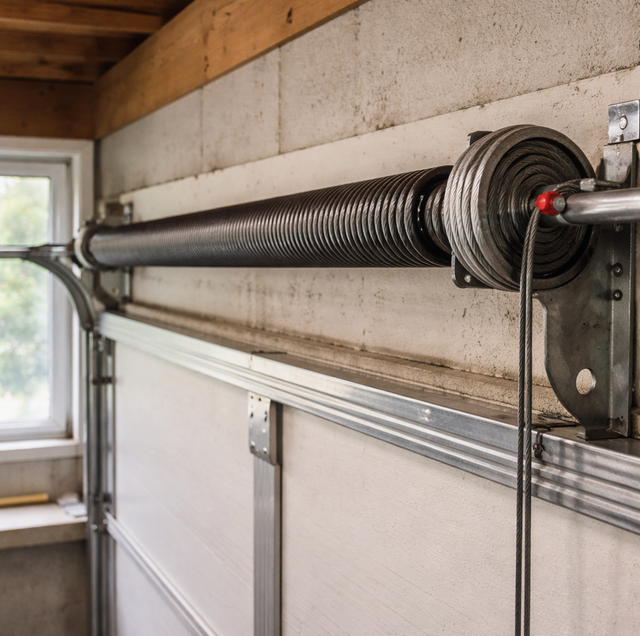
A torsion spring never touches the door. It twists a steel shaft, the shaft turns a cable drum at each end, and the drums spool up the lift cables anchored to the bottom brackets. The door rises exactly as far as the cable those drums release, and the cable released is set by how many times the shaft rotates.
That is where height enters the math. A ten-foot door has three more feet of cable to pay off each drum, so the shaft makes more rotations, so the spring has to be wound more turns to carry that door to the top of the track.
Turns are a physical demand on the steel, separate from weight. Every coil twists a little when the spring is wound, and each coil only takes so much twist before the wire works near the edge of what it survives. Spread the same winding across more coils and each coil works less. That is why a taller door usually calls for a longer spring body: more coils to absorb more turns without overworking the wire. Meanwhile the spring still has to produce enough torque at the closed position to counter the door's full weight acting through the radius of the drum.
The Weight a Taller Door Adds
Height is panel area, and panel area is steel. Going from seven feet to ten adds close to half again as much door, before counting the parts that ride along with it: an extra section, another row of hinges, another pair of rollers, and on a wide opening another horizontal strut across the inside face.
For a baseline, a standard double door lands around 150 to 250 pounds and a single around 100 to 150. Add height and the number climbs past the top of those ranges. A tall single-car shop door can finish heavier than the double door on the house.
Weight sets how much torque the spring delivers at the bottom of travel, where the door hangs at full load, and the cables pull hardest. Travel sets how many turns that torque spreads across.
Reusing a Standard Spring on a Tall Opening
Two things go wrong, at opposite ends of the door's travel.
A spring sized for a seven-foot door, wound to the turn count a ten-foot door needs, is being worked past its design deflection from the first cycle. That is not a condition a technician winds into a door on purpose. The wire is stressed beyond what it was built to take, and every cycle after the first pushes it closer to failure years ahead of its rated count. A short spring covering a tall door's travel is a tape measure pulled to the last inch of its blade: still functional today, with nothing left in it for tomorrow.
Wound only to a turn count it can live with, that same spring runs out before the door does. The door feels heavy off the floor, the opener labors through the first stretch, and near the top a spring with no turns left stops keeping tension on the cables. Slack cable is how a lift cable walks out of its drum grooves.
Either way the door runs unbalanced, and that load lands on the opener's drive gear, the top section where the arm bolts on, and the end bearing plates.
What a Correct Tall-Door Spring Setup Looks Like
Sizing starts with the finished door's actual weight and its actual travel, both measured at the opening. Wire diameter, inside diameter, and spring length are chosen together because they trade off against each other. Wire and coil diameter set how much torque each wound turn produces. Length sets how many turns the spring can hand over before the steel is overworked.
Tall doors commonly land on a longer spring in heavier wire than the same-width standard door would use. A pair of springs on one shaft often shows up, too, including at single-car shop openings where a homeowner expects to see one. Splitting the required torque between two springs lets each run at lower stress, which is where cycle life comes from, and it avoids a single spring longer than the shaft and headroom have room for. A pair also ages as a set: both are wound to the same number of turns and experience the same cycles.
A tall door's drums carry more cable in more wraps. If a cable overruns its grooves near full-open, it can jump the drum flange and drop that corner without warning. Have any drum or cable irregularity checked before running the door again.
Drums, Cables, and the Hardware Above the Opening
The drums are the other half of the counterbalance, and they are rated by how much cable they can hold.
A cable drum has a helical groove machined into its face with a fixed number of wraps. A standard-lift drum holds the cable for a standard door height and no more. Give it a taller door's longer cable and the wrap runs out of groove and starts stacking on itself. The effective radius changes mid-travel, the two sides no longer match, and the door begins to climb crooked. Tall doors get higher-capacity drums for that reason, with cables cut to the longer length.
A taller, heavier door also twists the torsion tube harder every cycle, so heavier doors often move to a larger-diameter shaft with end bearing plates and a center bearing bracket to suit. All of it hangs from the framing above the opening.
Headroom is the gap between the top of the opening and the ceiling or the lowest obstruction above it. A tall door in a building with an ordinary roofline leaves little room up there, which decides whether standard torsion hardware fits.
High-Lift and Vertical-Lift Track on Very Tall Openings
Some tall openings are solved with track geometry as much as with door height. Where a building has ceiling height to spare, the track can be built as high lift: the vertical track continues above the top of the opening before the radius turns the door into horizontal track. The door first climbs straight up for a stretch, lifting the horizontal track out of the way and letting a tall vehicle pull closer.
Vertical lift takes the idea to its extreme, with the door traveling straight up to its full height, with no horizontal run at all.
Both change the counterbalance. High-lift drums are shaped so that the cable pays off at a varying radius as the door works through the transition, and the spring is sized to that geometry. Drums, cables, track, and spring are all a different parts list, chosen for the lift type before anything is ordered.
When an Opening Gets Made Taller After the Fact
Sometimes the tall door is a retrofit. A shop takes delivery of a bigger tractor or a taller trailer, the opening gets cut and reframed, and a taller door goes in where a standard one used to live.
That changes far more than the door. The header above the opening is structural, and raising it is framing work that belongs to a carpenter or general contractor, done before any door hardware goes back up. Once that framing is finished, the vertical track gets longer, the horizontal track and its rear hangers move, the cables get longer, the drums change, and the spring changes.
Retrofits also tend to leave an opening slightly out of square, from the reframing work alone. A tall door gives that movement more track length to show up in.
Getting the Numbers Right Before Parts Get Ordered
Height, weight, travel, and drum capacity all move together on a tall door, so sizing one without the others leaves a gap somewhere in the assembly. The door gets weighed and measured on-site, the drums get matched to the cable length its full travel actually needs, and the spring gets built to carry that specific door through that many turns.
Frequently Asked Questions
Most residential openers ship with a rail sized for a seven-foot door. Eight-foot-and-taller doors require a rail extension kit, which lengthens the rail and the chain or belt so the trolley can travel the full height. On a correctly counterbalanced door, rail length is what stops the install.
Cables are cut longer than the door is tall. The extra length keeps several wraps seated on the drum when the door sits fully open, so the cable never pulls off the last groove. A cable that measures close enough on a seven-foot door unseats itself at the top of travel on a ten-foot one.
Extension springs stretch along the horizontal tracks, so the room they work in is fixed by the length of that track. They come rated for the common seven- and eight-foot door heights. Past that, the stretch a taller door demands runs out of track to happen in.
Height alone does not do it. One open plus one close counts as a single cycle whether the door moves seven feet or twelve, so a tall door does not accumulate cycles any quicker than a standard one. An undersized spring is what shortens spring life, since it runs the steel closer to its stress limit on every single trip.
Measure the finished opening from the floor to the underside of the header, since that is the dimension a door gets built to. Seven and eight feet are common stock heights; anything above that is usually made to order. Check the side room at each jamb, too, since the vertical track and end-bearing plate need clearance there.
Weight and width decide it, and the building around the door has little to do with the answer. Once a door exceeds what light residential hardware handles, the spec moves toward commercial parts: 3-inch track where residential doors use 2-inch, a heavier torsion shaft, heavier end bearing plates, and a hinge and roller grade rated for the load.
Have a tall door's counterbalance sized to its real weight and travel — broken spring repair, cable and drum work, and new garage doors for oversized openings. Arnold's Garage Door & Gates serves Fort Worth, Alvarado, and the DFW metroplex. Call Arnold: 682-337-7220.
