
Garage Door Opens a Few Inches Then Stops: What's Really Wrong
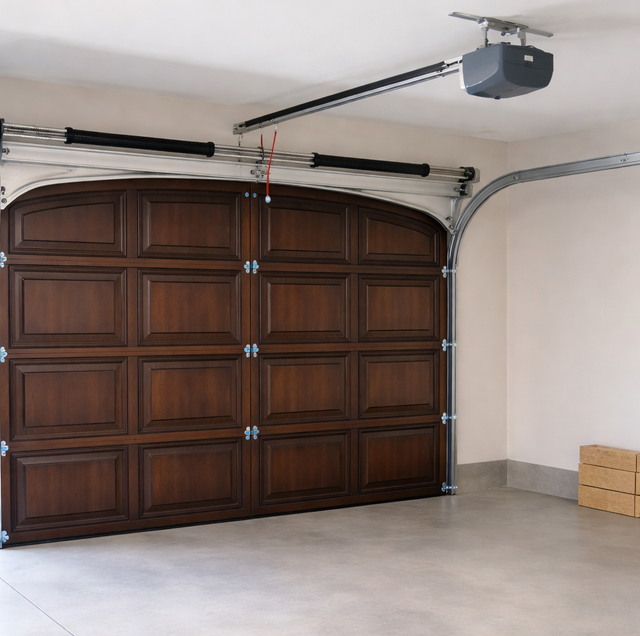
You press the wall button, the motor hums, and the door lifts maybe four inches before it stops cold and settles back with a flat thud against the concrete. Press it again, and you get the same short lurch, the same strain, the same stop. Then the opener light blinks, like it is trying to tell you something in a language you do not speak. That short travel is not random, and the way the door stops narrows the list fast.
Why the First Few Inches Are the Hardest
A sectional garage door is heavy. A standard double door weighs 150 to 250 pounds, depending on the material and insulation. The opener was never built to lift that. Its job is to nudge a door already counterbalanced by the springs above the opening. A torsion spring winds tighter as the door comes down, storing that weight as tension, then unwinds to give it back on the way up.
The bottom of the travel is where that matters most. With the door closed, the springs are at full wind and carrying the entire load, so the first few inches are where the counterbalance either works or it does not. If a spring has failed, the opener meets the door's raw dead weight the instant it tries to move, the motor loads up, and its force limit shuts everything down before the door can show you anything further up the track. That limit is a safety feature, not a malfunction: the opener cannot tell 200 pounds of dead panel from a child under the door, so it treats both the same way.
Matching the Symptom to the Cause
The details of that first attempt do most of the diagnostic work: whether the motor strained, whether the door stopped at the same height, and what you heard.
| What You Notice | Likely Cause | What Is Actually Happening |
|---|---|---|
| Motor strains, door rises 2 to 6 inches, then stops or drops back. Maybe a loud bang a day earlier | Broken torsion or extension spring | The opener is pulling full dead weight and trips its up-force limit |
| Door glides up smoothly, stops at the same short height every time, no strain | Up-travel limit slipped out of adjustment | The opener thinks it has reached fully open and shuts off normally |
| Door stops at a different point each time, often with a scrape or catch | Track obstruction, bent track, or a roller out of line | Friction in the track reads to the opener as an obstacle |
| Door rises an inch or two and stops dead against something solid | Manual slide lock still engaged | The lock bar is jammed in the track slot, pinning the door |
| Motor runs on, but the door barely moves | Stripped drive gear, slipped chain, or a cable off its drum | The opener runs without pulling the door |
| Light blinks, door opens fine but will not stay closed | Photo-eye misalignment or a broken beam | Sensors govern closing, not opening |
These overlap. A weak spring drags on the rollers for months before it breaks, so a failed spring and a rough track often arrive together.
What a Failed Spring Looks Like From Where You Stand
You do not need tools to spot most spring failures. A torsion spring is a tight, continuous coil wrapped around the shaft above the door opening, and a break usually leaves a visible gap of an inch or two where the coil separated. On doors using extension springs that run along horizontal tracks, a failure leaves one hanging slack or in two pieces.
The bang people report is real. A torsion spring stores a large amount of energy, and when the steel gives way, it releases it in an instant against the shaft and the ceiling. If you heard something like a gunshot overnight and the door refused to open the next morning, that sequence is close to diagnostic.
Do not pull the emergency release cord on a door stuck partway up with a suspected broken spring. That cord disconnects the trolley from the opener, and with no counterbalance left, the door's full weight can drop unrestrained.
Springs are rated in cycles, not years. A standard spring is built for roughly 10,000 open-and-close cycles, which is why a household cycling the door four or five times a day sees a failure around the six-year mark.
Opener Force and Travel Limits
If the motor sounds relaxed and the door stops at the same short height every attempt, the springs are probably fine, and the opener's settings are the suspect. Openers have two related adjustments: travel limits, which define where the unit is fully open and fully closed, and force settings, which cap the acceptable amount of effort in each direction. Older units adjust these with screws on the motor housing; newer ones learn them electronically during setup.
Limits drift. A power interruption, a logic board that lost its memory, a bumped screw, or an opener never fully programmed can leave the up limit set inches above the closed position. The tell is the absence of strain: a door stopping because the opener thinks it has arrived sounds completely normal.
Track Obstructions and Pinch Points
Vertical track runs up the jamb, then curves through a radius section into the horizontal track near the ceiling. Anything narrowing that channel creates a pinch point, and a door meeting one stops hard rather than gradually. Common culprits: a lag bolt that backed out of a jamb bracket, a dented track, a loose hinge, or a bent roller stem that rides against one wall of the channel.
Ground movement adds another version of this. Soil with high clay content swells as it takes on water and shrinks as it dries, and that cycle moves the slab and the framing above it. Over several seasons, the opening pulls out of square, and the vertical tracks stop running parallel. The door binds at the same spot low in the travel, and the opener reads that friction as an obstacle. The repair is squaring the tracks and rebalancing, not replacing the door.
The Sensor Question
Safety sensors are constantly blamed for this symptom and are rarely responsible. The photo eyes are the two small units bracketed to the track within about six inches of the floor, one sending an infrared beam, one receiving it. That beam only governs downward travel. If the beam breaks or the units fall out of alignment, the door refuses to close or reverses on the way down. It does not stop a door heading up.
The blinking light that comes with a sensor fault also appears in other fault states. And a door that starts down, reverses partway, and sits a foot off the floor gets described the same way as one that opened and stopped.
What a Technician Checks and in What Order
The first move is to disconnect the opener and test the door's balance by hand, which separates a spring problem from an opener problem immediately. A balanced door stays put around waist height and moves with modest effort. A door with a failed spring drops or refuses to budge, and at that point the opener is not the problem.
If the balance is good, attention shifts to the opener: travel limits, force settings, the drive gear and chain or belt, and any blink code the unit reports. If both check out, the search moves to the track, rollers, hinges, and cables, hunting the point where the door catches.
Worth avoiding meanwhile: repeated attempts. Straining against a dead-weight door grinds the drive gear, and a cable can unwind off its drum, turning a spring job into a spring and cable job.
Frequently Asked Questions
Not with a suspected broken spring. That red cord disconnects the trolley from the opener, and if the counterbalance is gone, the door's weight is held by nothing but the track. The release is meant to be pulled with the door closed, so the panel has nowhere to fall.
In practice, yes. Springs on a two-spring door go in as a matched pair and accumulate identical cycle counts, so the survivor sits at the same point in its fatigue life as the one that let go. Replacing only one usually buys a second service call.
Most current openers report faults via the LED, and the number of flashes indicates the code. Two flashes commonly point to a sensor or wiring circuit, and patterns differ by manufacturer. The code narrows the search but does not replace a balance test.
Rarely. A failing wall control or weak remote battery usually produces no response, or an intermittent one, rather than a consistent short lift. If the door travels the same few inches from the wall button, the remote, and the keypad alike, the controls are not the issue.
Two reasons. Steel loses ductility as it gets colder, so a spring near the end of its cycle life is most likely to fracture on a cold morning. Separately, the rubber bottom seal can freeze to the slab after a wet night, gluing the door down until the force limit stops the pull.
It can, over repeated attempts. The usual casualty is the plastic drive gear in a chain-drive unit, which strips its teeth when the motor turns against a load that will not move. Belt drives slip or fray instead. The opener is normally the second repair, not the first.
Get a door that stops a few inches up properly diagnosed — a technician tests the door's balance by hand, checks the spring condition, opener force and travel limits, cables, and track alignment. Arnold's Garage Door & Gates serves Fort Worth, Alvarado, and the DFW metroplex. Call Arnold: 682-337-7220.
