
Who Chose Your Garage Door Opener, the Builder or You
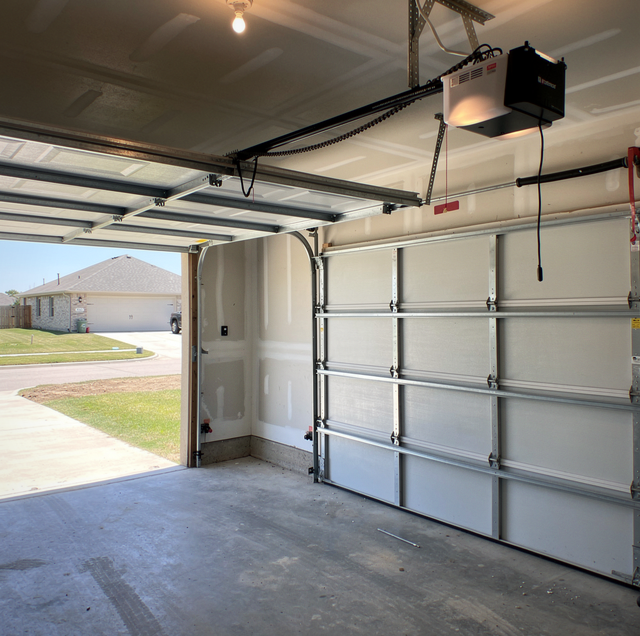
Nobody in your household picked the opener mounted above your car. On a house bought new, that decision belongs to a builder, made from a spec sheet, for a door that had not yet been hung, for buyers nobody had met yet. The unit lifting your door every morning was chosen to satisfy a purchase order at a specific price point, not fitted to the household that would eventually live under it.
That gap between how an opener is specified and how a door is actually used is the real difference between a builder-grade opener and a professional-grade one: who was in the room when the spec was set and what they knew about your garage at the time.
A Purchase Order Set the Horsepower Class
Openers are sold in horsepower classes, and a manufacturer's lineup runs from a light class sized for a single lightweight door up through classes built for heavier, taller doors. A builder ordering units for an entire subdivision buys against a minimum: whichever class clears the heaviest common door in that plan set, at the lowest unit that satisfies it.
That choice comes off a construction spec, not off the door that eventually got hung in your bay with whatever hardware the door crew had on the truck that week. The person placing the order had a plan set, a unit price, and a quantity. What they did not have was your door's finished weight, the condition of the hardware moving it, or any idea how many times a day that bay would run, because none of it existed yet on the day the order went in.
The practical effect rarely shows up on day one. An opener specified to the bottom of its class is fully capable of lifting the door it was matched to, and it will keep doing that correctly for a long stretch. The spec simply never had a household in it, because there wasn't one yet to put in.
Which brand built it, exactly what horsepower class your specific door calls for, and how many cycles it has already logged are each their own question, worth a separate look.
The closing packet from a new build often names the exact opener model the builder ordered. Check the warranty binder, allowance sheet, or appliance list before climbing a ladder to read the housing, since the paperwork settles the tier faster.
A Drive Medium Selected for Unit Cost, Not for the Room Above It
Openers move the trolley, and the door with it, using one of a few drive mediums running the length of the rail. Chain is the least expensive of these to manufacture and assemble, which makes it the default on the large majority of cost-driven packages, regardless of what sits on the other side of the garage ceiling. A builder buying by the unit for a plan that will go up on dozens of different lots has no way of knowing in advance which of those garages will end up under a spare room used twice a year and which will end up under a bedroom.
The chain itself runs over a sprocket at the motor head, and that's metal moving against metal on every cycle. Some portion of that operating noise carries up through the framing into whatever's built above it. Other drive mediums exist and transmit that noise differently, but none of that gets weighed against the specific house going up: the drive medium gets picked once, at the purchase-order level, and it's the same choice for every unit in that order.
The Accessories Reveal How the Package Was Priced
Three drivers sharing one visor remote is a common arrangement in a new-build household, and it follows directly from how that package was priced. An accessory list built to the functional minimum carries one remote, a wall console, and the safety sensor pair, with no outdoor keypad: enough to operate the door and pass a walkthrough, and nothing past that. A package specified for a known household usually carries more, because someone can ask how many people actually use that entrance and size the accessory count accordingly.
Rail piece count tracks package price the same way, with one continuous rail on the upper tiers and two or three bolted sections on the cost-driven ones.
Whether the wall console pairs with a smartphone app follows the same pattern. Many current motor and logic-board designs support that connection out of the box, but turning it into a working feature, an account, a paired app, a live link to your phone, is sometimes treated as a separate add-on rather than something the base package sets up for you. A builder pricing to that same minimum has no more reason to configure that connection than to include a second remote.
Whether Battery Backup Shipped with the Unit Was a Tier Decision
Battery backup, in which an opener keeps running on stored power during a utility outage long enough to open or close the door, is available on DC-motor models. Whether a given unit actually shipped with that battery installed depends on which tier of that motor line it belongs to, not on the motor type itself. The base tier of a DC lineup frequently ships without it, whereas a higher tier in the same lineup includes it as standard equipment.
A builder-grade purchase, priced to the base spec that satisfies the plan, lands on the tier without backup power far more often than not. The DC motor underneath is fully capable of running on battery. The capability sat in that motor line the whole time, waiting on a purchase order that never asked for it.
The Door Was Specified in the Same Pass
The opener rarely gets chosen in isolation. On new construction, the door and the opener are frequently specified in the same purchase order, sometimes pulled from the same manufacturer's catalog, so a door built to the lightest spec that satisfies the plan gets paired with an opener sized to lift exactly that door and nothing heavier. A builder-grade door tends to have fewer layers and no insulation, which leaves both halves of that pairing at the bottom of their respective ranges.
That pairing is internally consistent as long as neither half of it ever changes. The trouble is that a light opener and a light door share the same ceiling, and the opener was never asked to lift anything heavier than what shipped with it. If that door gets a later insulation retrofit, or gets replaced outright with something heavier, the opener inherits whatever gap opens up between what it was specified to lift and what it's now being asked to lift, because nobody revisited the opener spec when the door changed.
The Second Time, You Set the Spec
None of this is an argument to replace an opener that's doing its job. A light-duty unit on a light door, with a chain drive nobody upstairs ever hears and one remote that covers everyone who actually drives, was built correctly to the brief it was given and can run for years without a single one of these gaps ever mattering.
What's worth knowing is that these gaps close on their own separate schedules rather than all at once. An accessory is an accessory, a battery module is a battery module, and a whole opener is a replacement. Treating those as a single decision is how a unit that still works gets pulled down years before it has to be.
Frequently Asked Questions
Not usually at the core. Within a single brand, a builder-grade and a professional-tier unit often share the identical motor casting and logic board design, and the difference sits in what gets bolted around that core rather than in the drivetrain doing the actual lifting. A technician can confirm this by checking the model number against that brand's published lineup rather than assuming a cheaper package means a cheaper motor.
Model homes are usually finished to show the upgrade options rather than the base plan. On most new-construction contracts, the garage package is one of the line items a buyer can move up at the design center before the house is framed, so a model home can be carrying a tier nobody ordered for your lot. On a house bought already finished, that upgrade decision came and went without you.
Most keypads sold today operate wirelessly over the same rolling-code radio link as the remote, rather than requiring a low-voltage wire run to the switch box, as older wired keypad models did. That makes adding one later an accessory addition rather than a wiring project, which is part of why builders leave it off the base package: it's a simple add for whichever household actually turns out to need it.
Manufacturers typically start opener coverage at the date of installation rather than the date you closed on the house, so on new construction that clock started while the place was still being finished. The purchase record usually sits with the builder or the supplier who fulfilled the order, rather than with you, which is why the model and serial number matter more than a receipt you were never given.
It depends on the specific model rather than being a universal retrofit. On some DC-motor lines, the battery backup is a separate module that mounts alongside the motor head and connects through its own dedicated wiring, which is what makes it possible to add after the fact. For others, the main board was never designed to accept that module at all, so the option has to be confirmed on a model-by-model basis rather than assumed.
The drive medium isn't a bolt-on part. It runs the length of the rail assembly and is matched to the sprocket at the motor head and to the trolley riding on it, so moving from one medium to another means changing the rail and, on most models, the head as well. A chain that has gotten louder with age is worth looking at before that noise is read as a reason to pull down a working unit.
Find out which horsepower class, drive, and accessory setup fit the door you actually have — a visit puts eyes on your specific opener and door, rather than a builder's spec sheet. Arnold's Garage Door & Gates serves Fort Worth, Alvarado, and the DFW metroplex. Call Arnold: 682-337-7220.
