
Is a Broken Garage Door Spring an Emergency? When to Call
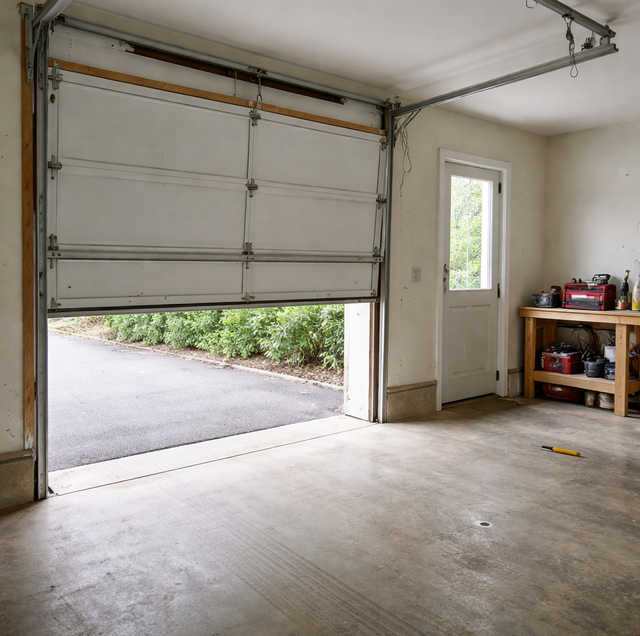
The spring is already broken, and nothing about the next twelve hours makes the break itself any worse. That matters at ten at night, because the urgency in a spring failure rarely comes from the spring. It comes from what the door is now doing to your access, your security, and anyone in the house who keeps pressing the button.
So the useful question is narrower than "is this an emergency." It is this: what has the failure locked you out of, or into, until a technician can reach you?
What Breaking Actually Does to the Door
A sectional garage door is heavy. A standard double door weighs 150 to 250 pounds, and the opener was never built to lift that much. The springs carry the weight. On a torsion system, the spring wraps a steel shaft above the opening and winds tighter as the door comes down, storing the door's weight as tension. In an extension system, springs stretched along the ceiling tracks do the same job by pulling rather than twisting.
When the steel fatigues through, the stored energy is released at once, which is why the break comes with a bang. It is a single event. The broken spring is not sitting up there building toward a second one.
What remains is a door with no counterbalance. Closed, it meets the opener with raw dead weight, tripping the force limit. Stopped partway, it hangs on the opener trolley and the track rather than on anything designed to hold it. That resting position sets the urgency far more than the spring does.
The Three Questions That Decide Your Answer
Where is the door resting? Fully closed is the safest position: nowhere to fall, opening sealed, house as secure as it was yesterday. Stuck open leaves a wide hole in your house. Stuck partway is the least stable of the three.
Where is the car, and when do you need it? A vehicle behind a closed broken-spring door is not coming out tonight without a technician. Nobody should hand-lift a 200-pound door with no counterbalance, and the emergency release does not restore the lift; it only disconnects the opener.
Who else is going to try the button? Repeated attempts against dead weight are how a spring job becomes a spring and opener job. If other people keep testing it, take the door out of service tonight, even if the repair is pending.
Never pull the emergency release cord on a door stuck partway up with a broken spring, and never attempt to hand-lift a door that has lost its counterbalance. Its full weight comes down on whoever is underneath the moment a grip slips.
Situations That Call for Same-Night Service
These are the situations worth an after-hours call, schedule permitting:
The door is stuck open, and the garage connects to the house: An open garage exposes the interior entry door, usually a lighter door with a simpler lock than your front door, plus everything stored inside.
A vehicle is trapped inside, and you need it before morning: A shift you cannot miss, a caregiving run, an early flight. The door will not go up by hand, so the repair is the only way to the car.
The door stopped partway and is hanging there: With no counterbalance, the trolley and track hold it alone. Nothing should pass underneath, and the release cord should remain untouched, since pulling it would remove the only thing holding the door up.
The door came off track or sits visibly crooked: Sometimes the break takes a cable with it, one side drops, and the panel skews. A leaning door can leave the track on any further movement.
Someone already pulled the release and the door is up: It is disconnected from the opener with no spring assist, and it should not be lowered by hand or left over anything you care about.
Weather is coming, and the opening is exposed: Wind and blowing rain reaching an opener or a panel box is a bigger problem than the spring.
When you call, lead with three things: whether the door is stuck open, closed, or partway, whether a car is trapped, and roughly how wide the door is. That lets a technician load the right parts before leaving.
Situations That Can Wait for the Next Appointment
The door is closed, and the cars are outside: This is where most broken spring calls land. The house is sealed, nothing is suspended overhead, and morning changes nothing about the repair.
The door is closed, and you have another way in and out: A second bay, a side service door, or parking in the driveway takes the pressure off. Two-door garages have separate spring systems, so a failure in one bay does not disable the other bay.
The trapped vehicle is not needed until later: A car behind a closed door is an inconvenience, since it sits inside a locked structure.
Nobody in the house is going to force the issue: This is the quiet condition under all of the above. A closed door that four people test every hour is a different situation from one nobody touches.
What to Do While the Door Sits
Take the opener out of play first. Unplug it at the ceiling outlet, or kill the circuit if that outlet is unreachable, and tell everyone in the house why. That step prevents most of the damage that happens between the break and the repair.
If the door is closed, leave it closed. Do not lift it by hand to free a car, and do not treat the release cord as a workaround. Hand-lifting means holding the full panel weight, and a slipped grip has nothing to catch it.
If the door is stuck open, spend the time on security rather than on the door. Lock and deadbolt the interior entry door, move valuables out of sight, lock the vehicles, and leave a light on in the garage. Disabling remote or app access keeps a stray signal from making things worse.
If a car has to come out and the door is stopped fully open and stable in its track, backing the vehicle out is reasonable. Do not park anything back underneath afterward.
What Changes When the Door Stays Broken for Days
The spring does not get worse sitting there. Other parts do.
Repeated attempts against dead weight are the main risk. A chain-drive opener strips the teeth off its plastic drive gear, and a belt drive slips or frays. Cables are another casualty, since a door that lurches and stops can let a lift cable unwind off its drum, which must be reset before the door can move safely.
There is also the matched pair problem. Doors built with two springs: install them together and cycle them identically. A standard spring is rated for roughly 10,000 open-and-close cycles, so a household running the door four or five times a day reaches that mark in about six years. When the first one fails, the second is at the same point in its fatigue life, which is why both are usually replaced at once.
Where Most Broken Spring Calls Land
Sorted honestly, most spring failures happen with the door closed, at night, with vehicles parked outside or not needed until morning. Those are appointments. Treating them that way gets a technician arriving with the right spring already on the truck.
The true after-hours calls share one feature: the door failed in a position that leaves the house open, a vehicle stranded, or a heavy panel suspended over something. If that describes your situation, waiting is the risk. If it does not, unplug the opener, leave the door alone, and call when the phones open.
Frequently Asked Questions
Often, and it is worth asking when a door is stuck open late. Bringing a door down without a working counterbalance takes two people or the right equipment, and once down it can be held with locking pliers clamped into the track above a roller until the parts arrive.
Rarely from the break itself. The damage comes from what follows if attempts continue, so an opener unplugged within a minute of the bang is almost always fine. Worth knowing: after new springs go in, the opener's force settings usually need rechecking, because the effort the door demands changes once the counterbalance is correct again.
Stand inside with the door closed and look at the shaft above the opening. One long coil centered over the door means a single spring; two coils meeting at a center bracket mean a pair. Long springs running back along the ceiling beside each track are an extension setup, which uses one per side and sometimes two on heavier doors.
Get anything moisture-sensitive off the floor and away from the opening, especially cardboard and anything plugged in, since wind-driven rain reaches surprisingly far into a garage. If the opener sits directly in line with the opening, unplugging it protects the board from a wet surge and stray button presses.
Usually not. Most breaks are simply the spring reaching the end of its rated cycle life or its fatigue life, which is a wear-item failure rather than a structural one. The exception worth ruling out afterward is a door that was already out of balance from a track, cable, or roller issue before the spring went, since that shortens a spring's life without being the spring's own fault, and the technician who replaces it should be able to tell you which situation you had.
Under a door that was already closed when the spring broke, yes. After a torsion spring breaks, the halves stay captive on the shaft, so nothing is coming down on the hood. That is different from a door that dropped hard or slammed on its way down, since a fast landing can leave cables, brackets, or hinges stressed in ways you cannot see from the driveway, and that door is worth treating as unconfirmed until it has been checked, even once it is sitting flat on the slab. The other exceptions are an extension spring door missing its safety cable, where nothing contains a broken coil, and a door stopped partway, which should have nothing underneath at all.
Call for after-hours help if a broken spring left your garage stuck open or your car trapped inside — same-day service is available as the schedule allows, with after-hours emergency calls for the situations that cannot wait until morning. Arnold's Garage Door & Gates serves Fort Worth, Alvarado, and the DFW metroplex. Call Arnold: 682-337-7220.
