
What Is a Jackshaft Garage Door Opener, and Do You Need One
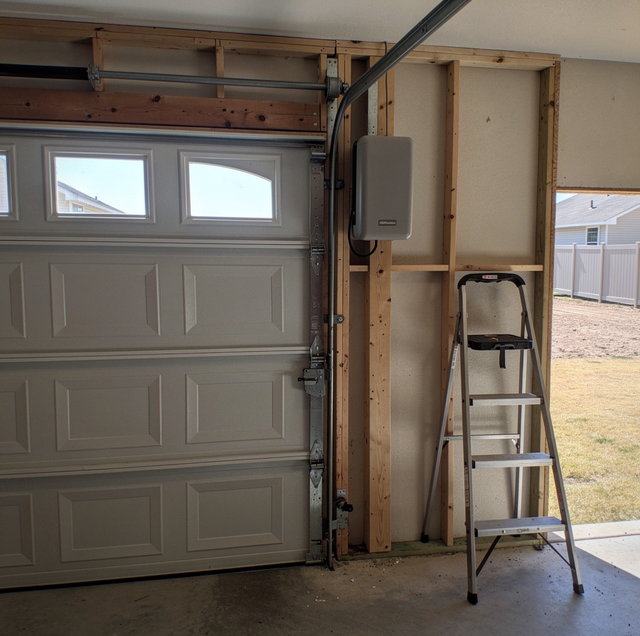
A rail-and-trolley opener needs a straight run of open ceiling from the header back past the middle of the garage, plus something solid to hang the far end from. In a fair number of garages, that space is already claimed. A rack of overhead storage spans the same joists the rail would use, a car lift's crossbeam sits exactly where the trolley would travel, or the ceiling was framed with open trusses and finished in a way that leaves nothing to bolt a rail bracket to.
A low header creates the same problem from a different angle. If there isn't enough clearance between the top of the door's travel and the ceiling, a trolley opener runs out of room before it ever gets the door open. Plenty of garages are framed this way, and a jackshaft opener is built for exactly that situation.
Before you call anyone, check two things: whether the door runs on a torsion shaft mounted above the opening rather than extension springs stretched along the horizontal track, and whether the wall beside the door is clear enough to mount a housing.
It Turns the Shaft Instead of Filling the Ceiling
A jackshaft opener mounts on the wall beside the door, at one end of the torsion shaft that already runs across the header. Instead of pulling the door up and down with a chain, belt, or screw riding along an overhead rail, the unit couples directly to that shaft and turns it under power, the same shaft the springs already wind and unwind against. There's no trolley traveling back toward the far wall and no powerhead hanging from the ceiling partway down the garage.
The whole drive lives in one compact housing next to the door, low enough to reach from a stepladder rather than a ladder set up under an open rail. Because the ceiling never enters the equation, none of the space above the door needs to be clear, open, or even framed to support a rail bracket. That single difference is what makes the format worth considering any time the ceiling itself is the obstacle.
That direct connection also tends to run quieter day to day. A rail-and-trolley opener sends a chain or belt the length of the ceiling with a trolley riding along it, while a jackshaft unit's coupler simply rotates in place next to the door, with no hardware sliding back and forth overhead to add its own noise to the cycle. That difference matters again when a finished room sits directly above the garage: a jackshaft unit's housing couples into the wall studs beside the door rather than the ceiling joists that room's framing shares, so there's no powerhead mass bolted overhead for a listener upstairs to notice.
Overhead Storage and a Lift Already Claim the Rail's Path
Overhead storage racks are usually hung from the same ceiling joists a trolley rail would need, and they're rarely installed with a rail's clearance in mind. Once bins, seasonal totes, or lumber are racked along the ceiling, retrofitting a rail-and-trolley opener means either relocating the storage or accepting an opener that can't run its full length without striking something.
A car lift raises the stakes further. The crossbeam and the lift's posts occupy exactly the airspace a rail would pass through on its way from the header to the back wall, and a lift isn't something that gets repositioned to make room for a garage door opener. A jackshaft unit sidesteps the conflict outright, since its drive never passes through the header.
An Open Truss or a Finished Ceiling Gives a Rail Nothing to Hold
A trolley rail needs a fixed point near the back of the garage, usually lagged into a joist or a truss chord, to carry the load of the door as it starts and stops. An open-truss ceiling left unfinished sometimes has nothing at the right span to anchor to, and a finished ceiling, drywalled over for a bonus room or a workshop above, hides whatever framing is up there and turns locating a solid anchor point into a guessing game.
A jackshaft opener only needs a mounting point on the wall next to the door, tied into the same framing the header and jamb already use. That's framing an installer would check anyway, so a garage that can't offer a good ceiling anchor can usually still offer a good wall one.
Low Headroom Above the Door Leaves No Room for a Trolley to Travel
Some doors sit high enough on the wall, or the ceiling slopes low enough, that there's only a few inches of clearance once the door reaches the top of its travel. A trolley opener needs room above that point for the carriage to keep moving toward its resting position, and a rail-and-trolley system forced to stop short of full travel doesn't stay reliable for long.
Because a jackshaft unit turns the shaft in place rather than sending anything across the ceiling, it doesn't need travel room above the door at all. The shaft rotates the same amount in either direction; the format built around it just doesn't ask the ceiling to support a moving part.
A Tall or Oversized Door Makes the Ceiling Run Impractical
As a door gets taller, a trolley rail has to run further back to give the panels somewhere to travel once they're horizontal, and on an oversized door that run can stretch well past what a standard rail length comfortably covers. Extending or reinforcing a rail for a large door adds hardware and length that a lower, shorter door never needs.
A jackshaft unit's demands don't scale with door height the same way. Since it turns the shaft rather than tracking the door's horizontal travel across the ceiling, a taller or wider door mainly changes how much the shaft itself must handle, not how far the rail needs to reach. That keeps the format practical on doors where a ceiling-mounted rail becomes an increasingly awkward fit.
A Jackshaft Opener Still Needs a Torsion System and a Balanced Door
None of this makes a jackshaft opener an automatic fit for whatever door is there. The unit couples to a torsion shaft, so it needs a torsion-spring system already in place; a door running on extension springs mounted along the horizontal track isn't set up to accept a jackshaft drive as it stands.
Because the motor drives the shaft directly, without the small amount of give a trolley connection allows, a door that's out of balance puts that unevenness straight into the drive every time it runs. Installers typically confirm balance before mounting the unit rather than after. The wall space beside the door has to stay clear too, which rules the format out wherever a workbench, shelving, or a side door already fills that spot.
Many wall-mounted units also add a deadbolt-style lock that engages the vertical track when the door is closed, something most ceiling-mounted openers don't include as standard. The release works differently from a rail-and-trolley opener as well. A ceiling unit disengages with a cord hanging down from the trolley, a familiar handle within reach from the floor. A jackshaft unit's release sits on the housing beside the door instead, disengaging the coupler from the shaft rather than dropping a trolley off a chain, and it's worth having that difference walked through in person rather than guessed at the first time it matters.
A jackshaft unit's release disengages the motor from a loaded torsion shaft. Never trigger it with the door open partway; an unbalanced or heavy door can suddenly drop the instant the driver lets go.
Frequently Asked Questions
Most jackshaft units are built around a DC motor rather than an AC one, since a DC motor provides smoother, more controlled starts and stops when it's turning a shaft directly, rather than driving a chain or belt with some built-in give. That soft start carries more weight on this format because the motor is connected straight to the same shaft the springs act on, with nothing between them to absorb a rough start. Ceiling-mounted openers come in both AC and DC versions depending on the model, so motor type alone isn't a distinguishing feature between the two formats generally, but it's a near-constant in wall-mount units specifically.
A ceiling-mounted opener's powerhead almost always includes a bulb socket that lights the garage automatically when the door cycles, since the unit already hangs in the middle of the ceiling. A jackshaft unit doesn't have that vantage point, so the courtesy light usually comes from a separate fixture or from a light built into the wall-mounted control station rather than from the drive unit itself. It's worth asking what lighting a specific jackshaft model includes, since it isn't automatic the way it is with a ceiling powerhead sitting overhead.
Yes. Because the unit couples to the end of the torsion shaft rather than to a fixed rail position, it can be mounted on either side of the door, left or right, where there is clear, accessible wall space. That flexibility is often what makes the format workable in a garage where one wall is blocked by shelving, a side door, or a subpanel and the other isn't.
The deadbolt-style lock some jackshaft units include engages a hole in the vertical track once the door closes, which does more than an opener's drive connection alone. With the lock engaged, the door can't be forced up from outside by hand the way a door without that lock sometimes can, since the track itself is pinned rather than just the drive holding tension. Not every wall-mount model includes this lock, so it's a feature to confirm rather than assume.
It does more than a rail-and-trolley opener would. A shaft that's bent or worn, often from age or from a spring failure that damaged it, transmits that irregularity straight into a jackshaft drive every time it turns, since the coupling is direct rather than through a chain or belt that tolerates a little play. A rail-and-trolley system's flexible connection absorbs some of that irregularity instead, which is one reason shaft condition is checked specifically before a jackshaft unit is installed.
On models where the tier includes battery backup, a ceiling-mounted opener usually carries the battery either inside or alongside the powerhead, which rides on the rail. A jackshaft unit has no rail to mount it to, so the battery pack sits on the wall near the drive housing instead, wired into the same unit rather than traveling anywhere. The inclusion of the backup still comes down to which tier of opener was chosen, not to which format it's built into.
Find out whether a jackshaft opener fits your garage — a quick look at the shaft and the wall beside it is usually all it takes to know. Arnold's Garage Door & Gates serves Fort Worth, Alvarado, and the DFW metroplex. Call Arnold: 682-337-7220.
