
Garage Door Opening Slowly: Springs or a Tiring Motor
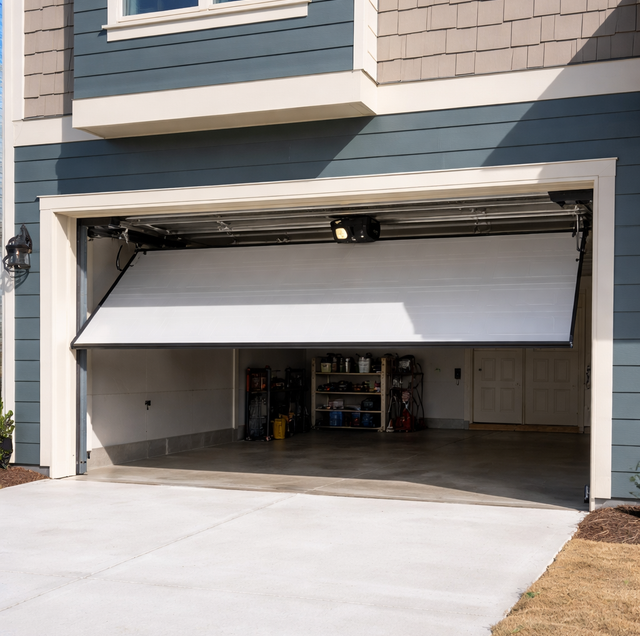
The change is small enough that you keep talking yourself out of it. In the spring you could hit the remote from the end of the block, and the opening was clear by the time the car reached the apron. Lately you sit in the driveway watching the last stretch of door climb the track. Nothing broke. Nothing banged. The door still answers every time, only later than it used to, and later again this week than last.
A door that loses speed on a slope like that is reporting wear in one of two systems. They show it in different parts of the travel, and only one of them ends with a spring on the floor.
What Sets a Garage Door's Speed in the First Place
Residential openers do not have a throttle. The motor turns at a set rate, the gearbox reduces it, and the trolley crawls the rail at whatever speed that gearing produces. With no load on it, that speed holds steady for the life of the unit.
What varies is the load. The springs above the opening are sized to the door's measured weight so a couple hundred pounds of door behaves as though it weighs almost nothing at any height, leaving the opener a small push to start things and keep them tracking. Electric motors slow down when you load them, so anything that quietly adds weight to the opener's share pulls the door below its normal speed, and so does anything that reduces the motor's output to what it once had. Two origins, one symptom, and the difference lives in when and where the door drags.
When Fading Spring Torque Is Behind the Slowdown
Springs do not only fail by snapping in half. A torsion spring stores energy by twisting, and every cycle works the steel. Over thousands of trips, the wire takes a permanent set and gives back less torque than it did the day it was wound, looking identical from the floor the whole time.
A standard residential torsion spring is built to roughly 10,000 cycles, and a two-car household running the door four or five times a day reaches that count in a handful of years. The approach is a slope: the spring weakens by degrees, the weight the opener is left holding creeps up a pound or two at a time, and the motor answers by running slower.
The tell is where in the travel the drag shows. A closed door hangs its full weight on the springs, and as the sections roll into the curve and out along the horizontal track, that weight transfers to the ceiling. A fatigued spring makes the first few feet off the concrete the slow part, and the door picks up once it flattens out overhead.
Closing tells the other half. With the springs down on torque, the door is heavier than the opener planned for, so it drops easily and sometimes eagerly, running ahead of the carriage and leaving the chain slack. A door that has grown sluggish going up while closing as fast as ever is pointing at the counterbalance, not at the motor.
When an Aging Opener Runs Out of Push
Openers fade too, and on an older unit the fade comes from three places.
The motor is first. Bearings and bushings dry out and add drag the windings have to overcome. On units built around an AC motor with a start capacitor, that capacitor loses capacity as it ages, and a weak one gives a beat of hum before anything moves, a lazy start, and a motor that never reaches full speed under load. Capacitors fade along a curve, which is why the door slides slower by the week while still running every day.
The drive train is second. The nylon gear inside the gearbox wears its teeth down, the sprocket rounds off, a chain stretches, or a belt goes slack, and the trolley drags on a rail that has collected years of dust into old grease. That is friction the motor pays for on every inch of travel, in both directions.
Heat is third. A motor working harder runs hotter, and a hot motor makes less torque, so the fourth cycle in a row comes in slower than the first.
The signature of the opener path is uniformity. The door is slow from the floor, slow through the curve, and still slow along the horizontal run where it weighs almost nothing. It is slow going down as well, which matters most, since gravity does the closing and a healthy drive train has power to spare in that direction.
Time it. Once a week, run the door with a phone stopwatch and write down two numbers: floor-to-open and open-to-floor, along with the outside temperature. Four entries turn a vague impression into a trend line a technician can use.
Telling the Two Apart From Where You Stand
Four observations separate these without touching anything.
Watch where the door drags. Slow off the floor and normal overhead points at counterbalance, while a steady crawl the whole run points at the opener.
Compare directions. Weak springs make the door harder to lift and easier to drop, so opening suffers alone. A worn drive train slows both.
Listen to the motor's pitch. A motor bogging under load drops in tone at one point in travel and recovers when the load eases. A motor short on output sounds flat from the instant it starts, and a hum before any movement usually comes from the starting circuit.
Compare ages. Openers commonly reach the end of a useful life past the decade mark, so a unit older than the springs above it has earned the suspicion.
Disconnecting the trolley to lift a suspect door by hand removes the only thing restraining its weight if the springs are already weak. That check is worth leaving to the visit rather than trying at home.
One check gets skipped here on purpose. Balance testing by hand is the standard next step, but it belongs to a visit where the door can be secured first, not to a driveway guess.
What Gets Measured on the Service Call
The counterbalance settles first, because a tired spring makes a healthy opener look worn out, and no reading from the motor means much until the load is right. The door goes up, a scale goes under the bottom section, and that number gets compared against what the installed springs are rated to carry. The wind remaining on the shaft gets checked against the door's height, along with coil spacing, rust, cone and drum condition, and cable condition.
The opener side follows. Current draw at the motor under load says whether it is straining or coasting; the capacitor gets tested with a meter; the gear case comes open for a look at tooth wear; and the rail, trolley, chain tension, and force settings get checked. The repair is then a matched pair of springs sized to the door's measured weight, work on the opener, or both where the two aged together. Hanging a new opener over a fatigued spring set only puts a stronger motor in front of the same load.
Frequently Asked Questions
Timing that improves for a stretch almost always traces to conditions in the garage. Warm weather thins stiff grease in the rail and bearings, and light use lets an overheating motor stay cool. Spring steel does not recover lost torque and gear teeth do not grow back, so a lasting return to normal speed deserves as much attention as the slowdown did.
It explains part of the swing, and by more than people expect: a rail and bearings can lose a full second or two of travel time between a 90-degree afternoon and a 40-degree morning on the same healthy door, since cold grease measurably thickens. The way to separate that from real wear is to log the time against the same rough temperature band each week rather than comparing a warm day to a cold one.
On the way up, yes. Openers watch how much force a cycle demands and stop when it exceeds what they learned, so a door gaining effective weight eventually crosses that threshold and quits mid-travel. Reversing on the way down is a different fault, usually the photo-eye sensors or something sitting in the opening.
The spring-side slowdown looks identical on either drive type, since that half of the problem sits above the opener entirely. The drive-train half differs some: a belt stretches and glazes rather than stripping teeth, so a belt unit tends to announce wear as a jerky or uneven pull instead of the flat drag a worn nylon gear produces, and a chain unit adds sag and slap to the same list of symptoms.
Two clocks run at once. On the spring path, the coil loses torque until it breaks, usually on a cold morning, and the door goes unusable in one cycle. On the opener path, the strain grinds the drive gear until the motor spins without moving anything. A weak spring also accelerates opener wear, so a slowdown left long enough tends to produce two repairs where one would have done.
Not meaningfully, and it can mask the real problem rather than fix it. Residential opener horsepower ratings mostly describe how much load the unit can start and sustain, not the top speed it travels at, since nearly all residential units share a similar gear reduction and rail speed regardless of motor size. A stronger motor on a door with fading springs just tolerates the extra weight longer before it shows, which delays the diagnosis rather than solving it.
Have a door that has been losing speed checked before it stops entirely — a technician weighs the door, compares it against the installed springs, and tests the opener under load to separate a counterbalance problem from a worn drive. Arnold's Garage Door & Gates serves Fort Worth, Alvarado, and the DFW metroplex. Call Arnold: 682-337-7220.
