
Garage Door Replacement Upsell? Questions to Ask First
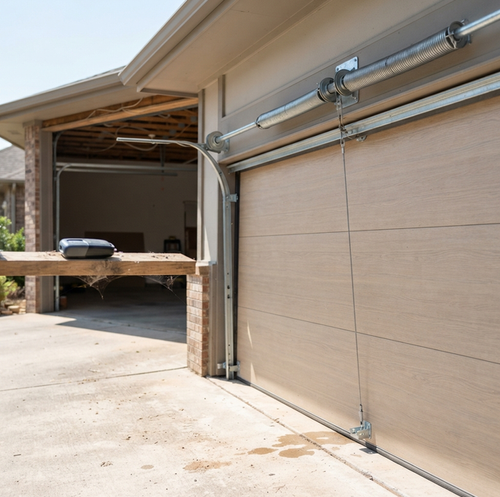
Quick Answer: A recommendation for full replacement should follow, not skip, a real diagnosis: a balance test, a look at the springs and cables, and an honest read on the door's age and wear. If a technician skips those steps, pushes for a same-visit decision, or can't explain in plain terms what failed and why a repair won't fix it, that's worth a second opinion before you sign anything.
The technician you called out for a stuck garage door spends about ten minutes in the driveway, looks the door over, and tells you it needs to be fully replaced. You didn't ask about a new door. You asked why the one you have stopped opening. Maybe that call is exactly right. A repair truly won't hold up on some doors, and a technician who tells you so is doing the job well. But full replacement is also the biggest job a technician can recommend, and the honest answer isn't always obvious from a quick walk-through. The difference usually comes down to whether the recommendation is backed by an actual diagnosis, one you can follow and that matches what you're seeing.
This isn't about one company versus another. It's a set of questions worth asking about any quote, from any technician, for any door.
When Full Replacement Really Is the Right Call
Replacement earns its place on certain doors, and knowing the real reasons helps you tell them apart from a sales pitch.
Structural rust-through or rot: Steel doors that sit low against a slab can wick moisture along the bottom section for years, and once rust eats through the panel itself rather than just staining the surface, there's no longer solid metal for hinges, rollers, or the bottom bracket to anchor into. Wood doors rot the same way at the base. At that point, a patch doesn't restore the structure. It just covers a hole.
Repeated spring or cable failures on old, high-cycle hardware: Torsion springs and lift cables are rated for a set number of open-and-close cycles, and a household running the door several times a day burns through that rating faster than one that opens it once. When the same door has already gone through more than one spring or cable failure in a short span, and the hardware is old enough to be nearing the end of its rated life, replacing the whole system rather than just the part that failed this time is a reasonable call rather than an upsell.
Serious collision damage: A car backing into the door hard enough to bend more than one panel, twist the track, or pull the frame out of square is a different situation from a single dent. A panel can flex a little. A warped frame or track can't be straightened back true without the door binding or racking every time it runs. Multiple bent sections plus a frame that's no longer square usually means the door's basic geometry is compromised, not just its skin.
Discontinued parts on an obsolete model: Manufacturers stop producing specific panel styles, window inserts, and hardware sets after a run of years. If your door is old enough that the maker no longer supplies a matching panel or the exact roller and track hardware it shipped with, a technician may not be able to source a real repair part at all, only a mismatched substitute. That's a legitimate reason to talk about replacement, not a hard sell.
Red Flags Worth a Second Opinion
None of what follows means a company is dishonest. Each one is simply a reason to slow down and ask more before agreeing to anything.
Skipping the balance test: A balance test is simple. Disconnect the opener, lift the door by hand about halfway, and see whether it holds that position on its own. A properly balanced door stays put with light effort; one that drifts down or shoots up tells you the springs are off, not necessarily that the door is done. A technician who recommends full replacement without ever disconnecting the opener or touching the springs has skipped the one test that would show whether this is a spring problem, a track problem, or something else entirely.
Pressure to decide on the spot: A legitimate recommendation holds up whether you say yes right away or call back tomorrow after thinking it over or getting a second look. Pressure to sign before you've had a chance to sit with the information or ask a follow-up question is worth noticing. Sound work doesn't usually expire in the next twenty minutes.
A diagnosis that doesn't match the symptom: If you called about a noisy door and the conversation jumps straight to full replacement without ever mentioning the rollers, hinges, or opener chain, or you called about a door that won't close and nobody checked the photo-eye sensors first, that mismatch is worth questioning. The explanation should trace a line from what you're experiencing to the part that's actually failing.
No plain-language explanation: A technician who can point to a specific worn or broken part, name it, and explain plainly why repairing that part won't solve the problem is giving you something to evaluate. One who answers with little more than "it's just old" or "it needs to go" hasn't given you much to go on. That alone isn't proof of anything, but it's a fair reason to ask again before you commit.
Questions to Ask Before You Decide
A short list worth running through before signing anything:
- What exactly failed? Ask for the specific part, spring, cable, roller, track, or panel, not a general description.
- Why won't repairing that part fix the problem? A repair that wouldn't hold should have a reason attached, tied to what's actually wrong.
- What did the balance test and the spring or cable inspection actually show? If neither happened, ask why not.
- How old is the door and its hardware, and how does that compare with a typical service life for a door used this often? Age and cycle count matter more than a birth year alone.
- Can I see a comparison of what a repair would involve versus what full replacement would involve, in terms of scope of work rather than cost? Knowing what each option actually touches helps you weigh a second opinion against the first one.
- Is it all right if I take some time to think it over, or have someone else look at it first?
A technician confident in the diagnosis will usually welcome all of these. Reasonable answers, no attitude required.
A Good Recommendation Explains Itself
None of this is really about garage doors specifically. Any home repair quote, whether it's a roof, a water heater, or an HVAC system, follows the same pattern: a real diagnosis names a part, ties it to the symptom, and gives you room to think it over. A recommendation that skips those steps isn't automatically wrong, but it hasn't earned your decision yet either. The technician's job is to explain the failure clearly enough that you could describe it back to someone else. If you can do that after the conversation, you have what you need to decide. If you can't, that gap is the signal to ask more questions or get another set of eyes on the door before committing to anything.
Frequently Asked Questions
A cycle count is the number of times a spring or opener is rated to open and close before it's expected to wear out, but it usually isn't stamped anywhere you'd notice on a quick look at the hardware, and it rarely shows up on a factory label you can just go read yourself. The reliable route is asking the technician directly what rating they're quoting for your specific springs and having that figure written on the invoice, rather than trying to track it down on the parts themselves. A household running the door several times a day with multiple drivers burns through that rating years faster than a door opened once each morning, which is why two doors installed the same year can be in very different shape.
No, and it's worth knowing which type you have before that conversation starts. A sectional door, built from several horizontal panels stacked in the track, can usually have just the damaged section replaced on its own. A one-piece or tilt-up door doesn't have that option, since the whole slab is a single panel, so any serious damage there means replacing the entire door rather than a section of it. Even within a sectional door, the panel that matters most is the bottom one: it's what the lift cables and bottom brackets anchor to, so it carries spring tension directly, while an intermediate section higher up mostly just fills space and takes far less load. A dented bottom section is a bigger structural question than the same dent two sections up.
Not necessarily. A door that's suddenly heavy or hard to open can trace back to worn rollers riding rough in the track, a cable that's started to fray or slip off its drum, or a track that's been knocked slightly out of alignment, in addition to a weak or broken spring. A technician should rule out those other causes before treating the springs as the culprit, since replacing springs on a door with a track problem won't fix the actual issue.
Sometimes, but it's worth asking specifically rather than assuming. An opener rated for the old door's weight can end up underpowered or overworked on a heavier replacement, like swapping a lightweight aluminum door for an insulated steel one, and the travel limits and force settings have to be reprogrammed for the new door's exact height and weight regardless of whether the same opener stays in place. A technician should tell you plainly whether the opener is being reused as-is, reprogrammed, or recommended for replacement alongside the door, and why.
Yes, and many technicians will note it on the estimate or invoice without being asked, listing what was tested, what was found, and which part is being recommended for repair or replacement. Having that in writing gives you something concrete to compare if you do get a second opinion, rather than relying on memory of a verbal conversation.
It happens more often on borderline cases, like a door well past the middle of its expected service life with one failed spring, where reasonable technicians can land on different calls. A second opinion isn't unusual or a sign that the first one was wrong. It's worth asking upfront whether a company charges a trip or diagnostic fee for that second look, since policies vary, so you know what the visit costs before you schedule it.
Get a second, no-cost opinion on your garage door — Arnold offers free on-site estimates with no diagnostic or trip fee, so you get an honest read on whether repair or replacement actually fits your situation. Arnold's Garage Door & Gates serves Fort Worth, Alvarado, and the DFW metroplex. Call Arnold: 682-337-7220.
