
Garage Door Spring Size: Why Weight Beats Guesswork
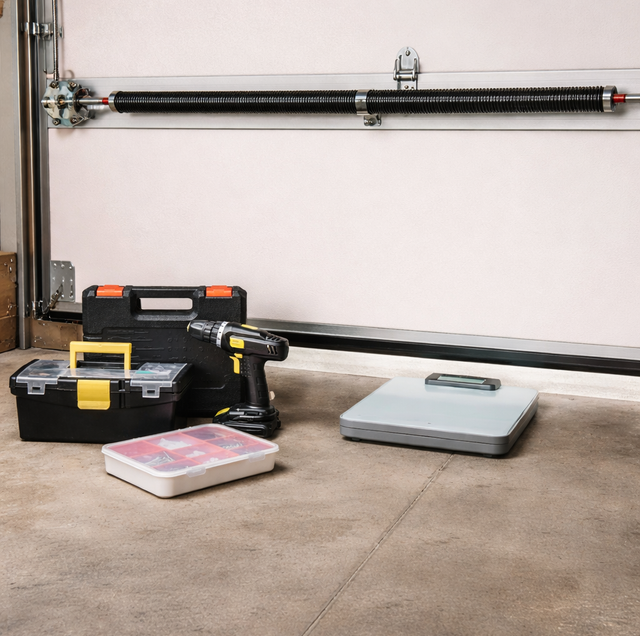
The technician pulls a bathroom scale out of the van, the same flat kind that lives in a hall closet, and slides it under the bottom section of your raised garage door. It looks like a prop from the wrong job. It isn't. That reading, taken while the door hangs with nothing holding it up, is what determines which spring goes back up on the shaft, and it's the number a phone call cannot produce.
Width and height indicate to a technician how the hardware fits within the opening. Weight tells how much work the spring must do, and only one of those can be answered from outside your house.
What "Spring Size" Actually Describes
Homeowners picture spring size like a light bulb: one number, one shelf, grab the matching box. A torsion spring is specified by three values plus a direction, and changing any one of them changes how the door behaves.
Wire diameter: the thickness of the steel, in increments like .207, .225, .234, .243, and .250 of an inch. A few thousandths here makes a large difference in what the spring can hold.
Inside diameter: the size of the hole the spring rides on, typically 1 3/4, 2, or 2 5/8 inches on residential doors, matched to the shaft and cones.
Overall length: the wound length of the coil body, which sets how many turns the spring can safely take.
Wind direction: left-hand or right-hand, wound in mirrored pairs on a two-spring door. Winding cones are usually color coded (black one way, red the other) so the pair doesn't get crossed.
Those four combine into what actually matters, which is torque: the rotational force delivered per turn, expressed in inch-pounds per turn. Two springs that look nearly alike on a rack can produce very different torque, and torque is what must match your door.
Why the Door's Weight Is the Number Everything Follows
A torsion spring doesn't lift the door. It stores energy that cancels the door's weight so the door becomes, in effect, weightless. When the counterbalance is right, you can stop a disconnected door at knee or chest height, and it stays there.
To cancel a weight, you first have to know it, and door weight varies more than appearance suggests. A non-insulated 25-gauge steel double door and a polyurethane-insulated 24-gauge door of identical size can differ by dozens of pounds. Add full-view glass sections, a wood overlay on a carriage-house-style door, or a heavier replacement panel installed years later, and the gap widens. Solid wood doors sit in a category of their own.
None of that shows up in "it's a sixteen by seven." Identical-looking openings can need different springs.
How the Weight Actually Gets Measured
Two approaches are common, and both require the door under control first, with the opener disconnected and the counterbalance released or already broken.
The scale method is what you'll see most often: the door comes down onto a bathroom scale set under the bottom section, and the technician reads the pounds directly. When a spring has already snapped, this is easy: the door is dead weight with nothing offsetting it. The other approach uses a weighted-pull gauge, a heavy-duty hanging scale hooked to the bottom bracket that measures the force required to hold the door in motion.
Neither is a homeowner task. A door with a broken spring is a few hundred pounds of steel held up by nothing, and an intact spring stores enough energy to injure whoever releases it wrong.
Weight isn't the only measurement taken. Door height sets how many turns the spring gets wound, and cable drum size sets the moment arm it works against, so a standard-lift and a high-lift drum change the math on the same door. Track radius and headroom limit what fits.
Why a Guessed Stock Spring Fails Early
Say a spring goes on that's close but light for the door. It still opens, the opener still runs, and for a while nothing looks wrong. What's happening is that the spring gets wound closer to its stress limit on every cycle to make up the difference. Running a spring past its intended load is like holding an engine at redline: it works right up until it doesn't.
Cycle life is the measurable version of this. A standard residential torsion spring is rated at around 10,000 cycles, one cycle being one open and one close, with high-cycle options built from heavier wire and longer bodies to reach several times that number. An undersized spring never reaches its rating in the first place.
Oversizing causes different problems. The door feels light going up and stubborn coming down. It may refuse to stay closed, drift upward on its own, or fight the opener's down force enough that the safety reverse trips partway through closing. A spring-heavy door is also dangerous to handle by hand, because it wants to travel up and takes fingers with it if it gets away. Correct sizing is the window between those two, where the cables, drums, bearings, and shaft see the loads they were built for.
A winding bar that slips off a loaded cone can kick back hard enough to break a hand or knock someone off a ladder. A spring wound past its rated turns can shatter without warning. Winding tension is professional-only work.
Why the Phone Can't Give You a Spring Size
You can learn plenty on the phone: whether the system is torsion or extension, whether one spring broke or both, what the visit involves. What you cannot get is a size, because the two facts that set it, measured weight and hardware geometry, are physically at your house.
Measuring the broken spring is a legitimate cross-check, and a good technician does it: the wire diameter is measured with calipers across a counted run of coils. But that only tells you what was on the door before. If the original was undersized, or the door was re-sprung with whatever was on the truck, matching it repeats the mistake. The old spring is evidence, not an answer.
Why Cold Mornings Expose an Undersized Spring
Springs rarely break during the easy part of the year. The first hard freeze is the most predictable failure window there is, because cold steel behaves differently than warm steel: it gets more brittle, and a coil already carrying fatigue from thousands of cycles finds its breaking point on a cold morning rather than a mild afternoon. The bang usually comes on the first cycle of the day.
A correctly sized spring reaches the end of its cycle life eventually too, usually in that same weather. An undersized spring gets there years early. If your door has gone through more than one spring in a short span, the sizing is worth a hard look before the next one goes on.
What the Weighing Step Adds to a Spring Replacement
The measurement takes a few minutes. What it buys is a spring whose rated torque matches the load, a door that holds position anywhere in its travel, an opener running a counterbalanced door instead of muscling a heavy one, and a realistic shot at the rated cycle life.
It also gives you a record. Once the weight, wire diameter, inside diameter, length, and wind are written down, the next conversation about that door starts from facts. The question worth asking is not what size spring is going on, but how that size was arrived at.
Frequently Asked Questions
It's tied to door height, not to feel. The field rule is roughly one turn per foot of height plus a small allowance, putting a 7-foot door near 7 1/2 to 7 3/4 turns and an 8-foot door near 8 1/2. Winding occurs in quarter-turn increments with steel winding bars, and a single quarter-turn off shows up as a door that drifts up or settles down.
Yes, but they're rated differently. Extension springs stretch along the horizontal tracks instead of twisting on a shaft, and they're rated by lift capacity in pounds, not torque per turn. A painted color code on the end coil identifies that capacity, so a technician can read the rating off an installed spring at a glance.
On a properly built dual-spring door, yes. That's also why both get replaced together even when only one broke: the survivor has the same age and cycle count, and pairing a new spring with a fatigued one puts the door out of balance. Some doors run a single spring by design, using heavier wire to carry the load alone.
It can, and that's a common reason a once-correct spring stops being correct. An insulation kit added behind the panels, one section swapped for a heavier-gauge panel, or a wood door absorbing moisture all add weight the original spring was never sized for.
There is, and it's the same check a technician runs. With the opener disconnected at the emergency release and the door raised to about waist height by hand, a balanced door stays put. A door that slides down is spring-light; one that climbs is spring-heavy. A door gone quietly heavy often shows up in the opener first, as slower travel, more strain noise, or an occasional unexplained reverse.
Sometimes. The spring's inside diameter has to match the shaft and cones, so a jump to much heavier wire can mean a heavier shaft. Drums are matched to door height and lift type, and the 400-8 drum common on standard-lift residential doors is not interchangeable with high-lift or vertical-lift drums. On a door converted or re-tracked at some point, those parts get verified rather than assumed.
Have a technician weigh the door and size the spring properly — a measured replacement outlasts a matched-by-eye one and leaves the door safe to lift by hand. Arnold's Garage Door & Gates serves Fort Worth, Alvarado, and the DFW metroplex. Call Arnold: 682-337-7220.
