
Why a Garage Door Stops Before It Closes in the Same Spot
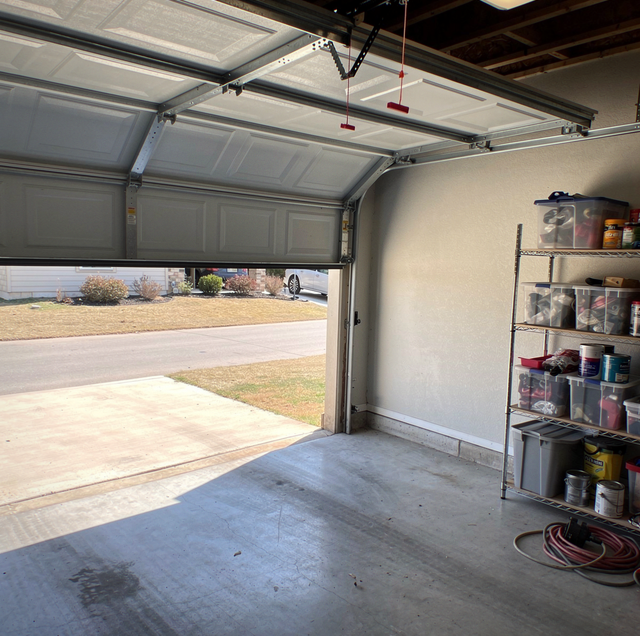
The same gap, in the same place, on every cycle. That is the most useful fact about a garage door that stops before it reaches the floor, and it is the fact most likely to get skipped on the way to guessing at a cause. A door fighting an obstruction would halt in a slightly different spot each time, because resistance is never identical twice.
A door that arrives at the identical point on Monday morning and again on Friday night is not fighting anything. It is executing an instruction. The opener holds a number in memory that represents fully closed; it counts to that number and shuts the motor off. What has gone wrong is that the number no longer describes this door in its current condition, and the gap at the bottom is the size of the disagreement.
A Travel Limit Is a Position the Opener Counts To
An opener has no way of sensing the floor. It cannot see the bottom section land, and nothing in the unit reports back that the door is down. What it has instead is a pair of stored values, one for the closed position and one for the open position, established when the unit was installed. Those values were set against the door as it stood on that particular day, in that particular opening, with whatever hardware it had at the time.
On each subsequent cycle, the opener runs the motor and counts. When the count matches the stored closed value, it cuts power, and the door stays wherever that count left it. If the stored value is short of what the door needs to reach the floor, the door stops above the floor and will remain in that position every cycle until the stored value is re-established.
A door that stops short and stays put has reached a limit, and the opener considers that cycle finished. A door that stops short and then travels back up has usually had a different rule fire: resistance the opener reads as an obstruction, or a safety input ordering it back open. A close limit set short can trigger that same reversal on its own, when the door meets the floor before the stored position is reached, so a short reversal does not by itself rule out a travel problem.
Run the door three times and compare where it halts. A gap identical on all three points at a stored value. A gap that moves between cycles points at something variable in the door's travel instead.
The Door Has Changed, and the Number Has Not
Everything about that stored closed position assumes the door and the floor sit where they sat on install day. Several ordinary things move them, and none of them touch the opener at all.
A replaced bottom seal: The weatherstrip along the bottom of the door is part of the dimension the stored value was set against. Fit a thinner or shallower profile than the original and the door now has to travel farther before it meets the floor. The count runs out before that extra distance is covered.
A floor that has dropped: Concrete moves with the soil beneath it. A slab that has settled at the door line, even by an amount you would not notice walking across it, has lengthened the trip the bottom section makes.
A door sitting differently in its opening: A sagging header, track brackets that were loosened and re-set, a replaced bottom section of a different height, or an old door swapped for a new one on existing tracks. Each of those changes affects where the door hangs relative to the floor while leaving the stored number untouched.
The Counting Mechanism Loses Its Reference
The count itself can go wrong even when the door has not moved an inch out of position. Older openers ended travel with a mechanical switch, and newer ones count electronically instead, tracking drive revolutions rather than a fixed point. Wear on the older style, or a dropped count on the newer one, changes where that stop lands, even though the door's own position never moved.
Anything that changes the relationship between drive revolutions and door movement has the same effect. Chain retensioning is normal maintenance and worth doing, but it shifts the trolley's position relative to the count, which is why travel is confirmed afterward. Slippage anywhere in the drive train means revolutions turn without the door covering the matching distance.
A Power Interruption Cleared or Corrupted What Was Stored
Stored travel lives in memory on the logic board, and memory is only as reliable as the power feeding it. An outage, a tripped breaker, or a voltage dip in the middle of a cycle can leave that memory in a different state than it was in.
Some units come back with their values intact and behave as though nothing happened. Others come back holding a default value that was never set against this door, or a value that was partway through being written when the supply dropped. The tell is timing. The door was closing correctly, power was interrupted, and the very first cycle afterward stopped short and has stopped in that same place ever since.
That sequence does not make the board faulty.
Wear Has Moved Where the Door Comes to Rest
Rollers wear at the stem and in the wheel. Hinge knuckles elongate around their pins. Track fasteners work loose, letting a section of track shift a little out of line. Each of those is small on its own, and a residential door carries a lot of them.
Added together across every hinge and roller on the door, that wear changes how the section stack sits at any given point in its travel. The stored count has not moved. The door's real closed position has. Lift cables and cable drums belong on this list as well, since a cable seated differently on its drum, or a drum that has crept on the shaft, changes how far the door drops for a given amount of drive. That hardware stays under load whether the door is up or down, and it is not something to handle, test, or adjust.
A door stopped short of the floor is not closed. The gap admits animals and hands, and the door is still hanging on its counterbalance, so pulling or pushing it down by hand is not a fix and is not safe.
Force Has Been Turned Up to Push Through a Short Limit
Force and travel are separate stored settings that meet at the end of every cycle. Travel decides where the opener intends to stop, and force, already covered as its own setting, is what lets the door push through a limit that no longer matches its real closed position.
When someone raises the close force so the door will drive down past a stored value that was already short, the door may well reach the floor again. Two faults are now stacked. The travel value still does not match the door, and the opener is pushing harder than this door requires, which eats the margin it relies on to tell a real obstruction from ordinary resistance. The second fault hides the first, and the door looks fixed right up until something is under it.
Re-establishing travel is a technician adjustment and is made against a door that has already been mechanically checked, because setting a stored value on a door that is not moving freely locks the existing fault into the number. Force settings drifting on their own, a door that only moves while the button is held, a door that reverses the instant it touches the floor, and a door that binds partway through its run are separate faults, each with its own diagnostic path.
A Repeatable Stop and an Inconsistent One Point in Different Directions
A stored number cannot be right on some cycles and wrong on others. That is the whole value of repeatability as evidence. When the door halts at the same height every time, whatever is deciding that height is fixed: a stored value, a switch that throws at a set point, or a hard mechanical reference the door keeps reaching, such as debris packed along the door line or an object left standing in its path.
A stop position that wanders is reporting something else entirely. Variable resistance responds to conditions, not to a setting. A door that stops higher on cold mornings and lower on warm afternoons is describing stiffened lubricant and seals, not a corrupted memory. A door that halts at a different height on nearly every cycle is describing something intermittent, whether that is a signal dropping in and out or a section catching in one part of the track and clearing in another.
There is a third pattern worth separating from both. A stop point that shifts a little at a time over weeks or months, always in the same direction, usually means something dimensional is changing while the stored number holds steady: hardware wearing out, a floor settling, a door working its way out of position. Random variation and steady migration are not the same report, and the difference is visible from nothing more than paying attention to where the door lands.
Frequently Asked Questions
Travel is stored as two independent values, one for the opening direction and one for the closing direction. A door can hold a perfectly good open value while its closed value has drifted, so full travel one way and a short stop the other way is an ordinary combination. It tells you the fault sits in the closing value rather than in anything shared by both directions.
They do, and they track position from a different reference. A wall-mounted unit sits beside the torsion shaft and drives it directly, rather than pulling a trolley along a rail, so it reads the door position from the shaft's rotation. The symptom looks identical from inside the garage, but what the opener is counting is different.
Battery backup is offered on DC-motor models, and whether a particular opener includes it depends on the model tier rather than on the motor type alone. A unit running on backup stays powered straight through an outage, so its stored travel is never interrupted in the first place. It does nothing about a stored value that has drifted for any of the mechanical reasons above.
It is the same category at the opposite end of the run. If the stored open value exceeds the door's actual open travel, the opener keeps driving after the top roller has already hit the curved section of the track, and the motor labors against a door with nowhere left to go. Strain at the top of the cycle is worth reporting quickly, because it puts load on the top section and its hardware.
It could, if the pattern moves with humidity instead of staying fixed. Wood expands and contracts with moisture in a way steel and aluminum doors do not, so a wood section's actual size shifts across the seasons even though the stored travel value never does. A gap that opens in a dry stretch and closes again in a humid one describes the door's material, not a fault in the opener. A stop that holds at the same height regardless of the weather still points to a stored value.
A new install includes establishing travel against the door as it stands on installation day, so the stop position will match the door again immediately afterward. If the reason the old value stopped matching was a change in the door or its hardware, that change is still present, and the new unit is simply setting a fresh number against a door that still has the same condition. Sorting the door first is what makes either opener behave.
Have the travel re-established against the door as it stands now, after the hardware itself has been checked — a stored position that matches the door closes it fully on every cycle without asking the opener for extra force. Arnold's Garage Door & Gates serves Fort Worth, Alvarado, and the DFW metroplex. Call Arnold: 682-337-7220.
