
Garage Door Torsion Tube Wear: Why New Springs Die Early
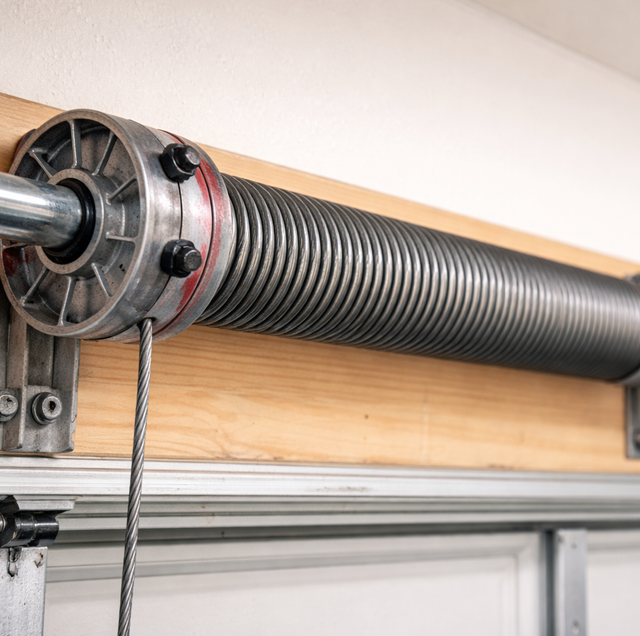
Stand off to one side of the opening, press the button, and watch the steel bar spanning the header. It turns as the door climbs, roughly one rotation per foot of travel, with the springs wrapped around it turning too. On most doors it spins like a driveshaft and never asks for attention. On some, the middle of it rises and falls with every rotation, or a coil ticks against it at the same point in each turn.
That bar is the torsion tube, sometimes called the torsion shaft. It has no moving parts and gets replaced so rarely that most homeowners never learn it is there. It is also the surface every torsion spring lives against for its whole working life, which starts to matter once a house is on its third set of springs.
What the Torsion Tube Does While the Spring Works
A torsion spring never touches the door. Its inner end anchors to a stationary cone bolted to the center bracket above the opening, and its outer end clamps to the tube via a winding cone secured with set screws. The torque it stores pushes against that bracket at one end and turns the tube at the other, where a grooved cable drum spools the lift cable raising each bottom corner of the door.
The tube has a second job nobody names. A spring body is a long, heavy coil supported only at its two cones, so it sags onto the tube under its own weight and rests there. As the door closes and the spring winds tighter, the body lengthens, and the coil diameter draws down a little, closing that small gap further. Each cycle slides the resting coil along the steel, then back.
On a smooth tube, a quiet slide. Give the coil something rough and the picture changes.
Why a Rough Tube Reaches the Spring at Its Weakest Point
Spring wire fails from the surface inward. A fatigue crack starts at a defect too small to see and grows with every cycle until the steel, still carrying the load, gives up. The awkward part is which surface takes that abuse. For a coiled spring, the curvature itself increases the calculated stress on the inner face of the wire, which is also the face that lies against the tube. Damage delivered at that spot lands where the steel can least afford a notch.
A tube coated in rust scale is an abrasive. So is a burr raised around a set screw dimple, or a ridge of corrosion under the strip the coil rests on. The wire's inner coating wears through, bare steel starts collecting moisture, and the pitting that follows is the crack starter the spring was built to avoid. A cycle rating assumes clean conditions; this spring is being sanded on a schedule.
A tube that visibly wobbles can let a cable drum creep on its set screws, and a drum that slips pays cable out on one side without warning. Keep people and vehicles clear of the opening until it is checked.
How a Bend Changes What the Coils Feel
A bow in the tube adds a second kind of load. The cones fix the spring at two points, so a spring stretched between them on a curved axis has to follow that curve, and the resting contact travels around the coil once per rotation. The wire gets a small bending flex laid over the twist it was designed for, several times per trip up the track.
The ends feel it too. A drum riding on a bent tube wobbles, so the point where the cable leaves the groove shifts through each rotation, and cable tension rises and falls with it, leaving the spring holding a load that pulses. The tube also orbits within its bearings, working the races and the fasteners that hold the end plates to the flag angle at each jamb.
None of this stops a door, which is why a bend usually goes unnoticed until the second or third spring.
Where the Damage on a Torsion Tube Comes From
Set screws: every cone and every drum grips the tube through set screws that bite into the steel. Residential tube is commonly a hollow one-inch section, thin enough that an overdriven screw dents the wall inward and raises a lip around the crater. Repositioning a drum leaves the old dimples behind while new ones go in beside them, and a screw re-seated into an old crater never bites properly.
Shock and weather: a spring letting go drops the door faster than the drums can pay cable out, and that jolt reaches the tube, as does a vehicle backing into the door. Corrosion works the slower angle: the coil lying along the top of the tube shields the steel underneath from drying, so scale forms where the sliding happens.
Mounting that was never in line: the end bearing plate at each jamb and the center bearing at the header have to sit on one axis. Set the center bracket a fraction high or low against those plates, and the tube gets pulled into a bow as the hardware comes tight, and it holds that bend as long as it stays up. On a wide opening running a two-piece tube and coupler, the same error kinks the span at the joint.
Whatever gets hung on it: bikes, hoses, and stray lumber end up leaning on a bar that crosses the opening at a convenient height. Steel already carrying a fully wound spring should carry nothing else.
Telling Tube Damage From a Spring That Simply Wore Out
Most broken springs are ordinary. A standard spring carries a rating near 10,000 cycles, which a busy two-car household spends down in roughly six years. It gives its warnings in the last stretch; it breaks, and both halves of a matched pair get there together with evenly aged coils.
A tube problem reads differently, and the wear pattern on the old spring is the clearest separator. A spring that lived its full life shows even coating loss and orange bloom spread across the undersides of the coils. A spring riding a rough tube shows something narrower instead: a bright polished stripe or a scored line on the inside face of the coils, in a band where the body rests, often with matching scarring on the tube itself.
Timing backs it up. A fresh set producing the same noises, hesitation, or early failure as the set it replaced is reporting something the swap never addressed.
Then there is what the assembly does while it runs. The tube turns about once per foot of door travel, so a scrape repeating six or seven times in one run is tied to shaft rotation, while a catch at the same height every time belongs to the track or a roller. A drum that looks like it breathes in and out as the door travels, or end bearing plate bolts that keep working loose, both point at a shaft turning off a straight line.
With the door fully open, the spring is nearly unwound, so a little more shaft sits bare between the coil and the drum. A straight-on phone photo of that stretch records scoring and rust before any parts get ordered.
What Gets Checked Above the Opening
Reading a tube properly means getting the tension off and sliding the hardware clear, since the sections hidden under the cones and drums are where set screw damage lives. The tube gets sighted for straightness, checked for scoring and scale along the strip the coil rests on, turned in its bearings for free movement, and measured against the end plates and center bearing for a common axis.
A garage door torsion tube is stock material, sold in standard lengths in one-inch and one-and-a-quarter-inch sizes, hollow or solid, and cut to the opening. Since the springs, cones, and drums all come off to change one, the tube gets replaced inside the same window a spring job already opens.
Where the Tube Fits in a Repeat Spring Failure
Sizing gets the attention on a spring job, and it deserves it. What a sizing conversation cannot see is the condition of the steel the new spring will rest against for its next several thousand cycles. Torsion tube wear rarely makes it onto a repair checklist, which is most of why it survives one spring job after another. A second early failure on the same shaft is the tell worth acting on, whether or not anyone thought to look at the tube the first time.
Frequently Asked Questions
Not reliably. A straightened tube still has to run true through three bearings on one axis, and a residual bow of a few thousandths, too small to see, is enough to reproduce the drum wobble that started the problem. New tube is stock material cut to length, and the springs and drums are already off for the work.
They fail in different ways. A hollow tube, the common residential choice, resists twist well for its weight while denting at set screws and collapsing where one was overdriven. A solid shaft shrugs off denting, and suits heavier or wider doors where twist along the span becomes real. Those doors also move up in diameter, from one inch to one and a quarter.
For a real answer, yes. What you can reasonably ask for afterward is what the report actually found: whether the tube ran true in the bearings, what the hidden spans under the drums and cones looked like, and whether anything got straightened, replaced, or just noted for next time.
It can, by way of the drums. A drum reclamped away from an old dimple sits a fraction off position, changing where the cable leaves the groove and how evenly the two sides take up. Add a wobble from a bend, and the cable takes a tension pulse every rotation, one of the ways a lift cable frays up at the drum, when frays usually start at the bottom bracket.
A light garage door lubricant on the exposed shaft between the coil and the drum, the same stretch worth photographing, cuts sliding friction where you can safely reach it. The strip under a fully wound coil is a technician's territory while the assembly is apart. Lubricant does nothing for a bend, a raised burr, or a dented wall regardless of where it's applied.
It adds one more joint to check. A wide opening sometimes runs two shaft sections joined by a sleeve coupler at the center bracket, and that coupler can pull the two halves slightly out of line the same way a misset bearing plate does, kinking the span right at the joint. It gets read for a common axis along with everything else, and it is one more place a set screw can dent the wall.
Ask for the torsion shaft to be inspected while the springs are off — hardware and parts work covering the tube, bearings, drums, and cables alongside broken spring repair. Arnold's Garage Door & Gates serves Fort Worth, Alvarado, and the DFW metroplex. Call Arnold: 682-337-7220.
