
WD-40 on Garage Door Springs: The Wrong Can to Reach For
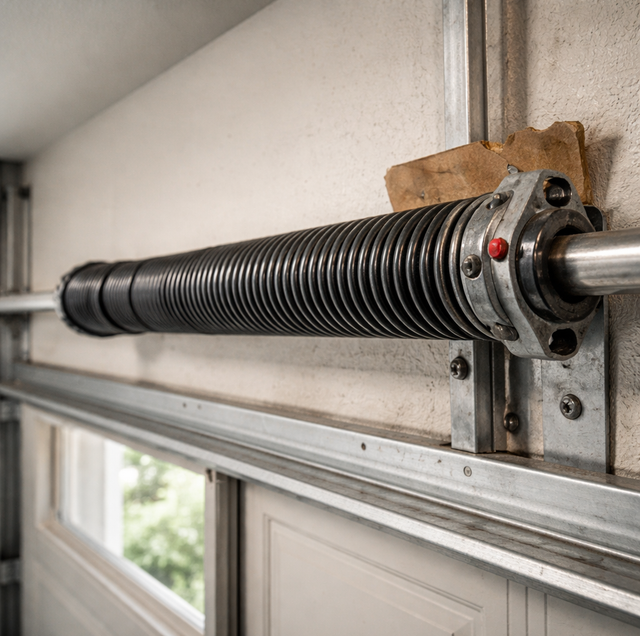
A garage door starts creaking on the way up, and the sound seems to come from the spring above the opening. That creak is worth pausing on before reaching for whatever is closest, because it is often the first sign a spring is fatiguing, not just dry. Plenty of homeowners reach for the multi-purpose can on the shelf anyway, give the coils one pass with the red straw, and the creak stops.
The creak really does stop. That is why this mistake keeps getting repeated, garage after garage, and why it can quiet a warning worth hearing. The immediate result looks like a fix. What follows over the next several months, and what got silenced along with the noise, is where the trouble sits.
What WD-40 Actually Is
The name gives away the design goal. WD stands for water displacement, and the product was built to push moisture off bare metal and slow corrosion on parts that had been sitting wet. Everything it does well follows from that. It creeps into tight gaps, loosens the bond between rust and steel, frees seized threads, and floats grime out of places a rag cannot reach.
Most of what leaves the nozzle is a light solvent with a small amount of thin oil dissolved into it. The solvent gives the spray its penetrating properties, thinning the mix enough for it to wick into a joint by capillary action. Then the solvent does what solvents do. It flashes off over the following hours and days, leaving a very thin film of light oil behind, thinner than anything carrying real load can use for long.
That makes the product a penetrant, a cleaner, and a short-term rust barrier. It does all three well. None of the three is lubrication in the sense a loaded, moving assembly needs.
Why That Combination Is Wrong for Springs
Applying a penetrant to a garage door spring sets three properties in motion in sequence.
The first is solvent action, which strips what was already there. A torsion or extension spring does not arrive at your house bare. Oil-tempered wire, the most common type, carries a light factory oil film meant to keep moisture off the steel through years in an unconditioned space. A solvent carrier sprayed over the coils thins that film, lifts it, and lets it run off with the excess. (Galvanized and powder-coated springs hold a bonded finish that a solvent does not strip the same way, which is part of why they tend to hold up better in a damp garage.) On oil-tempered wire, the coils end up with noticeably less of that factory film than they had before the can came out.
The second is evaporation, which takes away the replacement. The thin oil left after the carrier flashes off has too little body to stay on a part that flexes and rubs against itself with each cycle, so the remaining film tends to thin well ahead of the next scheduled maintenance pass.
The third is dust, and it does the quietest damage. Whatever residue lingers is tacky enough to hold everything floating in a working garage: floor grit, sawdust, pollen, the fine sand that rides in on tires. Coils shift against one another as the spring winds and unwinds through every open and close, so grit caught between them becomes a mild abrasive paste, dragged across the wire on every cycle.
That last point carries further than it sounds. Springs rarely give out because they got tired all at once. They fail through fatigue, and fatigue cracks begin at surface defects: a corrosion pit, a scratch, a worn spot in the coating. Anything that strips the protective layer and then grinds dust into the exposed steel works both ends of that process at once.
What Lubrication on a Spring Is Actually For
Two jobs, and homeowners usually know about only one.
The obvious job is friction. Coils sliding against each other produce the creak people notice, and a proper film cuts that contact noise while shaving a little drag off the door's travel.
The quieter job is protection. That film is a moisture barrier over steel living its whole life near an exterior wall, cycling through temperature swings. Keeping the barrier intact is what makes lubrication a maintenance item at all. A spring you cannot hear is not the goal. A spring whose surface remains sealed.
What the Right Product Looks Like
What belongs on the coils is a light spray sold specifically as a garage door lubricant. Two chemistries cover nearly all of them: silicone-based and lithium-based.
Silicone stays flexible when the garage gets cold, does not soften rubber or plastic, and tends to hold less dust. Lithium-based spray goes on light and sets into a slightly thicker white film that clings well to steel under load. Either is appropriate on spring coils, and both share the properties the penetrant lacks: enough body to stay where they land, no aggressive solvent needed to get there, and no stripping of the coating already on the wire.
Products at either extreme cause their own trouble. A heavy grease is too thick, holds far more dust than it repels, and stiffens in the cold. A penetrant is too thin and washes the surface clean. The correct product sits between the two, which is what the garage door label on the can is telling you.
How the Application Itself Goes Wrong
Even the right product gets used badly, and the usual error is volume. Every bit of film past a thin coat is extra surface for dust to stick to.
With the door closed, a light pass along the length of the spring is the whole job. No tools, no contact with the spring, nothing that puts force on any part of the assembly. Running the door through one full open-and-close cycle afterward lets the coils work the film across their contact faces. Excess that drips onto the floor, the door face, or the cable drums is wasted product doing harm.
Spray only, never touch. A wound torsion spring can hold hundreds of pounds of tension, and lubricating it never requires a tool or a hand on the coils. Stop and call a technician if a coil shows a gap.
Hold a piece of cardboard behind the spring while you spray. It catches overspray that would otherwise land on the wall and the opener rail, and it keeps the coat lighter because you are not compensating for what missed.
Where the Same Mistake Shows Up Elsewhere
Springs are the main event, but the wrong-can habit spreads through the rest of the door.
Hinges take lubricant precisely at the pivot points, where the pin turns inside the barrel. Rollers take it at the stem bearing; lubricant on the wheel itself just attracts grit and can cause it to skid on the track. Sealed nylon rollers often need nothing at all.
The track is the one place where nothing belongs. It is a guide surface, and the rollers are supposed to roll along it. Lubricant in the track collects grit, transfers onto the wheels, and encourages them to skid, wearing flat spots and loading the roller stems sideways. A wipe with a dry cloth is the correct maintenance for a track. A penetrant sprayed down its length is the most common version of this whole mistake.
Where This Fits in Routine Maintenance
Lubrication is one line item on a maintenance visit, and the one a homeowner can reasonably carry between visits with the right can in hand. The rest of a tune-up sits outside that: balance across the door's travel, cable wind on the drums, hardware torque, roller and bearing wear, safety reverse response.
The lubricant question is still worth getting right on its own, because it runs continuously between service calls. A spring, when treated correctly, reaches its rated cycle life under the conditions the manufacturer assumed. A spring wiped clean by a penetrant every few months spends those years working with a bare, dusty surface.
Frequently Asked Questions
Twice a year suits most residential doors, timed to the seasonal swings. A door that cycles many times a day, like the one serving as a household's main entry, benefits from a third pass. If the coils still look slightly wet from last time, leave them alone.
No, and there is nothing to undo urgently. Wipe the coils with a dry cloth to lift the residue and whatever dust it has collected, then apply a proper garage door lubricant in a light pass. The concern with this product is repetition over years, not a single use. What matters is that the next several applications come from the right can.
This is where the answer changes, and it surprises people. A chain drive opener's chain and the rail it rides on want a heavier product than the springs do, typically a white lithium grease or a lubricant sold for opener rails, applied where the trolley travels. A light silicone spray flings off a moving chain and leaves the contact surface dry. Belt drive openers are the opposite case: the belt gets nothing, ever, because lubricant on a belt causes slip and degrades the material.
It rarely harms surfaces outright, but it causes two specific problems. Silicone repels paint, so any surface it coats will reject touch-up paint later with fish-eye craters until it is thoroughly cleaned. And overspray reaching the photo-eye lenses near the floor leaves a film that dust adheres to, which can weaken the beam enough to cause the door to reverse for no visible reason. If a door starts refusing to close in the days after a lubrication pass, clean those sensor lenses first.
For one part of the door, yes. Graphite and dry film powders are made for locks and cylinders, where oil would attract dust and gum the pins, so the keyed lock on a garage door handle is a fair place for them. On spring coils, they are the wrong tool, because a dry powder gives you no moisture barrier and nothing sticky enough to stay on a part that flexes. The powder works loose, blows out, and leaves the steel exposed.
That is the opposite error, and it is nearly as common. A grease built for a chain or a cable is thick enough that dust and grit stick to it and stay there, and it stiffens noticeably in cold weather, adding drag right where the spring works hardest. It does not need to be stripped in a panic; a light garage door lubricant sprayed over a light dust of old grease still helps, though wiping the heaviest buildup off with a dry cloth first gives the new product somewhere clean to land.
Book a maintenance tune-up that includes proper lubrication — a technician treats springs, hinges, rollers, and the opener rail with the right product for each, then checks balance, cable wind, and safety reverse in the same visit. Arnold's Garage Door & Gates serves Fort Worth, Alvarado, and the DFW metroplex. Call Arnold: 682-337-7220.
