
Residential vs. Commercial Garage Door Springs: The Cycle Gap
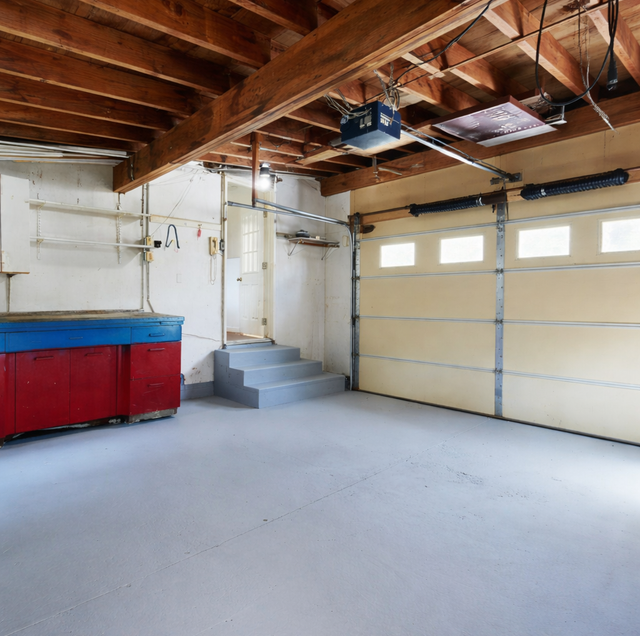
An RV bay tall enough to swallow a fifth-wheel. A shop door that shares a wall with the house door but nothing else about how it's built. A service bay that runs a dozen times before lunch. None of these are quite a house door, and none are quite what most people picture when they hear "commercial."
Size is the obvious difference between a residential door and a true commercial one. It is not the biggest factor in choosing the spring. What decides that is how many times each door is expected to move before the steel above it is finished.
Cycle Count Is the Line Between the Two Categories
One cycle is one trip up and one trip back down. That is the unit every torsion spring is rated in, and it is what separates the residential shelf from the commercial shelf.
Standard residential stock is rated at 10,000 cycles, spent down slowly over years of ordinary household pace, which is why most people meet a spring failure once or twice in the time they own a home.
Now hang that same spring above a bay at a service shop. A truck comes in, the door runs. It goes out, it runs again. Add a parts delivery, a customer pickup, a technician moving equipment to the lot, and twenty or thirty cycles in a single working day is unremarkable. At that pace, a 10,000-cycle spring is used up inside a year, and the cables, drums, and operator that ran alongside it aged the same year.
Commercial spring stock begins where residential stock ends. Ratings run into the tens of thousands of cycles, with higher tiers available for doors in near-constant motion. The alloy is much the same oil-tempered or galvanized spring wire found on a house door. What changes is the geometry.
What a Higher Cycle Rating Is Actually Built From
Cycle life comes from how hard each individual coil is twisted when the spring is wound. Every coil takes a share of the total winding, and the closer that share sits to the wire's limit, the sooner a fatigue crack starts walking around the coil.
Spread the same winding across more coils and each one works more easily. That is the whole trick. A spring rated several times higher than standard, sized for the same door, is longer in the body and usually built in a different wire diameter, chosen so it still delivers the same torque at the same turn count.
This settles a question that comes up on service calls. Cycle rating cannot be added to a spring already on the shaft by winding it differently. The rating was set by the wire, and the coil count before the spring left the coiling machine.
Duty Classification Sorts a Commercial Door Before Any Spring Is Picked
Manufacturers publish commercial sectional doors in duty classes keyed to expected daily traffic. A light class covers a bay that opens a few times a shift. Heavy duty covers a door that barely stops moving.
That class does more than pick a spring. It drives section gauge, strut count, hinge gauge, roller grade, track weight, and the counterbalance together, because all of those parts see the same traffic. Residential doors carry no equivalent tier. Stock residential springs assume household use, which works fine right up until a door stops being used like a household door.
Width and Weight Change the Torque the Shaft Has to Carry
A residential double door runs roughly 150 to 250 pounds and a single around 100 to 150. Commercial bays are wider, often taller, built in heavier gauge steel with struts on every section, and they leave those bands behind quickly.
The spring answers that weight as torque, delivered through the shaft to a drum at each end. Torque is what a torsion tube must transmit along its full length without twisting so much that one end lags behind the other. Commercial width is where that limit shows up first: a shaft sized for a house door gives up too much twist between the center bracket and the far drum on a wide commercial opening, and the two sides stop lifting together.
Commercial work steps up to a larger shaft for that reason, with 1-1/4 inch the common size, moving to a solid shaft on the heaviest doors. End bearing plates and the center bearing bracket get heavier to match. Wide commercial doors also routinely run three or four springs on one shaft, more coils than the one or two a house door uses, since a shaft that long has room for it and the torque needed rises past what two coils can deliver at all.
Measure the torsion shaft before assuming anything about the hardware grade. A 1-inch tube and a 1-1/4-inch tube look identical from the floor, and the drums, couplers, and bearings that fit one will not fit the other.
Track Gauge and Rolling Hardware Step Up Alongside the Spring
Track is the clearest tell in the assembly. Residential doors run 2-inch track. Commercial doors run 3-inch track in heavier steel, mounted on brackets bolted through a continuous angle down each jamb, which carries the extra load into the building framing.
Rollers follow, with a longer stem, a sealed ball bearing, and often a steel tire where nylon would do on a house door. Hinges go up in gauge at every joint, and lift cables go up in diameter, which means drums are grooved for the larger cable. Any one of those left at residential grade becomes the part that wears out first while the spring still looks fine.
Rolling Steel Doors Keep Their Springs Out of Sight
Not every commercial door is a sectional. A rolling steel door has no sections and no horizontal track. A curtain of interlocking slats coils onto a barrel above the opening, and the torsion springs live inside that barrel, on a shaft running through it.
The counterbalance principle is identical. The packaging differs, and that changes how the door gets serviced. There are no coils to inspect from a ladder, no visible gap announcing a spring has separated, and tension adjustment happens at the barrel's end wheel or bracket.
Springs inside a rolling steel barrel cannot be seen from the floor, so a weakening one shows up only in how the curtain moves. A curtain that runs down fast or catches on one side should stay closed until a technician checks it.
Where an Oversized Residential Door Actually Sits
Then there is the door that fits neither shelf cleanly. An RV bay tall enough to swallow a fifth-wheel. A shop door on a detached building.
Weight and width put a door like that squarely in commercial hardware territory. It wants 3-inch track, a larger shaft, heavier bearing plates, heavier hinges and rollers, and often a pair of springs where a homeowner expects one, with the torque required and the room above the opening settling which.
The traffic tells a different story entirely. An RV bay might open twice a month. A shop door might run four times on a weekend and sit still for a week.
The building does not set the spring. The load and the traffic do.
Those are two separate specifications, and collapsing them into one is where oversized doors get spec'd wrong. What grade of hardware carries this door's weight is one question. What cycle rating suits its traffic is another, and the answers need not come from the same category. An RV bay can correctly land on commercial structural hardware with a spring at an ordinary residential rating, because a door opened twice a month will never reach 10,000 cycles. A small bay on a self-storage building that opens twice a week is the same situation running the other direction.
One wrinkle is worth knowing on the low-traffic end: on a door that rarely runs, the coating on the wire matters more than the number on the cycle tag, since a spring can sit for years without ever spending down its rated cycles.
Why the Counterbalance Is Easiest to Get Right on Day One
A spring spec is simple to set correctly while a door is being ordered and awkward to revise afterward, because raising a cycle rating means a longer spring body, which needs clear shaft between the center bracket and the end bearing plate plus headroom to sit in. Once the door, track, and operator are installed, that room is whatever the original layout left behind. Neither of those two numbers changes because the building looks industrial. A shop door on a quiet property and a warehouse bay running all day can sit on the same floor plan and still need opposite answers above the opening.
Frequently Asked Questions
Sometimes, and the limits are physical. The winding and stationary cones are bored for a specific shaft diameter, so a cone bored for 1-1/4 inch will never seat on a 1-inch tube. Body length is the second limit, since a longer spring needs unobstructed shaft to occupy. Where both work out, it is a routine request.
Households that use the garage as the main entry into the house run well past what a light-use door sees, and each extra driver in the household adds cycles on top of that. Meanwhile, a detached shop door on the same property might sit for weeks between openings, which is how two doors installed the same week end up on very different spring timelines despite starting even.
They carry duty ratings of their own, usually in cycles per hour and cycles per day, and a trolley, jackshaft, or hoist operator gets selected against the same traffic figure the spring is. Correct counterbalance is what lets that rating hold up, since an operator dragging an under-sprung door spends its duty allowance early. Many commercial operators are also offered in three-phase versions with no residential equivalent.
Look at the end bearing plate where the shaft passes through the jamb before reaching for a tape measure. Residential plates are a light stamping on a two-bolt pattern, while commercial plates are thicker, use a larger pattern, and often carry a greaseable bearing. Struts across the inside face of every section point in the same direction.
No, and that surprises people who expect an upgrade to feel like one. A higher-rated spring for the same door produces the same torque the standard one did, at the same turn count, so the door lifts and lands identically on day one. What changes are only visible in a shaft measurement: the upgraded spring needs a clearer length to sit in, which is why it's a decision made when the door is ordered, before the shaft and headroom are already spoken for.
Partly. Track, rollers, hinges, bearing plates, shaft, and springs can all be changed on a door already hanging, provided headroom and side room allow, and that is a common fix on an oversized door under-specified at install. The sections are the exception. A residential-gauge panel stays what it is, and struts can stiffen a wide section but add weight, which puts the counterbalance back on the list.
Have a commercial bay or an oversized residential door sized to its real weight and its real traffic — commercial garage door service, broken spring repair, and hardware and parts matched to the door's duty. Arnold's Garage Door & Gates serves Fort Worth, Alvarado, and the DFW metroplex. Call Arnold: 682-337-7220.
