
One-Car vs. Two-Car Garage Doors: Why Spring Repairs Differ
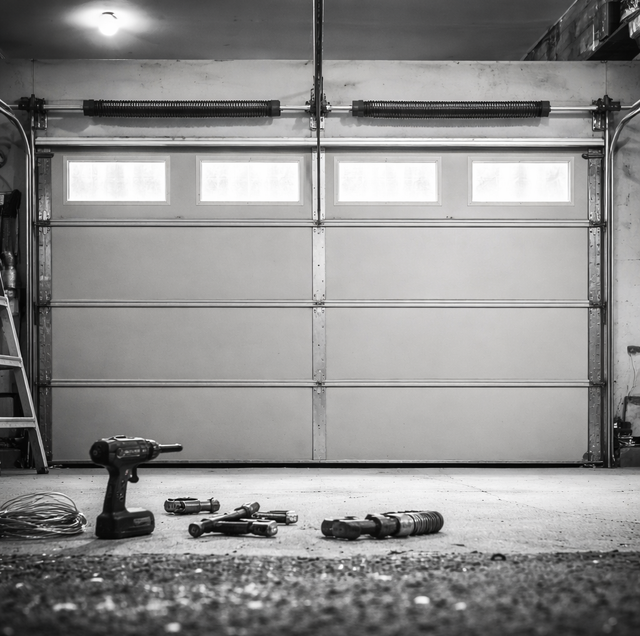
Plenty of houses have both doors on one wall: a 16-foot double for the cars and an 8- or 9-foot single at the end for the truck, the mower, or a workbench. One garage, one header, two separate machines.
When a spring lets go behind one of them, the natural assumption is that the other door is the same repair, just smaller. It usually is not, and the reasons are worth knowing before a service call goes out.
What the Extra Width Adds in Pounds and Hardware
A single-car door usually spans 8 or 9 feet. A double spans 16 to 18. Both are commonly 7 feet tall, so nearly the whole difference lands in width: twice the steel skin, twice the length of every section, twice the run of hardware across the opening.
The weights follow. A single-car steel door usually weighs 100 to 150 pounds; a double, 150 to 250. Those bands overlap at the edges, so a light single-layer double can land close to a heavy insulated single, and how a door is built tells you more than how wide it is.
Width changes the door as a structure too. Each section on a double spans the full opening with nothing holding up the middle, while the opener arm pulls at one point near the center of the top section. That is why wide doors get intermediate hinges, and why most factory doubles get a strut across the top section.
One Spring, Two Springs, and Where They Sit on the Shaft
Above the opening runs a steel shaft the width of the door, a cable drum at each end and a center bearing plate lagged into the header at the middle. Torsion springs slide onto that shaft: stationary cones bolted to the center bracket, winding cones out toward the ends.
A single-spring door puts one spring on one side of that center bracket, and the shaft runs bare from the bracket to the opposite bearing. That empty stretch gets mistaken for a spring that fell off more often than you would expect. A two-spring door carries one coil on each side. Both coils feed torque into the same shaft together, and the shaft hands that combined torque to both drums.
The count follows the door's weight, not its width. Splitting the load across two springs keeps each coil within the wire diameter and body length that fit above the opening. That is why a 16-foot door usually gets a pair, and why the pattern bends both ways: some doubles ship with one heavier spring, and some heavy singles, solid wood or full-view glass, get two.
Why a Failure Reads Differently on Each Door
On a single-spring door, a break is binary. The one spring carrying the whole door fractures, the counterbalance drops to zero, and the door becomes dead weight. The opener meets all of it in the first inch, strains, trips its up-force limit, and quits. Nothing moves. The diagnosis takes one look at the coil above the opening, where a break leaves a clean gap of an inch or two.
On a two-spring door, one break leaves the survivor still wound and still feeding torque into the shaft. That spring was sized to carry about half the door, so the door is now short roughly half the torque it needs on every cycle. The opener meets far more load than it was built to move and usually trips its force limit inside the first foot or two. If it does drag the door up, it fights the whole trip, and the door will not hold position at any height.
That in-between response is the trap. A door that will not move gets a phone call the same morning. A door that groans, lurches, and climbs partway gets tried again, and again, and every attempt routes full door weight through the opener's drive gear, the top section, the lift cables, and the rollers.
A door short one spring also comes down differently: with the trolley released, it can close much faster than a balanced door, which is why a half-sprung double gets secured before anyone works near it.
The diagnosis has more branches on the wider door. Both coils get checked, since a break can sit on the side you never see. A door that feels heavy with both coils intact points somewhere else: a pair near the end of its cycle life, a set undersized from the day it went up, or a cable that slipped a wrap on its drum.
What Actually Changes in the Repair
Part of the job is identical on both doors. Every residential sectional door, at any width, runs two cable drums, two lift cables, two end bearing plates, and one center bearing. Turn count is set by door height and drum size, so a 16-foot door and a 9-foot door of the same height and the same drums get wound the same number of turns.
Stand inside with the door closed and look at the shaft's center. One coil with bare shaft to one bearing means a single spring. A coil on each side of the bracket means a pair, worth knowing before parts get ordered.
The differences show up in sizing and handling. One spring covering a whole door delivers that door's entire counterbalance torque alone, which means heavier wire, a longer body, or both, next to either spring of a matched pair. A pair mirrors itself, one left-wind and one right-wind, and both go up together even when only one broke, since the survivor carries the same age and cycle count.
Wide doors also change what sits above the opening. The shaft may arrive in two pieces joined by a coupler, and the center bracket that holds the stationary ends of both springs absorbs the entire counterbalance reaction at a single patch of header framing. Both get checked while the springs are off.
When a Two-Car Garage Has Two Single Doors
Plenty of two-car garages carry two single doors side by side, each in its own opening with a post between them. That layout is two complete counterbalance systems: two shafts, two sets of springs, four drums, four cables, and usually two openers. Nothing is shared except the wall.
The consequence is timing. Springs are rated in cycles, and cycles land per door. The bay you back out of every morning runs up its count while the second door sits for weeks, so the two rarely need springs in the same year. A failure also leaves the garage half usable, which is why these doors go longer before anyone calls. The one sitting still is under load the whole time, since a closed door holds its springs fully wound. What it escapes is the cycling that fatigues the steel.
Two Doors on One Wall, Two Different Service Calls
What sorts this out before anyone touches the door is the same handful of details every time: how wide the opening is, how many coils sit above it, and whether the door moves at all when the button gets pressed. Those separate a dead single-spring door from a half-counterbalanced double, and they decide what comes off the truck.
Worth mentioning on that call: whether the door has changed since it went up. A heavier replacement section, a glass insert package, or a new door on the original hardware all move the weight the springs were picked for, and the count that suited the old door may change with it.
Frequently Asked Questions
Two setups hide them. Where headroom is tight, the torsion assembly can sit at the rear of the horizontal tracks near the back wall, so nothing shows above the door. Some doors enclose their springs inside a sealed torsion tube, where no coil is visible at all. Extension springs run alongside the horizontal tracks near the ceiling.
No. The surviving spring only delivers the torque it was wound for; it cannot cover what the broken one dropped. It also carries the same age and cycle count as the one that just failed, since both increased together and ran through every cycle together. That shared history is why a rebuild sends both springs out, the survivor included.
No. Rollers ride at the ends of each section, two per section, so roller count follows door height. Width adds intermediate hinges across the middle of each section, and each one is another wear point the springs work against.
No. Each door needs its own operator on its own rail, with its own travel and force settings. The control side can be shared: a multi-button remote or an in-car transmitter can be programmed to run both doors, while each opener keeps its own wall control.
Mostly in handling. A 16-foot section is long and awkward, and it takes two people to carry and set it without racking the panel or denting an edge on the doorframe. Once it is in the stack, the hinges, rollers, and any strut still have to be returned to their original positions on the replacement.
Not necessarily. A single heavier spring is a legitimate factory configuration on a lighter double, and what matters is whether its torque matches the door's measured weight. A rebuild is the moment to revisit it: a matched pair spreads the same load across two smaller coils, and it takes shaft length on the empty side of the center bracket.
Have the spring configuration on your door identified before parts get ordered — a technician weighs the door, matches a single spring or a pair to it, and checks the cables, drums, bearings, and hinges on the same visit. Arnold's Garage Door & Gates serves Fort Worth, Alvarado, and the DFW metroplex. Call Arnold: 682-337-7220.
