
Garage Door Opener for Detached Garage — What Distance Changes
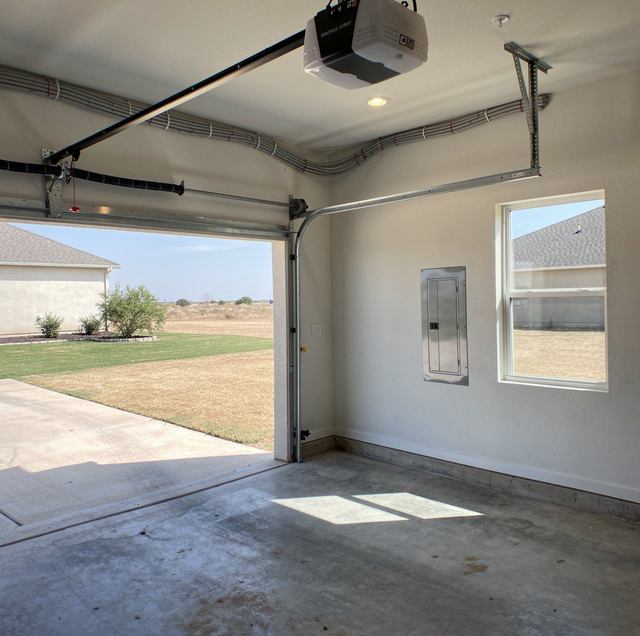
The stretch of ground between a house and a detached garage isn't just distance you cross twice a day. That separate building carries its own roof, draws power over its own feed, and sits exposed to weather the attached garage next to the kitchen never feels. Specifying a garage door opener for a detached garage means working through a short list of questions an attached-garage owner never has to ask, and the order you work through them in matters as much as the brand you land on.
Separation is what puts each of those questions in play. Start with the electrical supply entering the building, because every other item on the list assumes the opener already has a permanent circuit dedicated to it.
The Building's Own Electrical Supply Sets the First Limit
A detached garage is fed in one of two ways: a subpanel of its own, or a single branch circuit run from the house panel, sized decades ago for a bulb and one receptacle. The opener wants a permanent outlet at the ceiling near the header rather than a cord run across the floor or looped over a rafter. What matters more for a separate structure is whether the feed and the panel behind it have anything left to give.
Look at what else in the building already draws. A chest freezer cycling on its own schedule, an air compressor that pulls hard the moment its pressure switch closes, a table saw or a welder on the bench, a second refrigerator, and increasingly an EV charger, all sit on the same supply the opener is about to join. A detached building tends to accumulate exactly those loads, because it is where they get put. The opener's own draw is brief and modest by comparison, but it lands on top of whatever is already running, and the question an electrician answers is whether the building's total still leaves headroom.
Distance is the second half of that. The feed to a detached garage may run a long way from the house panel, often underground, and voltage drop over that length is a calculation an electrician makes before sizing conductors, not something the opener's spec sheet accounts for. A motor that sees sagging voltage at the instant it starts a heavy door behaves differently from the same motor on a short run. Worth asking too: Does the building have its own disconnect? A subpanel with a means of shutting the whole structure down at the building itself is a different service situation from a garage whose only kill switch is a breaker back in the house.
Running a garage door opener off an extension cord or a temporary drop cord is a genuine fire risk. The motor's startup draw is exactly the kind of load an extension cord isn't rated to carry continuously.
Signal Has to Cross the Same Distance Power Does
A garage door opener listens for two different kinds of signal, and distance treats them differently. The remote clipped to a visor or the keypad mounted by the man-door talks to the opener directly, unit to unit, on a radio frequency designed to reach across an open stretch of yard and through a couple of exterior walls. A phone app talking to a smart opener asks for something else entirely: it needs the opener to be on a home network, which depends on what your router's wifi actually covers, not on what a dedicated remote can reach.
A smart opener that can't see the network is one you can only control from inside the garage, standing right next to it, which defeats most of the reason to buy one. Extending coverage to a detached structure generally means either running a hardwired connection to the building or adding a wireless access point or repeater that gives the opener's radio something to talk to at that distance. That's a decision for whoever sets up the network, separate from anything about the opener's own hardware.
Arriving matters as much as leaving. Anyone who reaches a detached garage without a paired remote needs an entry keypad at the door that works whether or not a phone can find the network from the driveway, which is why keypad reach gets checked from the spot people actually stand, not from the middle of the yard. If the building sits behind a gate, the gate operator's power and signal needs should be planned alongside the opener's rather than after it, since both draw from the same supply and compete for the same radio space.
An Unconditioned Building Swings Wider Than an Attached Garage
A garage attached to the house borrows some of its climate, sharing a wall or two with heated and cooled living space. A detached structure has none of that. It's exposed on every side, so its interior temperature tracks the outdoor swing far more closely, running colder on cold mornings and hotter on hot afternoons than an attached garage ever does.
Heat lands hardest on the control board. The logic board and its capacitors sit inside a plastic housing bolted at the highest point of the space, where hot air collects and lingers through an afternoon. Sustained high temperatures are harder on electronics than on the steel parts around them, and a board that spends its summers at the top of an unvented detached building is working in conditions the same board never sees in a garage with conditioned walls. A backup battery, if the opener carries one, is in the same spot and receives the same exposure, and heat shortens a sealed battery's usable life more than cycling does.
Cold works in the other direction on the same two components. A battery delivers less of its rated capacity when it's cold, so the outage reserve you were counting on is smallest on exactly the nights an ice storm is most likely to take the power down. Thickened drive lubricant also makes the first cycle of the morning heavier. Neither extreme rules out a detached installation, but this is the building where an opener's published operating range is worth reading instead of skipping.
Being Out of Sight Changes What Backup Power Is Worth
In an attached garage, a door left open is something you notice walking past the connecting door, or hearing the opener cycle at an odd hour. A detached garage doesn't offer that. It sits outside the normal sightlines of the house, so a door that failed to close, or one that someone simply left open, can stay that way for hours without anyone the wiser.
That changes the value of two features that are easy to treat as optional on an attached garage. Battery backup keeps the opener and its safety sensors working during a power outage, preventing the door from being left where it stopped mid-cycle. A door-position sensor reports the open or closed status to a phone or a wall console, eliminating the need to walk out to check. Neither one replaces looking, but both narrow the gap between something going wrong and you finding out about it.
Pair battery backup with a door-position sensor. During an outage, the opener still runs on its battery, and the sensor still reports open or closed, so a building you cannot see from the house doesn't go dark.
Settle the Electrical Question Before You Compare Models
Of the four distances a detached garage creates, three can be engineered around. Signal reach extends with a hardwired run or an access point. Temperature exposure narrows by choosing an opener rated for a wider operating range. Sight-line gaps close with battery backup and a position sensor.
The supply into the building is the one that binds. A panel with nothing left over, or a run long enough that the motor sees sagging voltage every time it starts, limits what can go on that wall no matter which model you like on paper. Door construction and motor sizing belong to a different set of questions, taken up on their own. Once the building's capacity and the length of its feed are settled facts rather than assumptions, comparing drive types and smart features is no longer guesswork.
Frequently Asked Questions
Most residential openers are mounted to the ceiling, with a rail running from the header back to a rear bracket, assuming there's clear ceiling space above the door track. Some detached garages, especially ones with open trusses or very little headroom, don't have that space. For those, a jackshaft unit bolts to the wall at the end of the torsion shaft and drives that shaft under power, sitting entirely in the space beside the door opening. It changes how the opener attaches to the building, but the power and signal questions already covered still apply once it's installed.
Multi-button remotes exist for exactly this situation, with each button paired to a separate opener's receiver, so one visor unit can operate both doors. It works cleanly when both openers come from the same brand family and the same rolling-code generation, since the remote and the receiver have to speak the same way. Mismatched brands or a much older receiver on one of the two buildings usually means carrying two remotes, or updating the older receiver so a single remote covers both.
Common residential garage doors range from about 10 feet by 10 feet to roughly 14 feet by 14 feet, and a detached structure built for a boat, an RV, or extra vehicle storage often falls at the larger end of that range. A bigger, heavier door asks more of the opener's motor and drive components. The power, signal, temperature, security, and access questions in this list apply the same way regardless of the door size on the building.
Opener motors come in AC and DC types, and battery backup is available across DC-motor models, though whether the battery ships with the unit or is added separately depends on the model tier rather than the motor type itself. DC motors also provide a soft start and stop, easing the motor into motion rather than snapping it straight to full speed, which puts less shock load on the drive system at each end of travel. An AC motor opener can still be a sound choice for a detached garage; it just means checking what backup options that particular model offers.
A detached garage sits on its own foundation and slab, which settles and shifts independently of the house, rather than moving with it as an attached garage's slab often does. That independent movement can nudge the photo-eye sensor brackets out of alignment sooner than you might expect on a garage that shares a foundation with the house, so it's worth checking whether both sensor lights are steady rather than blinking a little more often than you would otherwise. If one is out of alignment, that's a quick fix for a technician rather than something to force back into place yourself.
Entry keypads come in two forms. A wireless keypad runs on its own battery and talks to the opener's receiver the same way a remote does, which means it can be installed on a detached garage with zero wiring involved. A wired keypad instead requires a low-voltage cable run back to the opener's control board, which makes installing one the same kind of project as running power to the building in the first place. For a stand-alone structure without existing wiring, the wireless version is usually the one installed without opening a wall or running new cable.
A walk-through of the building answers the power, signal, and weather questions that a spec sheet can't — the supply, the feed length, and the exposure are all visible on-site before a model is chosen. Arnold's Garage Door & Gates serves Fort Worth, Alvarado, and the DFW metroplex. Call Arnold: 682-337-7220.
