
Property Management Garage Door Repair: What to Require
A work order queue rarely arrives in the order you would like. One tenant reports that the garage door will not lift. A second address has been waiting since Friday. An owner wants a clear account of what failed and why, and the maintenance tech at the property has already decided the opener is at fault.
Spring failures show up often enough across a portfolio that they stop being emergencies and start being a scheduling problem. The door is down, there may be a vehicle behind it, and the person who reported it does not own the building and is not the one a vendor needs to reach to get the job done. That split is what a vendor either handles cleanly or turns into your afternoon.
What Changes When the Caller Is Not the Person Living There
A homeowner calling about a broken spring is the person standing at the door and the person who decides. Split that single role across an owner, a tenant, and you, and a routine repair picks up a handoff at every step. The technician needs access to a garage the tenant controls. What failed and what it needs may have to be described to an owner who was never on site. And somebody has to tell the tenant when to expect a visit, then confirm it happened.
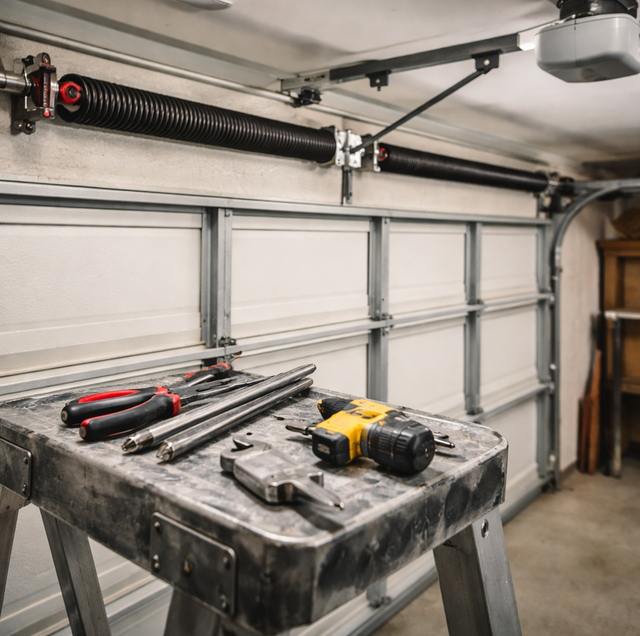
The mechanical work is unchanged: a broken torsion spring is measured, matched, replaced, and rebalanced against the door's weight. What changes is how many phone calls it takes. A vendor used to working with managers asks about access and reporting in one conversation. A vendor who does not will call you back for each.
A Work Order That Actually Describes the Repair
Almost every repair on a rental or association property has to be explained to someone who was never in the garage. That makes what gets written down about the job the working record of the whole visit.
A note reading "replace spring" tells an owner nothing and gives you nothing to compare against the next failure at another address. A useful one names the property and unit, identifies which door, states what failed, and specifies the replacement part by wire diameter, inside diameter, length, and cycle rating. Anything else found while the door is apart, like frayed cables or a failing bearing, belongs on the same record as a separate item, so it is clear what was found versus what was fixed.
What matters for your own files is coding. Tying each service record to the unit and to whatever work order number you supply keeps one property's history from blending into another's.
Access and Working Around Tenants
Access is the variable that turns a one-hour repair into a second trip. A detached garage with its own driveway is simple. An attached garage whose only interior entrance sits inside an occupied unit is not.
Before you dispatch anything, settle four things: whether the tenant needs to be home, whether a vehicle is trapped inside, what arrival window the tenant can actually offer, and who has the keys and codes. Then ask the vendor how they communicate. A text before arrival, a direct number the tenant can reach during the visit, and a message to you once the door is back in service covers most of what you would otherwise spend the day chasing. Deciding up front whether the technician can speak with the tenant directly saves you from relaying every message about a parked car yourself.
Response Expectations Across a Portfolio
Not every down door deserves the same urgency, and saying which kind you have gets you a more honest answer about timing. A door stuck open at an occupied unit is a security issue overnight and usually the first to move. A door stuck closed with a car behind it needs same-day attention. A door that is loud, slow, or rising crooked is still working and belongs on the regular schedule. Broken springs land in the middle two categories almost every time, since a snapped torsion spring leaves the door too heavy to lift by hand.
What you want is a realistic time window, a call if it slips, and after-hours availability for the nights a tenant cannot get a car out. A vendor who promises same-day for everything is telling you something about how they schedule, and it is not good news for the day you need them.
Keep on-site maintenance staff off torsion springs entirely. A wound spring holds enough stored energy to injure someone the moment a set screw is loosened, and this work belongs to a technician who does it regularly, not to general maintenance staff.
Recurring Failures and What the Pattern Is Telling You
Springs are rated in cycles, where one cycle is a full open plus a full close, and builder-grade springs commonly carry a rating near 10,000 cycles. A single-occupant rental may take many years to reach that. A unit with three drivers coming and going burns through the same spring far faster, which is why one address in a portfolio can seem to eat springs while identical doors nearby sit untouched.
When the same unit comes back a second or third time, only a few explanations are plausible, and each belongs on the work order. The spring may have been undersized for the door from the beginning. The door may be heavier than the original spec after a panel replacement or added insulation. Or the usage runs higher than a builder-grade spring was picked for, in which case a higher cycle-rated spring is the practical answer at that unit.
Turnover as the Natural Maintenance Window
The easiest garage door visit to schedule is the one nobody is waiting on. Between tenants, the unit is empty, there is no coordination to do, and a technician can take the opener off the door and check balance by hand without interrupting anyone's morning.
A balance check reveals the one thing a working door hides: whether the springs still match the weight they lift. A counterbalanced door stays put when stopped halfway. One that drifts down or climbs is reporting springs near the end of their useful life, which is a repair you can put on the calendar before it pages you. The same visit covers cables, drums, rollers, hinges, track alignment, opener force and travel settings, and a photo-eye reversal test.
Frequently Asked Questions
Almost always wear, and it is worth saying plainly since it comes up. A spring's cycle count is driven by how many times the door runs, not by how carefully anyone runs it. A heavy hand on the wall button does not meaningfully shorten a spring's life; the spring is sized for full cycles either way. What does move the needle is usage rate: a unit with several drivers coming and going wears through a builder-grade spring faster than a single-occupant unit does, which is a household-size question, not a tenant-behavior one.
That is worth flagging when you schedule, since it changes who needs to be present. A garage reached only through an interior door means someone with a key to the unit has to let the technician in, not just open the garage door from outside. Say this ahead of time instead of letting the technician discover it on arrival, since that is the difference between a scheduled visit and a wasted trip.
Sometimes, but not automatically. Two doors at the same address rarely share a spring size unless they were installed on the same day, so grouping them into one visit still means measuring each door separately rather than assuming one part fits both. What it does save is a second trip and a second scheduling round, which matters more on a property with limited access windows.
Ask that the spring specification and the reason for failure be written on the service record each visit, and keep those records sorted by unit rather than by date. Two service visits at one address showing the same wire size and the same failure mean the part was never matched to how that unit actually uses the door. That history is what turns a third repair into a decision to size the spring differently rather than repeat the same fix.
A photo from the tenant of the spring above the opening beats a paragraph of description, since it shows a gap in the coil, a single spring versus a pair, and often the hardware's overall condition. If a previous spring replacement happened at that unit, its recorded measurements get the correct part on the truck the first time, which matters most on an older property where nobody wrote the original spring size down anywhere else.
Scheduling runs the same way, and the mechanical work varies by equipment type. Common-area and shared-structure doors are frequently commercial roll-up or heavier sectional units with hardware unlike that of a residential door, and driveway gates run on operators that are serviced separately from anything overhead. Grouping common-area equipment with unit doors into one scheduled visit is usually the more efficient way to cover both.
Book garage door repair at a rental or association property — broken spring replacement, cable and off-track repair, opener service, and scheduled maintenance visits. Arnold's Garage Door & Gates serves Fort Worth, Alvarado, and the DFW metroplex. Call Arnold: 682-337-7220.
