
What Makes Garage Door Springs So Dangerous to Fix Yourself
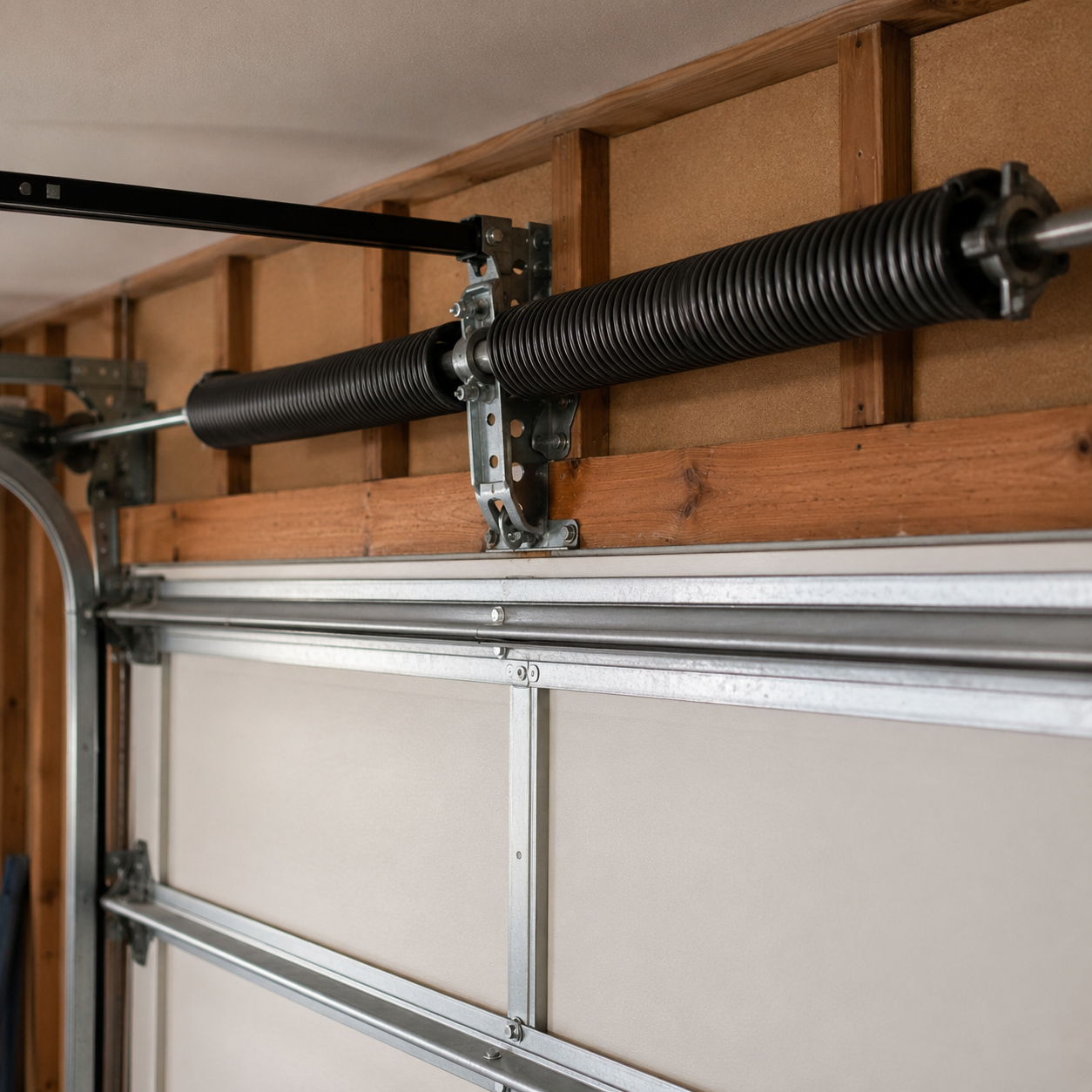
A garage door spring looks like something you could pick up at a hardware store: a coil of steel, the same basic shape as the spring in a screen door or a pen. That resemblance is exactly what gets people hurt. A garage door spring isn't a bigger version of a hardware-store part. It's a small piece of steel wound tight enough to store hundreds of pounds of mechanical force, and the difference between "spring" as most people picture it and "spring" as a technician sees it is the entire reason this one job stays strictly professional-only, even for homeowners who happily handle almost everything else around the house.
What's Actually Wound Above Your Door
Look at the horizontal metal shaft mounted above a standard garage door, and you'll see one or two thick coils sitting on it. Those are torsion springs, and they're the reason a door that weighs anywhere from about 130 pounds for a light single-car door up to somewhere in the 150-to-350-pound range for a heavier insulated double door feels close to weightless when you lift it by hand.
The mechanism is simple to describe and easy to underestimate. During installation, a technician winds that spring roughly seven and a half full turns on a standard 7-foot door, taking a quarter-turn at a time with a pair of steel winding bars, storing torque in the coil the way you'd store energy in a twisted rubber band, except scaled up to move a few hundred pounds of steel and glass. Once wound to the correct tension and locked to the shaft, the spring does almost all the lifting work every time the door opens. The opener motor barely has to help; its job is just to nudge an already-balanced door along its track.
That's also what makes the spring dangerous. All of that stored torque has nowhere to go until something releases it, in a controlled way when a technician winds it down deliberately, or in an uncontrolled way if the spring snaps, a winding cone slips, or a bar comes loose mid-turn. A spring that lets go while it's under full winding tension doesn't gently unwind. It releases instantly, and the two loose ends whip around the shaft with enough force to break bones, cause deep lacerations, or send nearby hardware, brackets, or the bar itself flying across the garage.
Why a Screwdriver Isn't a Winding Bar
Winding bars: Solid steel rods, sold or fitted specifically to seat into the winding cone's holes, long enough to give a technician real mechanical advantage and a wide swing radius to control the spring by hand, turn by turn. A screwdriver shaft is thinner, smoother, and shaped for driving a screw, not for holding several hundred pounds of rotational force against a coil that wants to spin the instant it's given the chance. Slip a screwdriver, a ratchet, or a pair of pliers into that cone and the tool can simply pop free, and when it does, the energy that was being controlled through it releases all at once with nothing to catch it.
This is also why technicians keep their body out of the plane the bars swing through, work the spring in small controlled increments rather than one big motion, and never step away mid-wind with the spring only partly tensioned. A spring at 60 percent of its wind is not 60 percent safer. It's still storing enough torque to hurt someone the moment it's disturbed.
Extension Springs Store the Same Energy, Differently
Not every garage door uses a torsion shaft. Some, especially older or lighter single-car doors, use extension springs instead: long coils mounted along the horizontal tracks on each side, above the point where the track curves. Instead of twisting, an extension spring stretches as the door closes, storing energy in tension along its length rather than in rotation around a shaft.
They fail differently than torsion springs, but the underlying danger is the same: stored energy with nowhere planned to go. A snapped extension spring can retract violently or, worse, come loose from its mounting and travel the length of the track like a slingshot. That's the reason extension-spring systems are supposed to run a safety cable through the center of each spring, anchored at both ends independent of the spring itself, so a break gets caught by the cable instead of turning the spring or its end fitting into a projectile. Plenty of older installations were never fitted with one, which is part of what a technician checks on an extension-spring system before touching anything else.
Guessing the Size Is Its Own Danger
Winding a spring safely is only half the job. The other half is making sure it's the right spring in the first place, and undersizing or oversizing isn't just a longevity problem; it's a safety one. A spring is specified by its wire gauge, its coil diameter, and its wound length, and a technician winds it to a specific number of turns matched to that spec, not "until it feels tight." A spring built for a lighter door but wound to a heavier door's turn count carries more stored torque on the shaft and end brackets than that hardware was ever rated for, which means a failure under an oversized wind releases more force than a correctly sized spring would, not less. Guessing the wind count from a chart meant for a different door, or reusing a spring pulled from a different job, is exactly the kind of shortcut that turns an already-dangerous task into a more dangerous one. Age and cycle count play into the same picture: springs that have quietly fatigued from years of daily use, regardless of the season, are the ones most likely to let go with no warning at the moment someone starts working on them, which is one more reason a technician checks a spring's history and condition before ever touching a winding bar to it.
Why This Job Stays Off the DIY List
Plenty of garage door maintenance is forgiving work. Lubricating hinges, tightening a loose bracket, swapping a remote battery, or vacuuming out the track are all tasks a homeowner can handle safely with basic tools and a little patience, because none of them involve stored energy that's actively trying to release. A spring is a different category of problem entirely. It's not that winding or replacing one requires special skill in the way, say, painting a door well does. It's that the margin for a mistake is a steel bar moving with enough force to seriously injure whoever is holding it, and that margin doesn't shrink no matter how careful or mechanically confident someone is. A technician's advantage isn't bravery; it's the right bars, a known wind count for that specific spring, and enough repetition to control the process without improvising under load.
Where the Real Risk Sits
The danger in a garage door spring was never really about the spring itself. It's about how much energy a small coil of steel can hold once it's wound, and how little warning there is before that energy finds a way out. Understanding the mechanism doesn't make the job safer to attempt; if anything, it explains precisely why the people who do this for a living treat it with more caution than almost anything else on a service call.
Frequently Asked Questions
It varies by spring, but a technician doesn't guess; the count is based on the spring's wound length and the door's height. A standard 7-foot door on a typical 4-inch drum works out to about seven and a half full turns from a fully relaxed start, and an 8-foot door to roughly eight and a quarter. Techs often mark a reference line on the shaft and cone with chalk before starting so they can track exact quarter-turns as they go, rather than estimating tension by feel.
Look for a thin steel cable running through the hollow center of each spring coil, anchored independently at the rear track hanger and again at the front track bracket, not just looped onto the spring's own end hooks. A cable anchored to the spring's own hardware doesn't do its job, because if the end fitting itself is what fails, the cable fails right along with it instead of catching the spring. If you can't see a cable running through the coil at all, that setup was never retrofitted with one.
Yes. When a spring or its end bearing plate fails under tension, it isn't just the spring that moves. Loose cable clips, cone fragments, or a shard of the mounting bracket can be thrown several feet, which is why technicians clear people and pets from the garage, not just from directly under the shaft, before doing any spring work.
A cordless drill sometimes gets used, but only to hold tension on a bar that's already engaged after the spring has been wound by hand, never to wind a spring from a fully relaxed state. Winding from zero requires the controlled, incremental feel of hand-turned bars; a drill spinning at speed can overshoot the correct tension before anyone reacts.
Most manufactured torsion and extension springs carry a stamped cycle rating, such as 10,000 or 20,000 cycles, along with a manufacturer warning against DIY winding or removal. That stamp is also useful diagnostically: a technician can often tell roughly how old a spring is and how much life it likely has left just from reading it.
Watch for a coil that's developed a visible gap between windings, a winding cone that's rotated slightly out of its original position, or a door that's suddenly harder to lift by hand than it used to be. Any of those means the spring is losing tension unevenly rather than holding steady, and it should be treated the same as a fully broken spring: don't wind, adjust, or force it, and get it looked at before it lets go on its own schedule.
Leave spring work to someone who winds them every day — Arnold's Garage Door & Gates handles torsion and extension spring service with the right bars and a properly sized spring every time, not guesswork. Arnold's Garage Door & Gates serves Fort Worth, Alvarado, and the DFW metroplex. Call Arnold: 682-337-7220.
