
Old Garage Door Opener, New Home — What You Don't Know Yet
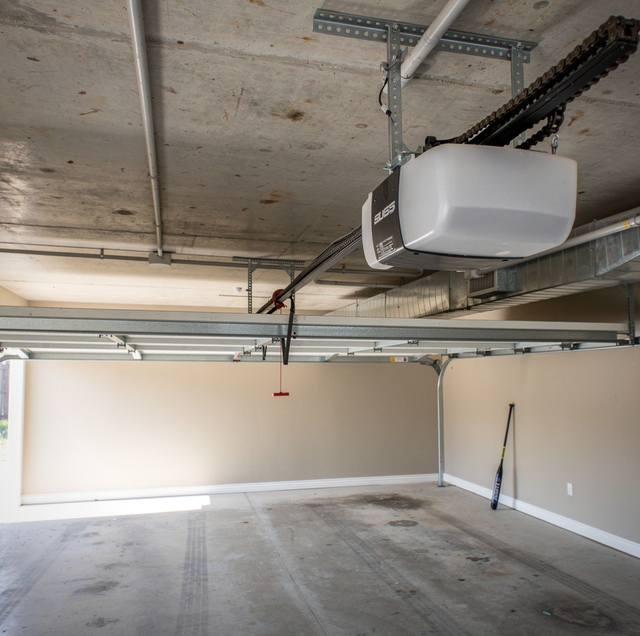
Two garage remotes turn up in a kitchen drawer during your first week in the house, tucked in among old takeout menus and a spare key nobody explained. There's no manual anywhere, no folder of receipts, no name or number for whoever serviced the door last. On the garage ceiling sits an opener that was there before you saw the listing photos, doing its job every time you press a button, telling you nothing about how it got there or what it's been through.
An opener you buy and install yourself comes with most of its unknowns already resolved: who has the remotes, how it's been treated, whether the safety features work. An opener you inherit resolves none of that. Everything below closes those gaps one at a time, before you trust a machine you know nothing about to run above your car or your kids.
Never pull the manual release cord while the door is up. Disengaging the trolley with the door open lets it fall under its own weight, and worn hardware on an older, unfamiliar opener gives you even less warning before that happens.
Nobody Told You Who Still Has a Way In
In a house you've lived in for years, you generally know who has been handed a remote. In a house you just closed on, you don't. Previous owners may have kept a spare in a car they later sold, and a contractor, a house sitter, or a relative who used to check on the place could still be holding a transmitter — none of them handed anything back at closing, because there was nothing to hand back.
You have no baseline to measure against, either. Nobody who closed on the house with you can tell you how many remotes were ever programmed into that opener, so there's no way to know how many are still working out there. A technician can clear the opener's stored memory entirely and reprogram it so that the only transmitters that work afterward are the ones currently in your household. That's a service call, not something you establish yourself by counting what turned up in a drawer.
The App May Still Answer to Someone Else
A number of openers on the market connect to a phone app in addition to, or instead of, a physical remote. That connection runs through an account tied to an email address, a phone number, or a household, set up by whoever installed or last configured the unit. The physical hardware on your ceiling and the account that controls it over the internet are two separate things, and buying the house transfers one without automatically transferring the other.
If the opener you inherited is Wi-Fi connected, it's worth confirming on day one whether that account still belongs to someone else. An account that was never removed can, depending on how it was set up, still see activity on the door or retain some remote access. Using the opener normally won't tell you this — it's a fact you have to go check.
The Opener's Condition Says More Than Its Age
A motor and drive system wears out according to how often they've run and how much resistance they've had to fight, not according to a date printed on a label. A house where the garage door doubled as the front door, used every time someone left for work or pulled a car in for the night, put far more cycles on that opener than a house where the garage sat mostly closed. You have no way to know which kind of household you inherited from.
How openers age in general, and what drives total cycle count over a unit's life, are subjects in their own right. What matters for an inherited unit is that you're starting somewhere on that curve without knowing where. Visible condition tells you more than a birth date: how the housing looks, whether the chain or belt runs quietly or with a grinding note, how worn the rail looks where the trolley travels.
The Safety Reversal Has Not Been Confirmed, Only Assumed
Every opener built in recent decades relies on more than one system to stop the door and send it back up if something is in its path: a photo-eye sensor pair that watches the space near the floor, and a force-sensing function in the motor that reacts to unexpected resistance. Both stay quiet until they're needed.
That's what makes them easy to take for granted in a house you didn't set up yourself. Weeks of the door closing normally, with nothing ever stepping into its path, tell you nothing about whether either system would catch a real obstruction. Whether the reversal and the sensors still function needs to be verified by someone checking them deliberately, not assumed based on how the door has behaved so far.
An Unmaintained Door Becomes the Opener's Problem
The opener and the door it lifts aren't independent of each other. The springs carry most of the door's weight, leaving the opener to manage only what's left over, and anything that adds resistance to the door itself gets passed straight through to the motor and drive. Dry hinges, rollers that have gone stiff or started binding in the track, a track that's drifted slightly out of alignment: none of that is the opener's fault, but the opener is what compensates for it, cycle after cycle.
You have no way to know whether the previous household kept the door itself lubricated and adjusted, or let it go for years while the opener quietly absorbed the extra strain. A door that's been neglected can make a perfectly sound opener look like it's struggling, even though the actual wear is happening in the track and rollers rather than the motor.
The Unit's Generation Determines What You Can Still Buy for It
Openers are built in generations, with control boards, plug-in accessories, and matching remotes tied to the generation to which a given unit belongs. An opener from an earlier generation may not accept newer accessories at all, and if its drive or control board ever fails outright, the availability of a matching replacement part depends on what's left in inventory for a line that may no longer be in active production.
Most openers carry a model or manufacture date on a label attached to the housing or motor unit itself. That label, not the unit's general appearance, is the fastest way to confirm which generation you actually own.
Model information on the unit is the starting point, and from there it's a question of what that line still supports. Knowing this before something fails changes whether a future repair is a simple parts swap or a search through what's left of a discontinued run.
A Previous Repair May Have Been Left Unfinished
Repairs on an opener sometimes happen in stages, especially if a part was back-ordered, if a homeowner chose a stopgap fix over a full one, or if a service call was cut short for reasons unrelated to the door. None of that gets written down anywhere you'd find it. You're looking at whatever was left behind, with no record of whether it was the finished job or a placeholder.
Signs of unfinished work tend to show up as mismatches: hardware that doesn't match the unit's era, a control panel that behaves inconsistently, a component that looks noticeably newer or older than everything around it. None of those signs tell you what happened, only that something happened while you weren't there. Whether it was completed, addressed halfway, or never finished is a question that a machine with no service history can't answer on its own.
One Inspection Turns Every Unknown Into a Record
Every one of these unknowns traces back to the same root cause: you're operating a machine with no service record, installed and maintained by someone who never met you and left no notes behind. A single inspection turns each unknown into something known. The opener's memory gets checked and, if needed, cleared and reset to only the transmitters currently in your household. Any app account still tied to a previous name gets identified. The condition of the motor, drive, and rail gets assessed against what they should look like, not against a date on a label. The safety reversal and photo-eye function are verified rather than assumed; the unit's generation is confirmed along with what's still available for it; and anything left half-finished by a previous repair is surfaced rather than discovered later, mid-cycle, with the door already moving.
From that point forward, you have your own service record instead of someone else's lack thereof. That's the difference between owning a house with an opener already installed and owning the opener itself.
Frequently Asked Questions
Many vehicles come with an in-car button system, commonly called HomeLink, that can be programmed to operate a garage door from the dashboard, separate from any handheld remote. If a previous owner set that up in a vehicle they later sold or traded, that vehicle's button may still open your garage door. It's worth keeping in mind, since programming a garage door into a car doesn't require handing anything physical to the next owner.
Brands commonly serviced include LiftMaster, Genie, Chamberlain, DoorLink, Mid-America, CHI Overhead Doors, and Haas, as well as US Automatic and LiftMaster for gate operators. An unfamiliar name on your ceiling is still very likely one a technician has serviced many times before.
It depends on whether your inherited opener runs a rolling code, which changes the transmitted signal with every press, or an older fixed-code system that repeats the same signal every time. An opener old enough to still be running fixed-code remotes is usually old enough that the control board's age and parts availability are the bigger question, which should shape how much weight you put on a stray, unaccounted-for remote. A technician checking the model can confirm which system is actually inside yours.
A repair performed after an inspection typically includes its own 30-day workmanship guarantee, separate from any tied to the original installation. A full installation, if that ever becomes the better option, is usually backed longer: commonly around a year of labor coverage and several years on parts.
Yes, and it's a separate question from the remotes turning up in a drawer. A keypad typically stores its own access code independent of the opener's paired-remote memory, so clearing the transmitter memory during an inspection doesn't automatically reset a code punched in years ago by someone who no longer lives there. If your inherited opener has a keypad mounted outside, checking or resetting that code is worth adding to the same visit rather than assuming a general remote reset covers it.
A technician can often still identify the model from markings on the control board itself or from the shape and layout of the drive components, even without a legible housing label. Without a confirmed model, though, matching factory accessories becomes harder, and the fallback is often a universal or aftermarket remote and keypad, many of which are designed to pair with a wide range of receivers regardless of the original brand. That's worth knowing before a missing label reads as a dead end.
Start with a full inspection of the opener and door you inherited — get a written baseline of what's working, what's worn, and what still needs a previous owner's information cleared out. Arnold's Garage Door & Gates serves Fort Worth, Alvarado, and the DFW metroplex. Call Arnold: 682-337-7220.
