
Replaced a Garage Door Panel? What Happens to the Springs
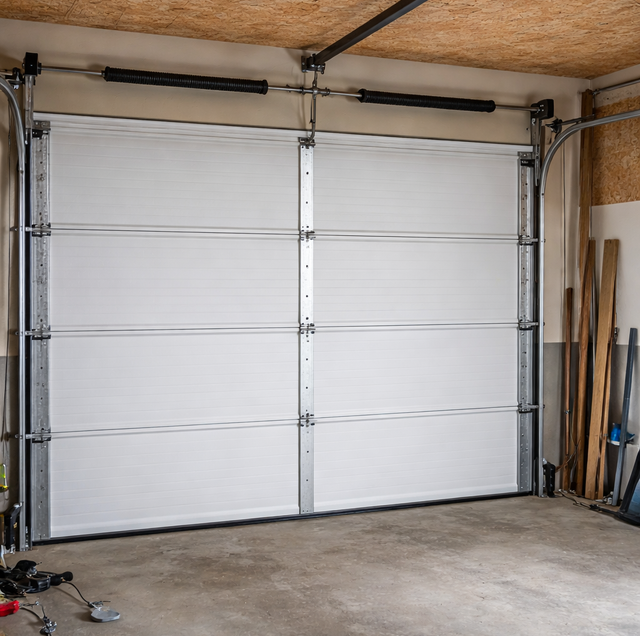
The new section went in this morning. Third up from the floor, one shade cleaner than the panels around it, hinges bolted through fresh holes, rollers seated in the track. The door runs. Above the opening, the springs sit where they were yesterday, wound to a turn count set years ago.
Nothing about that is alarming. A torsion spring is matched to a weight, and that weight is the total weight of all sections of the door. Swap one section and the total the spring was set against has technically changed. Usually it barely moved. Sometimes it moved enough to matter, and which one you got depends on what the new section is built from.
What a Panel Swap Touches and What It Leaves Alone
A section replacement is body work. Hinges come off the damaged panel's top and bottom edges, its rollers come out of the vertical track, and a new section goes into the same stack.
The counterbalance overhead is no part of that job. The torsion shaft, the springs on it, the winding and stationary cones, the cable drums, the lift cables, and the center bracket stay put and stay loaded.
Which is why the question comes up. Think of the spring as a counterweight cast for a single exact load: it delivers the same torque every cycle, no matter what hangs from the cables below it, and it has no way to sense that a section has changed. Door weight is the one thing a panel swaps hands with, without any signal attached.
Removing a section requires unbolting the hinges while the torsion spring above the opening remains fully wound and the lift cables remain under load. That stored energy does not release because a panel came off the door.
Where a Weight Difference Would Come From
Two sections that look identical from the driveway can be built very differently behind the skin, and construction is where the pounds live.
Steel gauge: residential sections fall within a narrow band, commonly 24 through 27 gauge, where a lower number indicates thicker steel. A section pulled from a different series can sit a gauge off in either direction.
Insulation: a single-layer section is hollow behind the skin. A two-layer section carries polystyrene board with a vinyl backer. A three-layer section has polyurethane injected and bonded between two steel skins. That spread is the widest item here, and crossing it is the change most likely to be felt.
Glass: window inserts add weight, and insulated glass more than a single acrylic pane.
Hardware riding along: a strut, the horizontal U-channel bolted across the inside face of a section, adds real steel when the replacement arrives with one, and the originals had none.
Moisture: this one runs the other direction. A wood or wood-composite section standing in weather for years holds water the dry replacement does not, so the door can finish lighter than it started.
A photo of the section's damage isn't enough for ordering. Give the supplier the door's manufacturer, series, and section number if the label is still legible, since two sections in the same opening can differ in gauge or insulation.
Why One Section Usually Does Not Move the Needle
Set that against the total. A double door weighs 150 to 250 pounds, the range set mostly by gauge and what's behind the skin, and a single door weighs 100 to 150 pounds. One section of four is a quarter of that stack, and the difference between two builds of the same section is a fraction of a quarter.
A matched replacement, same manufacturer, same series, same construction, changes essentially nothing. Even a near match usually lands inside the range a correct spring can absorb through turn count, which is where a technician's small adjustments live.
So most panel replacements finish with the original springs on the shaft and the door running as it did before. A technician who says the springs are fine after a single-section swap is usually right.
The Panel Jobs Worth a Balance Recheck
More than one section: a vehicle backing into a door, or hail heavy enough to dent a whole face, often damages several sections at once. Three replacements built a gauge heavier than the originals stack their differences, and what was negligible on one becomes measurable across three.
A construction jump: a hollow section replaced with an insulated one, or the reverse. It is the same mechanism behind a retrofit insulation kit changing how a door runs, concentrated into one panel. Discontinued doors are where it hides, since a substitute can match profile and embossment well enough to look right while being built to a different standard behind that skin.
The top section: the opener arm bolts to this one, so the operator reinforcement bracket and any strut have to come off the old panel and go back onto the new one correctly.
What a Mismatch Looks Like During a Normal Cycle
Run the door with the opener and watch two stretches of its travel.
A door that came back heavier than the spring expects shows it by comparison, not from a fresh baseline: it ran one way before the new section went in and a different way after, in the same stretch of travel. Watch the first foot off the floor, where the whole stack still hangs on the cables. If the door hesitated there yesterday and hesitates harder today, or the motor pitch drops lower than it used to on the way up, the new section likely added more than the spring accounted for. Coming down tells the same story from the other side: a door that used to settle onto the slab now travels the last foot quicker and lands with more of a thud.
A door that came back lighter inverts those symptoms. It goes up easily and gets stubborn about coming down. More spring than weight means the door wants to travel upward, so it can stall on the descent, sit loose on the floor, or trip the opener's down force and reverse partway.
One caution: a panel job also puts new hinges and rollers into the stack, and a roller binding in the track produces hesitation that has nothing to do with springs. Balance and friction feel alike from the wall button.
Where a Panel Job and a Spring Job Overlap
The two sit on opposite sides of the same door: sheet metal, stiles, hinges, and matching on one side, torque, turns, drums, and cables on the other. They meet at one number, which is what the door weighs, and timing is the argument for checking it during the panel visit, while the door is apart and the tools are out.
There is a longer tail to it that shows up on the next panel job. A door with replaced sections no longer matches the construction its model number describes on a spec sheet, and if a section ever needs replacing again, a discontinued profile or an updated construction can turn a simple swap into a hunt for the closest available match. Noting what went into the door, and when, is what lets a future technician tell a true reorder from a compromise before parts get ordered.
Frequently Asked Questions
Most manufacturers put an identification label on the inside face of a section, often near an end stile, listing model or series and sometimes a wind-load rating. A supplier can look up the original construction from it. If the label has worn off, the end stile stamping is the next clue.
Yes. It carries the bottom brackets the lift cables terminate at, and those stay under full cable tension the whole time the spring is wound, so the section gets handled with the door secured first. It also holds the astragal, the rubber bottom seal that seats against the slab in a retainer along the bottom rail.
It can. Garage door hinges are numbered, commonly 1 through 4 or 5 on a residential door, and the number sets how far the hinge holds its roller off the face of the section. Higher numbers belong higher up, because the vertical track sits deeper toward the top so the door pulls tight against the weatherstrip as it closes. A number 2 hinge in a number 3 position holds that roller at the wrong depth, and the door binds at one spot every cycle.
They do, and it limits what can be substituted. Residential sections are commonly 18, 21, or 24 inches tall, and the stack has to add up to the door's height, so a 7-foot door is usually four 21-inch sections and an 8-foot door four 24-inch ones. A wrong-height section cannot drop into that stack, since the horizontal seams would land in new places and the hinge and roller positions would move with them.
No. A door heavy before the impact was heavy for a reason; the new panel does not touch that reason, and that reason usually lives above the opening. The two coexist often, since a door limping on a fatigued spring gets run rough. Impact damage is worth chasing past the panel too, because the force that dented a section can bow a track or bend a roller stem.
Yes, and it usually runs better. A dented or racked section flexes as it travels, and the fresh hinges and rollers accompanying it have none of the play the originals developed. Less drag means the counterbalance meets less resistance, which can let a door that was slightly spring-heavy all along finally show it by drifting up. The springs did nothing different; they stopped fighting friction.
Have the door's balance checked while the new section goes on — panel replacement and a spring check handled on one visit, so the counterbalance matches the door you end up with. Arnold's Garage Door & Gates serves Fort Worth, Alvarado, and the DFW metroplex. Call Arnold: 682-337-7220.
