
One-Piece Tilt-Up Garage Door Springs: What Makes Them Different
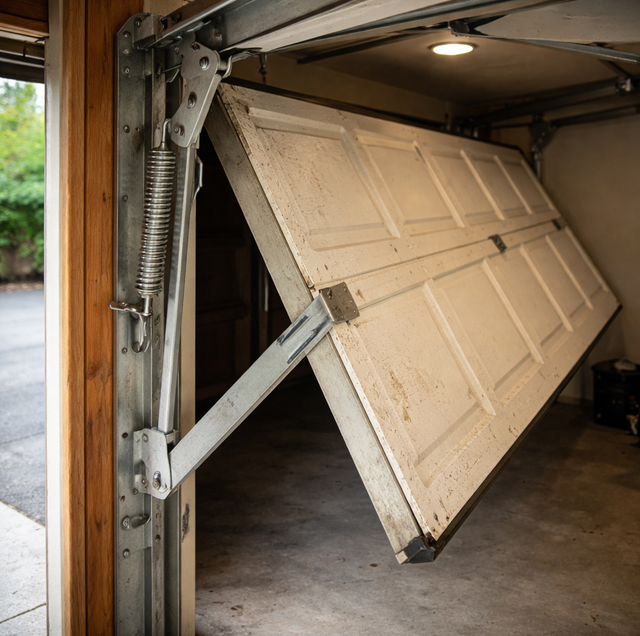
A one-piece tilt-up door gives itself away the second it moves. The bottom edge swings out over the driveway, the whole slab rotates in an arc, and the top disappears into the garage as a single rigid piece. Nothing folds at the curve of a track, because there is nothing to fold. Wood or steel, braced across the back, the door is a single panel on a pivot.
The hardware managing that motion is nowhere overhead. It sits down the sides of the opening, one assembly against each jamb, on garages built decades ago and still opening every day.
How a Single Panel Gets Up and Out of the Way
A sectional door handles the geometry by cutting the door into four or five sections that articulate around a curved track. A one-piece door has no such option. The whole panel rotates.
Two hardware families do that job. Jamb-type hardware pivots the door on brackets bolted to the door jambs: the panel tips up, the top edge swings back into the opening, and part of the door stays outside as a shallow canopy. Track-type hardware adds a pivot arm at each side plus horizontal tracks along the ceiling, so the panel tilts and rides all the way inside, parking flat overhead.
Both share the arc. As the panel rotates, the point its weight acts through travels along a curve, and the help the door needs changes at every angle. Vertical at the floor, it asks for the most. Near the top, lying nearly flat, far less. A tilt-up counterbalance has to follow that changing demand across the whole swing.
Where the Springs Sit and What They Pull Against
On most one-piece doors, the counterbalance is a pair of extension springs, one per side, mounted along the jamb or the side of the track assembly. One end hooks to something fixed: a bracket lagged into the jamb, a hole in a track hanger, or a plate from the hardware set. The other end connects to the moving side.
That second connection is where the design earns its keep. On some sets, the spring hooks straight to the tail of the pivot arm, the same arm the door swings on, so it pulls a lever that turns with the panel. On others, a short cable runs from the spring over a pulley and forward to that arm. Either way, a straight pull becomes rotation.
Because a lever does the translating, the value of that pull changes as the arm swings, the way effort at a hand-pump handle changes between the top and the bottom of its stroke. A straight-line spring geared through a rotating arm delivers help that falls off as the panel flattens out, in step with what a swinging panel needs.
When closed, the springs are at their longest and hold the most energy. Open, they have given back most of what they held, never all of it, which is why the hardware is still live with the door standing up. Tension gets set by where the hook lands: many sets carry a row of holes in an adjusting arm, and moving the hook one hole changes the preload. Either way, it is technician work.
What a Tilt-Up Door Does Without
Take stock of what is absent above the opening. No torsion shaft, no spring wound around it, no center anchor bracket on the header, no cable drums, no lift cables dropping to a bottom bracket. Along the door, no hinges between sections and no rollers climbing a vertical track.
The counterbalance on this door does its work through geometry at the sides, not through torque on a shaft overhead.
That is why sectional-door advice lands wrong here. Turn counts, wire diameter, inside diameter, wind direction, drum sizing: none of that vocabulary has anything to attach to. A tilt-up repair turns on what the panel weighs, what its springs are rated to lift, and whether the pivot hardware still holds its shape.
Signs of Spring Trouble on a Single Rigid Panel
A sectional door in trouble reports it locally: one section binds, one hinge complains, one roller drags. A one-piece door cannot. Every symptom involves the whole panel.
One side going weak first: A rigid slab cannot fold to accommodate the difference between its two sides, so it twists as it opens. One bottom corner leads the other up. The panel scrubs the stop molding along one jamb, leaving a line of bare paint. Daylight opens along one edge with the door shut, or the latch bars stop meeting their keepers and the lock gets stiff.
A spring letting go outright: The bang comes from one side of the opening at about eye level, and a failed spring on this hardware is usually visible from the floor, hanging slack at the jamb. That side drops what the spring was holding, and the load moves into the pivot bracket and the jamb behind it. Hence a broken tilt-up spring so often comes with a door wedged crooked in its own opening.
Both springs fading together: The door gets heavy at whichever part of the swing has the least help, usually right off the floor. It runs out of momentum near the top and stalls short, or it gets away in the last stretch of the closing arc and lands hard. A door that used to stay where it stopped and now settles closed on its own is telling the same story.
A one-piece panel sweeps its bottom edge out over the driveway as it moves, so the danger zone sits in front of the door as well as under it. Keep people and vehicles clear of that arc entirely.
Noise is worth listening for, since there is little else here to make it. Popping or knocking at a side assembly usually traces to a worn pivot bushing or to bolt holes that have gone oval in the bracket plates.
Why Parts and Service Are Harder to Come By
Sectional hardware converged. Torsion springs are ordered by four numbers and stocked everywhere, and a technician can carry the common combinations in the van.
One-piece hardware never converged. Bolt patterns, arm lengths, hook styles, anchor plate hole spacing, and spring capacities vary by manufacturer, and several of those manufacturers are long gone. Two tilt-up doors on the same street can carry assemblies with nothing in common. Replacement sets are still made, and many older doors can be fitted with a current one, but this is sourcing work, and not every old configuration has a drop-in part on a shelf.
Photograph both side assemblies before anything gets touched: the spring, its anchor bracket, and which hole in the adjusting arm the hook currently sits in. On hardware nobody stocks anymore, that photo is what a replacement gets matched against.
Weight drift complicates it. Extension springs on sectional doors have long carried a painted color code for lift rating, and some tilt-up springs use a similar convention, though the paint on a decades-old spring is usually gone. Meanwhile, a wood panel has been absorbing moisture and collecting repaint layers since it went up, which is why the panel gets weighed before a spring gets ordered.
Openers and Latches on a One-Piece Door
An opener adds a wrinkle. On a one-piece door, the top edge swings back while the bottom swings out, so the straight arm that suits a sectional door cannot follow the panel. Manufacturers sell a one-piece door arm kit for this, and where it bolts on matters: the bracket wants a stile or a back-brace member, since a thin panel inserts tears around the fasteners.
Then there is the lock. Most of these doors have a center handle with two latch bars that extend to keepers in the jambs. Throw that lock, press the opener button, and the motor pulls against a panel bolted into the opening on both sides. That fight goes straight into the pivot hardware and can bend an arm in one attempt.
What These Doors Ask of an Owner
Keep the swing clear. A car parked close to a tilt-up door is inside the arc, and so is anybody standing in the opening while it runs.
The side assemblies also belong in any maintenance visit, since springs, hooks, pivot bushings, and bracket bolts are wear items sitting where nobody looks. A tilt-up door whose counterbalance matches what its panel weighs runs a very long time. Most of the ones still in service are proof of that.
Frequently Asked Questions
From inside, look for horizontal joint lines with hinges bridging them. A sectional door has three or four of those seams; a one-piece door has none, only continuous bracing across the back. Quicker outdoor check: if a car can sit a foot from the closed door and it still opens, the door is sectional.
Ask about it specifically, because the answer depends on your hardware. Some tilt-up sets capture the spring inside a tube or run a rod through the coil; many others leave it open at the jamb. Any stretched extension spring that can fly if it parts is worth containing, and a technician can confirm which anchor points your set will accept.
Usually, though it is a whole-door and whole-track job. The deciding measurements are headroom above the opening and sideroom at each jamb, since sectional track needs both and one-piece hardware needs very little. That is part of why tilt-up doors ended up on low-headroom garages, and it is the first thing measured.
Yes, faster than on a sectional door. The pair was rated together, installed together, and has taken the same number of cycles, so the survivor sits near the end of the same fatigue life even though it hasn't broken yet. There is a geometry reason too: a mismatched pair pulls a rigid panel out of square immediately, where a sectional door's hinges mask a small difference.
Yes, with the correct arm kit. Force and travel settings get tuned to a door whose resistance changes as it swings through its arc, so numbers that suit a sectional door of the same width will not carry over, and the header bracket position gets set to this door's own geometry.
The panel and the springs age on separate clocks. Steel springs spend fatigue life every cycle whether or not the door looks good, and on hardware this old, the failures a technician finds first are often away from the coils: rusted or opened hook ends, an anchor bracket loose in old jamb wood, bolt holes gone oval at the pivot plates. All three change how the springs pull long before anything snaps.
Book a repair visit for a one-piece tilt-up door that swings unevenly, lands hard, or has a spring hanging loose at the jamb — broken spring repair, hardware and parts work, and an honest answer on what can be sourced for older tilt-up assemblies. Arnold's Garage Door & Gates serves Fort Worth, Alvarado, and the DFW metroplex. Call Arnold: 682-337-7220.
