
Garage Door Opener Chain Loose — What the Slack Is Telling You
Quick Answer: A chain does bed in, and retensioning it is normal maintenance. Slack that returns after it was set is reporting wear at the sprocket, trolley, or drive gear, and taking it up again relocates that load.
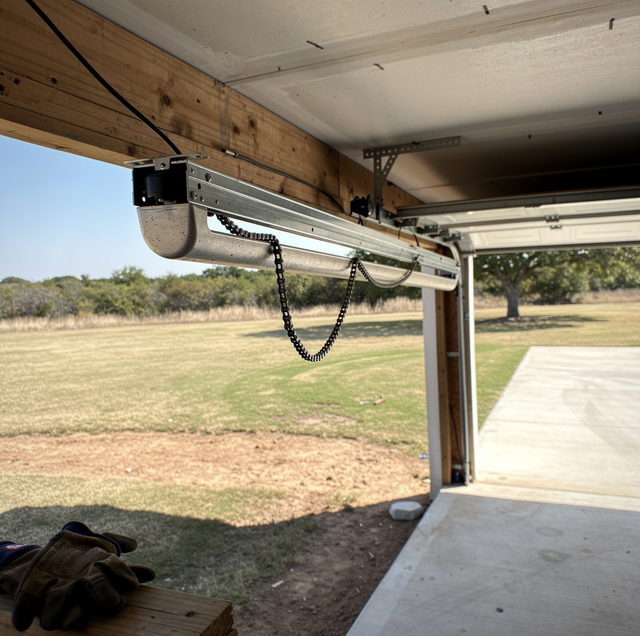
A garage door opener's chain runs inside a C-shaped aluminum rail, wrapped around a sprocket at the motor end and looped back near the header. With the door closed and the trolley parked at rest, that chain should sit close against the rail's underside, with no visible bow between the links. On a chain that has picked up slack, a section drops into a shallow curve below the rail, most noticeable across the middle of the rail's length. Run the door through a full cycle and watch that curve instead of the door: it doesn't stay put. The chain draws tight as the trolley pulls through the sprocket's rotation and drops loose again on the return stroke, so the same stretch of chain looks taut one moment and hangs clear of the rail the next.
A belt shows slack differently. At rest it should sit flush against the rail with that same absence of bow. Under load, a belt that has lost its grip on the sprocket doesn't sag so much as ride slack through part of the door's travel, arriving a beat behind where the trolley says it should be, sometimes with an audible chirp each time the sprocket's teeth lose their hold.
Slack That Returns After Retensioning Is Reporting Load on the Whole Drive
A roller chain is built from link plates pinned together at each joint, and every joint carries a small amount of play from the moment it's manufactured. New chain settles in during its first stretch of service as those joints seat against one another, which is why a chain drive commonly wants tensioning early in its life. That first adjustment is ordinary maintenance.
Past that bed-in, every cycle of the door puts the chain under tension, and every cycle wears the pin and bushing at each joint by an amount too small to notice on its own. Multiplied across every opening and closing, that wear adds up to extra length across the chain as a whole. That's the slack that keeps coming back, the accumulated result of every pin-and-bushing joint doing its job over and over rather than any single point of failure.
Which is why the second and third time a chain needs taking up matters more than the first. Setting it back once is maintenance. A chain that goes slack again shortly after it was set is reporting how much load it carries and how fast that load is working the joints.
Retensioning Is Routine Maintenance That Doesn't Reach the Load Behind the Slack
Taking up slack changes the chain's geometry at rest, and that is worth doing on its own terms. A correctly tensioned chain runs quieter, tracks the trolley cleanly through both ends of travel, and stops beating against the rail. What it does not change is how much force the opener has to deliver to move the door through its full travel, or whatever is asking for that force in the first place, whether that's a door that has grown heavy for its opener's class or springs that no longer carry as much of the door's weight as they once did. That resistance remains once the chain is retightened, and it still has to go somewhere.
Concretely, it goes into three places. The sprocket teeth experience increased mesh pressure each time the chain engages them, wearing unevenly rather than across the full tooth profile. The trolley's attachment point on the chain rides through the same load spikes at a tighter setting, which accelerates wear at that specific connection. And inside the motor head, the drive gear, commonly a nylon or reinforced-plastic part built as the sacrificial piece in that assembly, absorbs a rougher power transfer while the downstream resistance remains unchanged. None of those three announce themselves the way a sagging chain does. They just wear faster.
Chain Slap Is Damaging the Rail Before the Chain Ever Fails
A taut chain moves smoothly with the trolley because there's no free length for it to do anything else. A slack chain has room to move independently, and it uses that room whenever the trolley speeds up, slows down, or reverses near the ends of its travel. The slack section snaps taut and drops loose again in a rhythm, striking the inside of the rail channel on each cycle. Chain slap is that striking, and the sag is what gives the chain room to do it.
Each strike is a small impact rather than a steady load, and impact loading is harder on both surfaces than the same average tension delivered evenly would be. Repeated strikes peen the rail's inner surface at the point of contact and work-harden the chain's link plates in the same spot, and both of those things happen well before either part gives out. That's why the rattling from a loose chain shows up long before a snapped link or a jammed door does: the noise is the impact event itself.
Never reach into the rail or grab a moving chain or belt while the opener is running. A slack chain under load can whip unpredictably, and the trolley's pinch points don't stop for a hand in the way.
A Belt Doesn't Lengthen like a Chain in Normal Service, so Slipping Points Elsewhere
A drive belt is built around a cord reinforcement running its full length, and in normal service that cord holds the belt's length steady while a chain's pinned joints are working themselves longer. The cord has no joints to wear, so a belt moving a door's opener is not rated for, and does not accumulate length cycle by cycle, the way the chain described above does. Push a belt past that normal range, though, and the picture changes. A door that fights back, binding in its track or hanging heavier than the opener's class was built for, loads the belt beyond what it was specified to carry, and a belt under that kind of abnormal tension does elongate, leaving slack that shows up at the trolley.
So when a belt is slipping, skipping against the sprocket's teeth with a chirp of its own, or fraying at one edge, the belt's own age is rarely the whole account. Sprocket teeth that have worn or chipped can't hold the belt's ribs cleanly through every rotation, so the belt slips at that one worn point instead of gripping the whole way around. A contaminant at the belt-sprocket interface, grease migrated from another part of the opener, or dust packed into the ribs changes the friction the belt depends on to hold its grip. Fraying along one edge usually means the belt is rubbing against a rail guide or misaligned section it shouldn't be touching, which is a position problem rather than an age problem.
Replacing the Belt Isn't Automatically the Same Decision as Replacing the Opener
Whether the drive is chain, belt, or screw is a different question from what slipping or stretching under load reports. A belt is a normal wear part with its own expected service life, and one that reaches the end of that life on its own, without any of the sprocket, contaminant, or resistance issues described above, is a plain part swap and nothing more.
A belt that fails well ahead of that is reporting on what it was working against. A single early failure with no other signs is still probably just a bad belt. A second belt failing in a similarly short span, or a belt slipping alongside other signs the door is fighting through part of its travel, points at resistance somewhere upstream of the belt itself. In that case, the belt is the part absorbing the consequences of a problem somewhere else, and putting in another belt without addressing whatever it's fighting means the next one is likely to go the same way.
The Wear Behind the Slack Started Long Before You Could See It
Everything described above- the sprocket's uneven wear, the trolley's faster wear at its attachment point, the drive gear's rougher transfer of power, the peening inside the rail- happens before the chain sags into a visible curve or the belt starts to chirp. The chain and belt are simply the parts of the drive built to show slack where you can see it. The sprocket, the trolley, and the drive gear have no equivalent means of indicating their wear. They keep absorbing it until each reaches its own limit, out of view inside the rail and the motor head.
That makes visible slack a lagging signal rather than a leading one. By the time a chain bows below the rail again or a belt slips audibly, the parts around them have already carried that load for a stretch of the drive's working life. What gets addressed at that point is more than the length of a chain or the tension on a belt. It is the condition of every part that has been carrying that load to keep the door moving while the wear added up.
Frequently Asked Questions
Sometimes. Chain is made of link plates connected end to end by a master link, a removable connector rather than a permanently pinned joint, and a technician can use that master link to cut out a stretched or damaged section and splice in a new run of chain. Once the stretch runs the length of the chain rather than one section, full replacement is the more common call.
The chain loops around a second, non-driven sprocket near the header end of the rail, called an idler sprocket, and that fixed point wears from the chain running over it, just as the drive sprocket does. A worn idler sprocket can produce a slack pattern concentrated near the header rather than evenly along the rail, which looks different from ordinary chain elongation.
The cord buried inside the belt is usually fiberglass or steel, and that choice is the main difference between one belt and another. Steel cord carries less tension and is typically specified for openers rated for heavier doors, while fiberglass is lighter and quieter and is common on standard residential units. When a belt is replaced, matching the cord type specified for the opener matters more than the label on the box.
On many chain-drive openers, the loop isn't chain the whole way around. A length of steel cable runs from one side of the trolley back to where the chain picks up, so the chain only covers part of the travel. That cable can fray or unlay at its swaged end fitting, which reads as slack in the loop even when the chain itself is in good shape, so which half of the loop the sag sits in narrows the problem quickly.
The inside of the rail channel where the chain has been striking it usually shows a polished or slightly dented streak, distinct from the surrounding finish, at the point where the slack section was hitting hardest. It's not visible without opening or closely inspecting the rail, but it's one of the details a technician checks when a slapping chain has been running that way for a while.
Manufacturers typically specify a light lubricant for chain-drive rails and caution against packing the rail with grease, which attracts grit rather than repelling it. Treat that as service-visit work, done during a tune-up with the opener unplugged at the ceiling outlet and the door fully closed, never with the drive live. Belts need no lubricant at all, and adding one can make a slipping belt worse by changing the friction it depends on against the sprocket.
A diagnostic visit for a chain that keeps going slack or a belt that slips — the sprocket, trolley, and drive gear get inspected while the fix is still a repair rather than an opener replacement. Arnold's Garage Door & Gates serves Fort Worth, Alvarado, and the DFW metroplex. Call Arnold: 682-337-7220.
