
Car Stuck Behind Garage Door? Do This Before You Force It
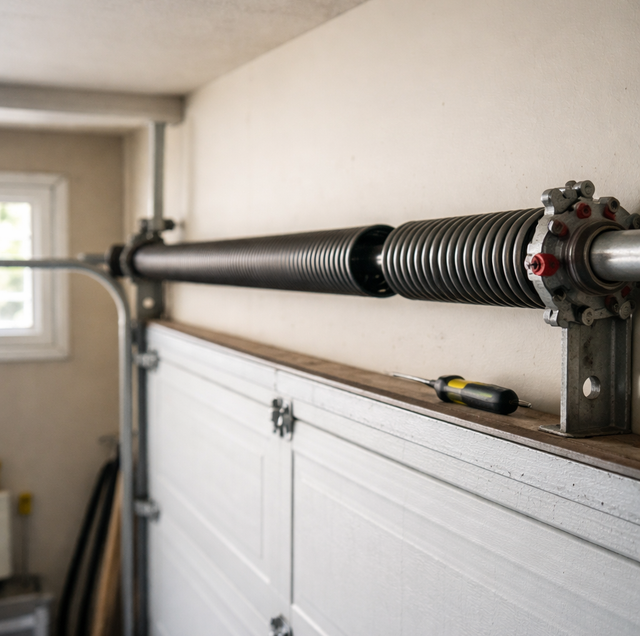
Quick Answer: A car stuck behind a dead garage door is almost always one of four problems: no power to the opener, a burned-out opener motor, a snapped torsion spring, or a door that has jumped its track. The first two are safe to work around: check the wall breaker and the outlet, then use the red emergency-release cord to disconnect the door from the opener and lift it by hand. The last two are not. If a spring is broken or the door is off its track, the door is no longer balanced and can crash down the instant you pull that release. Look for a visible gap in the spring coil and a door that feels far too heavy before you touch the cord. When in doubt, leave the car and call a tech.
It is a bad morning. You need to leave; the car is sitting in the garage, and the door will not move. The remote does nothing, or the motor hums and the door stays put, or you hear a loud bang from the garage overnight, and now nothing works at all. Before you start yanking on cords or throwing your shoulder into the panel, it pays to spend two minutes figuring out what actually failed. The right first move for a power outage is the exact wrong move for a broken spring, and getting that wrong is how people end up hurt.
Start By Figuring Out What Failed
Four problems account for nearly every dead door, and each one leaves a different fingerprint. Sorting them takes only a look and a listen.
No power to the opener: If the opener is completely silent- no hum, no lights, no click when you press the wall button- suspect power first. A tripped breaker, a bad outlet, or a genuine outage will leave the opener dead. Check the light on the opener unit itself and the wall control. If both are dark and the rest of the garage lights are out too, it is the circuit, not the door.
A burned-out or failed opener: Here, the opener has power, but the door does not move. The motor may hum, strain, or click; the lights may flash a code, but the door sits still. A stripped main drive gear, a snapped belt or chain, or a failed logic board all look like this. The key detail: the door itself is fine and still balanced. Nothing mechanical on the door has broken, only the machine that drives it.
A broken spring: This is the one to respect. The springs mounted on the shaft above the door, or along the tracks on an older setup, carry almost all the door's weight. When one snaps, the opener suddenly has to lift the full dead weight of the door alone, which it cannot do. You will often hear a loud bang, like a firecracker, at the moment it lets go. The opener may hum and jerk an inch, or do nothing.
A door off its track: If the door is crooked, jammed at an angle, or the rollers have popped out of the metal track on one side, it is off-track. This happens after an impact, a snapped cable, or a spring failure that lets one side drop. An off-track door is under uneven tension and can shift or fall without warning.
The Two Quick Checks That Are Safe to Do
If the opener is silent, the odds are good this is a power problem, and power problems are safe to chase.
Check the breaker and the outlet: Find the breaker panel and look for a garage or opener circuit that has tripped to the middle or off position. Flip it fully off, then back on. Openers also plug into a ceiling outlet, and that outlet is frequently on a GFCI, the kind with the small test and reset buttons, often located on a nearby outlet or on the panel. A tripped GFCI kills the outlet while leaving the breaker alone. Press its reset button and listen for the opener lights to come back. Plug a phone charger or a lamp into the outlet to confirm it is live.
Confirm it is not just the remote: A dead remote battery fools people constantly. Try the hardwired wall button instead of the remote. If the wall button works and the remote does not, you never had a door problem at all, just a battery. If the outlet is live and both controls are dead, the opener itself has likely failed, and you can move to opening the door by hand.
The Red Release Cord, and When You Must Not Pull It
Every automatic opener has a manual disconnect: a red handle on a cord hanging from the trolley, the sliding carriage that rides the rail and pulls the door open and shut. Pulling that cord disengages the trolley from the door arm, separating the door from the opener so you can raise it by hand. On a healthy, balanced door, this is exactly how you get your car out during an outage.
But that cord is only safe to pull on a door that is still balanced. A properly sprung door weighs almost nothing in your hands because the springs counter its weight. Disconnect the opener on that door, and it stays where you leave it.
Never pull the emergency release cord on a door you suspect has a broken spring or has come off its track. With the springs no longer holding the weight, the opener is the only thing keeping the door up, and pulling the release removes it. A steel door weighs well over a hundred pounds and can slam straight down onto whatever is beneath it, including your car, your foot, or your hands.
How to spot a broken spring before you touch anything: Look at the spring on the shaft above the door. A healthy torsion spring is a tight, continuous coil. A broken one shows an obvious gap of an inch or two where the two ends separated, like a break in a Slinky. That gap is the tell. The second test is weight, but do it gently: with the opener already disconnected, only if you are certain the spring is intact, or by feel if you must, a door with a broken spring feels shockingly heavy and will not stay put if raised even slightly. Extreme weight plus a coil gap means stop, back away, and call a pro. High-tension springs and cables are never a DIY repair.
Lifting the Door by Hand, Only If It Is Balanced
You have confirmed power is the issue or the opener has failed, the springs are intact with no gap in the coil, and the door sits square in its tracks. Now the manual lift is safe.
Pull the red release straight down and, on some models, back toward the door to fully seat the disconnect. Then grip the door by its bottom edge or a lift handle, keeping your fingers well clear of the seams between the panel sections, which pinch hard as the door folds. Lift with your legs in one steady motion. A balanced door rises easily and holds itself open. Get the car out, then lower the door gently and set it down square.
If the door fights you, feels heavy, or starts to drop, do not muscle it. Guide it back down, keep your hands out of the joints, and stop. A door that does not lift easily is telling you it is not balanced, and that is a spring or track problem you should not force.
Getting the opener working again afterward: Once power is restored or the failed opener is replaced, you re-engage the trolley. On most units, you pull the red cord back toward the motor, or simply run the opener once, and the trolley carriage snaps back onto the traveling assembly automatically as it passes. You will hear it click home. Test the door through one full cycle to confirm it catches and moves under power before you rely on it again. If the door has a manual slide-lock or T-handle on the outside, leave it open, not latched, while the opener is connected, since running the motor against a thrown lock can bend the door.
When to Skip All of This and Call a Tech
Some situations are not worth a minute of DIY. Call for help, and just take the other car or a ride, if you see a gap in the spring coil, if the door is visibly crooked or hanging off one track, if a lift cable is frayed or dangling, or if the door feels far heavier than it should. A car stuck inside for a few hours is an inconvenience. A door that drops on you is an injury. The tension stored in garage springs and cables is enough to break bones, and the tools and know-how to release it safely are what a trained tech brings to the job.
The honest read on most trapped-car calls is simple: if it is power, you will likely fix it yourself in five minutes. If it is a spring or a track, that is a service call, and forcing it only turns a repair into an emergency-room trip.
Frequently Asked Questions
Indefinitely, as long as the door is balanced and you relock the outside slide-lock while it is disconnected. The one real risk is security: a door on manual release can be lifted from outside by hand, so anyone who reaches the bottom edge can open it. If you leave home with the opener disconnected, throw the exterior T-handle lock so the door cannot be raised, and remember to release that lock before you re-engage the opener and run the motor.
Yes. Many newer openers now ship with a rechargeable battery backup built in, a feature that became standard on a growing share of models after it was mandated in some markets. A backup unit runs the opener through an outage for a limited number of cycles, usually around twenty full open-close cycles on a fresh charge, then it needs line power to recharge. A blinking amber or red light on the motor head often signals the backup battery is low and due for replacement, typically every one to three years.
Torsion springs sit on a metal shaft directly above the door and are the most common type on modern doors. Extension springs run parallel to the horizontal tracks along the ceiling, one on each side, and are found on older or lighter doors. The safety response is identical for both: do not operate the door and do not pull the release. The one visual difference is that a failed extension spring often stretches or dangles rather than showing the clean coil gap of a broken torsion spring, and its safety cable, the wire threaded through the spring, is what keeps a snapped extension spring from flying across the garage.
That specific behavior, a hum plus a small jerk with no real travel, most often points to a broken spring rather than a dead motor. The opener has power, and the motor is trying, but with the spring gone it cannot lift the full weight, so it strains, moves the slack out of the chain or belt, and gives up against the motor's built-in force limit. A humming, jerking opener is a signal to stop pressing the button, since repeated attempts can burn out the motor or strip the drive gear on top of the spring you already need fixed.
No. Keep the car and yourself clear of the door's path anytime you suspect a spring or track problem, because an unbalanced door falls straight down along the opening. If you must get a car out during a confirmed power outage with an intact, balanced door, that is fine, but never position yourself beneath a partially raised door that is not being held open by working springs. A prop or a helper holding the door does not replace a functioning spring system.
The manual release cord is universal and works the same on every automatic opener, smart or basic, because it is a purely mechanical disconnect that does not need power or a signal. The app and Wi-Fi features are useless in an outage since the opener has no power to receive the command, and the router is likely down too. Some smart models add a small keypad or a secondary battery, but the red cord is always the fallback, which is exactly why manufacturers make it bright red and hang it where you can reach it in the dark.
If your car is boxed in and you are not sure what to let go, call Arnold before you force anything — a quick look tells you whether it is a five-minute reset or a spring that needs replacing safely. Arnold's Garage Door & Gates serves Fort Worth, Alvarado, and the DFW metroplex. Call Arnold: 682-337-7220.
