
Crooked Garage Door: The Broken Spring Behind the Tilt
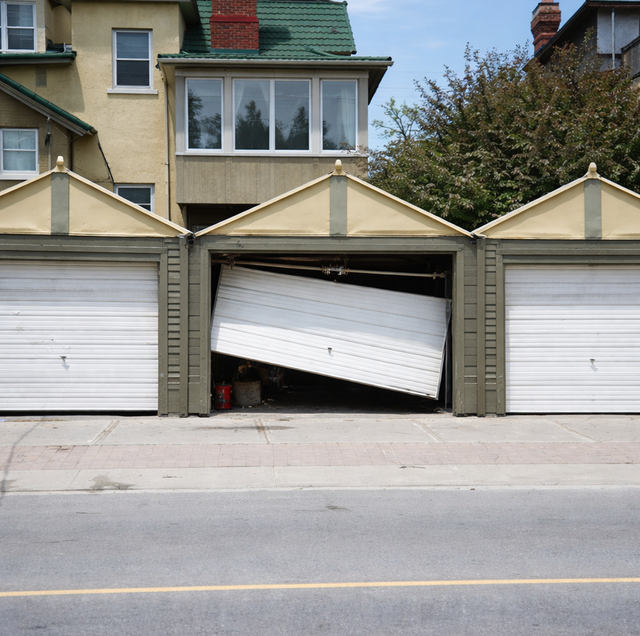
One bottom corner is still sitting on the concrete while the other has climbed a foot into the opening. The top edge tilts across the door like a picture frame knocked off its nail, and somewhere in the curve of the track a roller is grinding against metal it was never meant to touch. Maybe you heard a bang overnight. Maybe the door came down wrong yesterday and has not gone up straight since.
A door hanging diagonally indicates that the two sides of the lifting system have stopped agreeing with each other. The spring system is the first place to look because it is the only part that carries the full weight of the door.
How a Counterbalanced Door Stays Level
Above the opening on a torsion setup runs a steel shaft the width of the door, with one or two springs wound around it and a grooved cable drum at each end. A cable runs from each drum down the jamb to a bracket at the bottom corner of the door.
Both drums are clamped to that same piece of steel by set screws, so when the shaft turns, both drums turn the same amount, wind the same length of cable, and raise both corners together. The springs never lift either side by themselves; they feed torque into the shaft, and the shaft hands it out evenly.
Extension springs work differently. They stretch along the horizontal tracks near the ceiling, one per side, each pulling its own pulley and cable with no shaft tying the halves together. Nothing forces the left side and the right side to behave alike.
When One of a Matched Pair Lets Go
Most double doors run a matched pair of torsion springs on a shared shaft, each sized to carry roughly half the load. When one fractures, the shaft still receives torque, but only about half of what the door weighs. The door does not become impossible to move, just badly under-counterbalanced, and that is where the tilt starts.
The opener pulls from a single arm attached near the middle of the top section. With half the counterbalance gone, that arm drags a load the system was never designed to route through one point. The top section flexes, the door leans into the tracks, and the cables lose the tension holding them seated in the drum grooves. A slack cable can slip a wrap or jump the drum, and that corner stops rising while the opposite corner keeps climbing.
A torsion spring stores a large amount of energy, and when the steel fails, it releases it in a single crack people describe as a gunshot. Look at the coil above the opening, and a broken spring usually shows a clean gap of an inch or two where it separated.
Springs are rated in cycles rather than years; a standard residential torsion spring runs roughly 10,000 open-and-close cycles. A pair accumulates the same count, so the survivor is rarely far behind the one that let go.
The Extension-Spring Version of the Same Failure
On an extension-spring door, one failure produces the most dramatic version of this. The spring on the failed side stops pulling instantly while the good side keeps lifting normally, so the door goes diagonal on the very first attempt, often far enough to jam the rollers in the track.
The tilt points straight at the culprit: the low corner is the side that lost its spring. Look along the horizontal track above it and a failed extension spring hangs slack, lies in two pieces, or sits stretched with a gap where it parted. Check for the safety containment cable while you are there: a steel cable runs through the center of each extension spring and is anchored at both ends so a snapped spring stays captured. Older installations often lack them.
When the Spring Is Fine, but Its Hardware Slipped
Sometimes the coils are intact, and the torque is there, yet it never reaches the shaft's end. Winding cones and cable drums are both held to the shaft by set screws. If a set screw backs off, a cone casting cracks, or the coupler joining a two-piece shaft loses its grip, that drum stops turning with the shaft. It pays out cable, the corner beneath it sags, and the door hangs low on that side.
A mismatched pair does something subtler. When one spring is replaced, and the fatigued original remains on the shaft, the two deliver unequal torque, causing the door to ride unevenly and drift rather than hold position.
The signature of this group is what is missing. No bang, no visible break in any coil, no single morning when everything changed. Instead, one cable looks slack while the other stays taut, and the door came down slightly crooked before it ever went up crooked.
A racked door carries its weight through whichever cable and roller still hold, and that load can release without notice. Do not lever it back square by hand, do not reach under a hanging section, and stop running the opener immediately.
Cable and Track Faults That Look the Same
Two non-spring faults produce the same crooked picture.
A cable can come off its drum with every spring intact, usually when the door lands on something that stops one corner early: a trash can, a bag of mulch, a coiled hose. That cable goes slack while the door keeps closing, spools over itself, and the next opening cycle lifts unevenly.
Track alignment is the other. Lag bolts backing out of jamb brackets, a dented track, or a bent roller stem all catch one side. Soil with high clay content plays into this too, swelling as it takes on water and shrinking as it dries, which walks the slab and the framing above it. Over several seasons, the opening drifts out of square, the tracks stop running parallel, and the door binds on one side at the same point in its travel.
Sorting a Spring Cause From a Track Cause
You can narrow this down while standing.
Start with the coil. A visible gap in a torsion spring above the opening, or a slack extension spring alongside a horizontal track, ends the investigation there.
Then timing. A spring failure is an event: one cycle, usually a bang, normal before and crooked after. Track trouble arrives on a slope, showing up first as a groan or a catch at one height and worsening across seasons.
Watch the cables with the door closed. Both "taut" mean the drums are still doing their job. One hanging loose points at the drum, the cable, or its hardware rather than the spring steel.
Watch where the door struggles. A track bind catches at the same height every time. A counterbalance problem is a weight problem, worst near the closed position where the springs carry the most load, and the motor strains audibly before tripping its force limit.
Skip one check you will see suggested elsewhere. Testing balance by hand requires disconnecting the opener; on a door already racked, releasing the trolley removes the last restraint.
Getting a Racked Door Back Level
The first move is control. Locking pliers clamped to the vertical track below the bottom roller keep the door from traveling while it comes down under control.
The inspection follows the load path: spring condition and wind, cones and set screws, drum position, cable condition from drum to bottom bracket, the shaft, the end bearings, and the center bearing plate at the header. Torsion springs go back on as a matched pair, and both cables get respooled to equal length so the bottom corners leave the floor together.
Racking also leaves bent end hinges, elongated screw holes, and roller stems out of line, all of which get corrected or the new springs will lift a door that still does not track straight. The last steps are winding to the door's measured weight, confirming it holds position at any height, and reconnecting the opener.
Frequently Asked Questions
It can, and that damage outlasts the spring repair. Hinges are numbered by position, typically 1 through 4 or 5 from the bottom up, and the end hinges carrying the roller stems deform first. Once a section takes a permanent set, new springs will not pull it straight; the panel gets replaced.
Usually cable spooling. Each drum has grooves cut for a set number of wraps, and both cables are set to matched length at installation. One wrap off shows up as roughly that drum's circumference in height at the corner beneath it, most of a foot on a common residential drum.
It can, mainly at the header bracket and the arm. On a chain drive, though, the more common casualty is on the door side, since a rack strains the top roller and hinge before it reaches the motor. A humming opener that isn't turning the shaft usually means the drive gear already gave first, and a garage that runs the opener on a smart plug or app schedule is worth checking too, since an automated cycle attempt does the same damage as a person pressing the button.
Rarely on its own. A cable that ran slack while the door was racked tends to kink or fray near its bottom loop, and a kinked cable will not lie flat in the drum grooves behind any new spring. Drum set screws also bite small dimples into the shaft, so a drum reclamped in a new position gets the shaft checked for wear.
Yes, by two paths. The rubber bottom seal can freeze to a wet slab, and it rarely freezes evenly, so one corner tears free while the other stays stuck and the cable on that side goes slack. Cold also makes spring steel less forgiving, which is why a fatigued coil breaks on the first pull of a freezing morning.
There's no fixed number of days, but there is a fixed number of cycles before secondary damage sets in, and most households burn through them faster than they expect, since a crooked door gets tested by every driver in the house before anyone calls for service. A rough marker: once a second person in the house has run the door without knowing it was crooked, the odds of a hinge or a section joining the repair go up sharply.
Get a crooked or racked door inspected before it is run again — a technician secures the door, checks the spring, cone, drum, cable, and track conditions, and rebalances both sides. Arnold's Garage Door & Gates serves Fort Worth, Alvarado, and the DFW metroplex. Call Arnold: 682-337-7220.
