
Why an LED Bulb in the Opener Can Shrink Remote Range
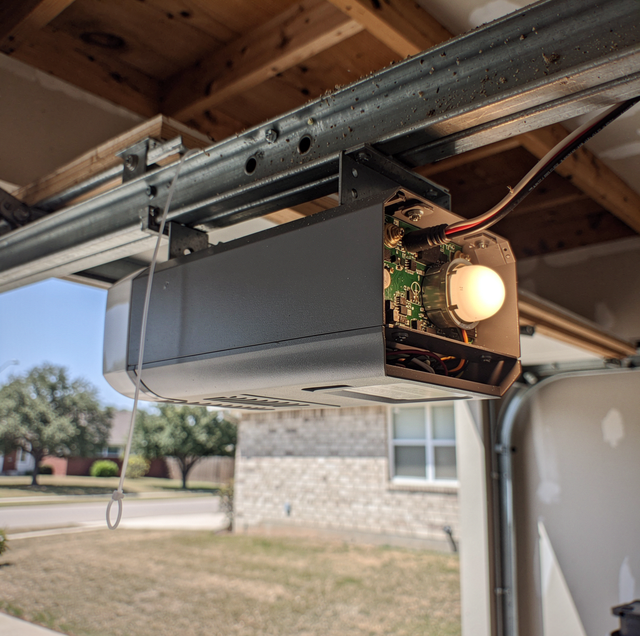
Quick Answer: An LED bulb's driver can radiate radio noise into the same band your garage door remote uses. That noise doesn't break the receiver; it raises the background level the remote's faint signal must be heard over, shrinking range instead of killing it.
One Saturday you finally get around to a small chore: the incandescent bulb in the garage door opener has been dim for weeks, so you swap it for an LED. It screws in fine, lights up bright and white, and you forget about it by dinner.
A week or so later, you notice the remote isn't reaching the way it used to. You used to hit the button from the end of the driveway and watch the door start moving before you'd even parked. Now you're rolling almost up to the door itself before anything happens, and the button feels like it needs two or three presses where one used to do it.
Nothing else changed. Same remote, same battery, same door. The one different thing sits in a socket a few feet from where the receiver listens for that remote's signal, and it has nothing to do with a remote that has quit outright, a door that runs on its own, or an opener that never responds at all, since those are separate failures with separate causes. This one is about range: a remote that still works, just from a shorter distance than it used to.
What the Remote Sends
A garage door remote is, by design, a low-power radio transmitter. Pressing the button sends a short burst on a narrow slice of the radio spectrum set aside for exactly this kind of short-range control, carrying a rolling code that the receiver checks before accepting the command. Low power keeps the button battery lasting for years and keeps the transmitter within the allowed spectrum. Still, it also means the signal reaching the opener is so weak that anything else broadcasting nearby can compete with it.
What the Receiver Is Listening For
Inside the opener's powerhead sits a small radio receiver tuned to that same narrow band, doing nothing but listening for a signal shaped like the one your remote sends. It matches a specific pattern against the background already present at that frequency. In a quiet radio environment, a weak signal from far away is still distinguishable from the background, which is why the remote works fine from a driveway or a car pulling in.
What an LED Driver Adds to the Same Space
An incandescent bulb is just a filament resisting current, and a filament radiates almost nothing in the radio spectrum. An LED bulb is different. Behind the diode sits a small driver circuit that converts household AC into the low-voltage DC the diode needs, doing so by switching the current on and off at high frequency rather than smoothing it as a linear power supply would.
A well-shielded driver keeps that switching noise contained inside the bulb. A cheap or unshielded one lets a portion of it radiate outward as broadband noise, spread across a wide swath of the spectrum that happens to include the narrow band your remote and opener use.
Why the Symptom Is Lost Range Rather than a Dead Remote
Nothing about the receiver itself changes when you install an LED bulb. It's still tuned to the same band, still filtering for the same pattern, and its sensitivity hasn't dropped at all. What changes is the noise floor: the baseline level of radio energy present on that band rises because the bulb is adding noise into the same space the receiver is trying to decode a signal from. A weak signal that used to sit clearly above that baseline now has less margin.
That's why the symptom is range loss rather than a total failure. The remote's transmitted power hasn't dropped, and the receiver's sensitivity hasn't degraded; the signal margin between the two has narrowed, so the remote has to be physically closer for its signal to clear the raised noise floor before the receiver can decode it.
Distance from the Antenna Determines How Much a Bulb Matters
Radio noise from a switching driver weakens with distance, just like any broadcast signal, so where the noisy bulb sits matters as much as whether it's noisy in the first place. A bulb burning in a ceiling fixture across the garage is radiating from many feet away. The bulb in the opener's own light socket is radiating from inches away, right next to the circuit board and the receiver it's competing with.
That thin wire hanging down from the powerhead is the receiver's antenna, the part of the system built specifically to pick up a weak signal from outside. A source of noise close to that antenna has an outsized effect on the signal margin at the receiver compared to the same source elsewhere in the garage, which is part of why the exact bulb in the opener's socket tends to matter more than any other bulb in the room.
Why the Timing Hides the Cause
Most openers turn their integrated light on the moment a command comes in, whether that's from the remote or a wall control, and the light stays on for a few minutes before switching off again on its own. That means the bulb is radiating noise exactly when you're pressing the remote and expecting the door to respond, every time. The interference and the attempt to use the remote are locked to the same event.
That timing is exactly what hides the cause. A remote that struggles only when the opener's light happens to be on looks, from the driveway, like a remote that's simply gotten weaker or a receiver that's simply gotten less sensitive, because the one situation that would reveal the real pattern, a command sent with the light off, almost never happens on its own.
Confirming the Light and Fixing It
There's a way to test for this without any tools, but power comes off first. Unplug the opener at its ceiling outlet, remove the bulb, then plug the opener back in and try the remote from the same spot in the driveway where it previously failed. If range comes back with the bulb out of the circuit, the light is the reason; if the remote still struggles from that same spot with no bulb installed at all, the range loss has a different cause, and the light can be ruled out.
To test cleanly, unplug the opener before swapping in a plain incandescent bulb instead of just removing the LED, then restore power before testing. An incandescent filament produces no radio noise, so a clear range improvement points straight at the bulb.
The fix, when the bulb is the cause, is usually just choosing a different bulb. Several manufacturers sell LED lamps specifically marketed as compatible with garage door openers, built with shielding meant to keep their driver noise from radiating the way a bargain LED does. Unplug the opener before installing one, then restore power once the new bulb is seated. Swapping to one of those, or simply trying a different LED brand, is a reasonable step to take on your own; it's a lighting change that doesn't require touching anything beyond the bulb itself.
If swapping the bulb doesn't change anything, or the range problem is present with the light off just as much as with it on, a technician can measure whether interference is actually present on that band, rather than you guessing which bulb to try next.
The Remote, the Battery, and the Opener Get Blamed First
When a remote's range shrinks, the remote itself is the first suspect, since it's the part in your hand and the part that's easiest to imagine wearing out. Replacing the battery is the next move, because it's cheap, fast, and has fixed plenty of other remote problems before. Only after both of those come up empty does attention usually turn to the opener itself, the wall control, or the receiver, since those are the pieces of the system you already think of as the garage door mechanism.
The light rarely makes that list, because a bulb isn't something anyone thinks of as having a signal to send or receive. It's supposed just to make light, and most of the time that's exactly what it does with nothing else going on. The only reason it belongs in that lineup at all is a driver circuit doing a job that has nothing to do with illumination, radiating into the same narrow slice of spectrum the remote and receiver depend on, at the one moment the two of them most need it clear.
Frequently Asked Questions
Yes. A compact fluorescent bulb runs on an electronic ballast, a different circuit from an LED driver but one that switches current at high frequency in much the same way. Swapping an old incandescent for a CFL in or near the opener can produce the identical range complaint, through the identical mechanism.
It can, because the mechanism is tied to the driver inside a specific bulb, not to LED technology as a category. A second replacement bulb from a different brand, or even from a different production batch of the same brand, can have a noisier or quieter driver than the first one, even when both bulbs share the same wattage and color temperature label.
It can. Dimming circuitry chops the AC waveform more aggressively than a driver running at full output, and with many LED drivers that extra chopping increases the harmonic noise radiated outward, so a dimmed LED bulb can interfere more than the same bulb run at full brightness.
Then something else on the same band may be involved. A WiFi range extender, a baby monitor, or another garage system operating nearby can produce a similar symptom, and a technician can test for those sources instead of assuming the bulb is guilty by default.
Beyond keeping its radio noise contained, a bulb sold for use as an opener is typically built to tolerate the vibration of a moving trolley and rail, which an ordinary household LED bulb isn't rated for. The compatible label usually covers both mechanical durability and radio behavior.
Yes. A remote kept in a vehicle's console can be affected by the vehicle's own electronics and wiring, a source that has nothing to do with any bulb in the garage. Built-in systems like HomeLink, which some vehicles use to trigger the opener directly from the dashboard, can be affected in the same way, which is another reason the light-off test matters before a bulb gets the blame.
Rule the light out — get a straight answer on whether the bulb, the wiring, or the opener itself is behind the range loss, instead of swapping parts on a guess. Arnold's Garage Door & Gates serves Fort Worth, Alvarado, and the DFW metroplex. Call Arnold: 682-337-7220.
