
Garage Door Reverses Before Closing? 6 Fixes to Try First
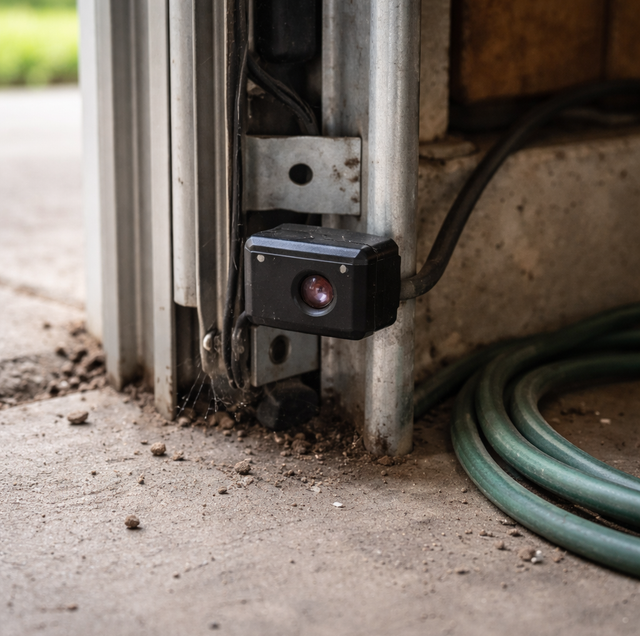
Quick Answer: A garage door that reverses right before it seats is almost always doing its job. Two safety systems can force that reversal: the photo-eye sensors near the floor that stop the door if their beam is broken, and the opener's own force and travel-limit settings that reverse the door if it thinks it has hit something. Wiping the lenses, clearing the beam path, and realigning the sensors until both lights hold steady fixes most cases. When the sensors are clean and aligned, and the door still backs off, the problem has moved up into the track, rollers, or the opener's settings, and that is where a tech takes over.
Few garage-door quirks are as maddening as one that closes almost all the way, pauses, then rolls back up on its own like it changed its mind. You press the button again, same result. The door is not broken in the usual sense. It is refusing to close on purpose, and it is trying to tell you why. Learning to read that signal is the difference between a two-minute wipe of a lens and an unnecessary service call.
The Two Safety Systems That Force a Reversal
Every automatic opener built since the early 1990s has to reverse a closing door under two conditions. Understanding both is the whole key to diagnosing this, because the fix is completely different depending on which one tripped.
The first is the photo-eye safety sensors, a matched pair of small units bolted to the track about four to six inches off the floor, one on each side. One sends an invisible infrared beam across the opening, the other receives it. While the door is closing, that beam is being watched constantly. Break it (a foot, a trash can, a pet, or, just as often, nothing you can see) and the opener slams the door back to full open. This is the system meant to keep a closing door off a child or a car bumper.
The second is the opener's force and travel-limit settings, the motor's sense of how hard it should have to push and how far it should have to travel to reach the floor. The opener learns a normal close: this much resistance, this much distance. If the door meets more resistance than that setting allows before it reaches the expected floor point, the opener reads it as an obstruction and reverses, even though nothing is in the beam. A door binding in a bent track will trigger this. So will a close-force setting dialed too sensitive.
Here is the useful part. The photo-eyes reverse the door at any point in the close, and usually send it all the way back up hard and fast. A force or travel problem tends to reverse it near the same spot every time, often in the last foot before the floor. Where and how the door quits tells you which system to look at first.
When the Photo-Eyes Are the Culprit
Sensor trouble is the most common cause by a wide margin, and the good news is that the sensors themselves rarely fail. They just get dirty, bumped, or blinded.
Read the little lights first: Both sensors have a small LED. On most units, one light is steady whenever the sensor has power, and the second light glows steady only when the two eyes see each other cleanly. A sensor light that is off, flickering, or blinking is the opener telling you the beam is broken or the alignment is off. Before you touch anything else, look at both lights and note which one is misbehaving. That reading points you straight at the problem side.
The photo-eye lenses collect dust, cobwebs, and spider webs across the beam gap, and a film you can barely see is enough to weaken the beam and send the door back up. Wipe both lenses with a dry, soft cloth and clear anything sitting in the beam path, like a coiled hose or a leaning broom, before assuming the sensors have failed.
Realign until both lights hold steady: The brackets holding the sensors are thin metal and easy to knock out of aim with a hip, a bike tire, or a bag of mulch. If one is pointing even slightly off, the beam misses its target. Gently nudge the sensor in its bracket while watching the steady-alignment light, and stop the moment it glows solid and stays that way. Both eyes must agree. If the bracket is loose enough to droop on its own, snug the wing nut or screw so it holds aim.
The odd one: sunlight: Late in the day, low sun shining straight into the receiving eye can wash out the beam the same way a bright flashlight hides a laser pointer. If your door only misbehaves at a certain hour and the lenses are clean, direct sun is a strong suspect. A tech can shade or reposition the eye so daylight stops fooling it.
When It Is Wiring, Not the Eye
Sometimes the lenses are spotless, and the alignment is dead on, yet a sensor light still will not hold. The trouble is often behind the sensor, in the thin two-conductor wire running back to the opener. A wire nicked by a staple, pinched under a bracket, or corroded at the terminal sends an intermittent signal, and the opener responds by refusing to close whenever the connection drops. Wiring faults are a pro repair, not a homeowner wipe-down, but knowing to suspect them saves you from replacing perfectly good sensors that were never the problem.
When the Track, Rollers, or Settings Are the Problem
If both sensor lights are rock steady, the lenses are clean, the beam path is clear, and the door still reverses, the safety eyes have cleared themselves of suspicion. Now the force and travel side of the house is where you look.
A door that binds partway down puts a spike of resistance into the system, and the opener reads that spike as a hit. The usual sources are physical: a dent or twist in the track, a bolt or pebble sitting on the rail, a worn or flat-spotted roller that drags instead of rolling, or a track knocked slightly out of plumb so the door rubs as it descends. Any of these can make a mechanically sound door reverse as if something were under it. This is also where a slab that has shifted pulls the opening out of square, so the door starts to rub one track and trip the force setting on the way down.
Season plays into this quietly and in both directions, so do not blame it on one time of year. In a cold snap, hardened grease on the track and stiff rollers add drag that can nudge a marginal door over its force limit; in humid or very hot stretches, moisture and heat can affect the sensor electronics and the fit of parts. A door that behaves in mild weather and acts up at the extremes is often sitting right on the edge of a force setting that needs a pro to reset.
The safe check you can do: You can look for and clear track debris yourself. With the door open, run your eye along both tracks for anything sitting on the rail and brush it away. That is the limit of the safe hands-on work here. The close-force and travel-limit adjustments are small dials or buttons on the opener that require testing the door's balance and reversal behavior after each change, and getting them wrong can make a door close too hard on an obstruction, which defeats the whole safety purpose. Those settings, and anything involving the springs, cables, or drums, are for a technician with the tools to test them safely.
How to Tell a Sensor Problem From a Track or Spring Problem
The pattern of the failure separates the two. A sensor issue is electrical and all-or-nothing: the door reverses instantly and shoots back up fast, often from any height, and you will usually see a sensor light out or blinking. A track, roller, or force issue is mechanical and positional: the door reverses at roughly the same spot every time, the sensor lights are both steady, and you may hear a scrape, a thud, or a hitch right before it backs off. If you can watch and listen for where and how it quits, you can usually tell a tech which half of the system to bring parts for before they arrive.
If the door feels heavy to lift by hand, slams down fast when you lower it, or you see a gap in the spring coil above the door, stop. That is a spring or balance problem, not a reversal to diagnose, and it is dangerous. Springs and cables hold enormous stored tension, so leave those to a pro and do not force the door in the meantime.
Frequently Asked Questions
On most openers, the overhead light bulb flashes a set number of times, commonly ten flashes, as a built-in error code the moment a photo-eye reversal happens. It is the opener flagging that the safety circuit, not a remote or a limit, stopped the close. If you count the flashes and check them against the model's manual, they often narrow the fault to a specific sensor or wiring fault before anyone opens a toolbox.
Yes, with care. Nearly every wall-mounted control button can override a photo-eye reversal if you press and hold it continuously through the entire close, which forces the door down while you keep watch. Release the button and the door stops. Never do this if a person, pet, or car could be under the door, and treat it only as a stopgap, since you are deliberately bypassing the safety system for that one close.
The sensors themselves have no scheduled lifespan and commonly run 10 to 15 years or more, because they have no moving parts. What fails around them is the exposed wiring, corroded terminals, and cracked lens housings from being bumped or hit. When a genuine sensor replacement is needed, they are always swapped as a matched sending-and-receiving pair, never one at a time, since a new eye and an old eye can struggle to sync.
Cold thickens the lubricant on the track and hinges and stiffens the rollers, so the door meets more drag on the way down and the opener reads that extra load as an obstruction. A fresh application of a garage-door-rated lubricant, which stays workable in cold far better than general-purpose spray oil, often settles a door that only balks when the temperature drops. If it persists, the force setting is likely tuned too tight for the door's real winter resistance.
Usually not, and it is a common way to spend money on the wrong thing. If the reversal comes from a bent track, a worn roller, or an out-of-square opening, a brand-new opener bolted to the same door will read the same resistance and reverse in the same spot. The opener is the messenger. Replacing it only helps when the fault is truly inside the motor unit or its own worn logic board, which is the minority of these cases.
The opener is set to run the door until its bottom seal just compresses against the floor, then stop, with the travel-down limit marking that exact endpoint. If that limit is set even a fraction too far, the opener keeps driving after the door has already hit the floor, senses the sudden stop as an obstruction, and reverses in the last inch. That last-inch reversal with clean, steady sensor lights is the classic signature of a travel limit set slightly long.
If your door keeps changing its mind at the floor, let Arnold read the pattern and fix the real cause instead of guessing at parts — a clean, quiet close that seats the first time, every time. Arnold's Garage Door & Gates serves Fort Worth, Alvarado, and the DFW metroplex. Call Arnold: 682-337-7220.
