
Adding an Opener to a Manual Garage Door — What Has to Be True
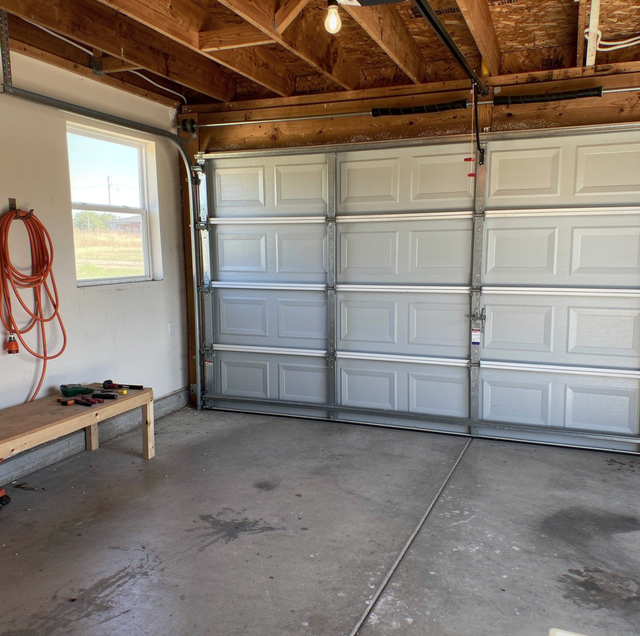
Some garages were never built with a motor in mind. You lift the door by hand, it holds wherever the springs decide to hold it, and the ceiling above it is open joists, a bulb on a pull chain, and a sheet of plywood somebody laid across the rafters for storage. No circuit was ever run up there. So the question is not which opener to buy. The question is whether this door, in this opening, can carry an opener at all.
That answer comes out of a sequence rather than a single yes or no. A technician works through it in a fixed order on-site because each item determines whether the next one still matters. If the door itself rules out automation, the wiring question never gets asked.
The Door's Construction Decides Whether an Opener Is Even a Candidate
Two very different doors get called garage doors. A sectional door is built from horizontal panels hinged together, riding rollers in a vertical track that curves back into a horizontal track running along the ceiling. Hence, the door bends at each hinge and travels flat overhead. A one-piece tilt-up door is a single rigid slab that pivots and swings outward as its top edge rises, sweeping the whole face of the door past the opening before it settles horizontal.
That difference changes the answer. A standard trolley opener pushes and pulls a sectional door's top section along the same horizontal path the door already travels, which is why the rail hangs where it does. A one-piece door's connection point moves through an arc instead, so the geometry a trolley opener is built around no longer describes the door. Some one-piece doors, depending on whether they use jamb hardware or pivot-style track hardware, can be automated with the correct arm and bracket. Others realistically end the conversation at replacement with a sectional door.
Common doors run 10x10 through 14x14, and the wider and heavier the slab, the less forgiving it becomes.
An Opener Is Not Built to Lift Dead Weight
This is where most manual doors either pass or stop. The springs, not the opener, carry the weight of the door. A properly balanced door is close to weightless through its travel, and the opener's job is to move that near-neutral load and hold it in position.
When the counterbalance is off, everything downstream absorbs the difference. A door that is heavy on the way up makes the motor pull against real weight on every cycle, loading the gear and sprocket assembly and the rail in ways they are not rated for. A door that is heavy on the way down can drop faster than the opener can pay out. And a door that only closes properly once force settings are pushed higher has quietly given up the margin that made those settings meaningful.
So the counterbalance gets assessed and corrected by the spring service before an opener is ever specified, not after. Springs, lift cables, and drums are pro-only work with stored energy, and there is no homeowner version of that check.
Never test, adjust, wind, or unwind a garage door spring, and never touch lift cables or cable drums. These parts hold enough stored energy to cause serious injury, and a spring that looks intact can still be badly out of balance.
Headroom Above the Door and Backroom Behind It Set What Can Be Installed
Two measurements get taken next. Headroom is the vertical space between the top of the door opening and the ceiling or the lowest obstruction above it, and it must accommodate the curved section of track, the counterbalance hardware, and the operator bracket at the top of the door. Backroom is how far the horizontal track and the opener rail can run back into the garage, since the door has to have somewhere to go and the motor unit hangs past the end of that run.
Manufacturers publish minimum clearances for each opener and rail combination, and those are what get measured against. The obstruction that kills an install is often not the ceiling itself but something fixed to it: a duct run, a water heater platform, a storage rack, or a sloped ceiling that drops as it crosses the door.
When the clearance is not there, the fix is different hardware rather than a different setting on the opener. The measurement decides the hardware, and it gets taken before anything is ordered.
The Rail and Motor Have to Land on Structure, Not Drywall
An opener has two mounting points, and both take real load. The head of the rail bolts above the door opening, into the header. The motor unit hangs from the ceiling several feet back, usually on angle iron or punched strap. Every cycle applies starting and stopping forces to both, reversing direction each time the door does.
A ceiling that only has drywall is a problem because drywall has nothing to give. The hardware has to reach solid framing, which means locating the joists, and that depends on which way they run. Joists running perpendicular to the door usually let the hanging brackets catch structure where the unit needs to sit. Joists running parallel to the door often leave the mounting point in an open space between members, so blocking must be added before anything hangs. In a finished garage, that also means opening the ceiling and patching it afterward.
The header above the opening gets the same scrutiny. Older openings are sometimes framed lightly, or the visible surface is a trim board over a gap rather than solid wood, and both change what the framing work in front of an install actually requires.
The Opener Needs Its Own Outlet Overhead
Openers plug in. The unit hangs near the middle of the garage and expects a grounded receptacle within reach of its cord, mounted at or near the ceiling. Plenty of older garages have a single wall switch and a bare lamp holder overhead, and nothing else, which means the outlet work happens before install day.
An extension cord is not the answer to that. A cord run across a garage is a trip and abrasion hazard, crossing the path of the door, the rail, and anything you carry through, and it is not a substitute for a dedicated receptacle at the ceiling. An opener is a permanently installed appliance, and the temporary connection becomes the permanent fault.
The receptacle gets added by an electrician, positioned where the unit will actually hang rather than where the ceiling happens to be convenient.
Automation Punishes a Door That Was Tolerable by Hand
Lifting a door by hand hides a lot. You feel the door catch, so you slow down, lift the corner slightly, and ease it past the spot without ever deciding it was a problem. A motor does none of that. It applies the same force through the same binding point for thousands of cycles.
So the running gear gets inspected before anything is automated. Rollers with flat spots, worn stems, or sloppy bearings. Track flanges that are bent, spread, or pulled away from the jamb where a bumper found them. Hinge holes elongated into ovals so the panels no longer sit square to each other. A top section that needs reinforcement because the operator arm is about to concentrate the entire pull load at one bracket.
Manual doors also carry hardware an opener cannot live with. A slide lock or T-handle latch that throws a bar into the track will hold the door shut against a motor, so those get disabled or removed during the conversion.
Correct all of that first. Doing it afterward means a new unit spends its early life fighting the door, and the force settings end up set to whatever the worst point in the travel demands. A door in poor mechanical condition should be brought back to good operating condition and then automated, in that order.
Before the visit, take three photos with your phone: the full ceiling from inside the garage, the space directly above the closed door, and the nearest outlet. It narrows the conversation before anyone measures anything.
What a Site Visit Settles That a Photo Cannot
A photo shows what a door looks like. It does not show what the door weighs, how it moves, or where the structure is. Headroom and backroom are measurements taken from fixed points, not estimated from an angle. Joist direction and spacing are confirmed by locating them, and the header is checked for solid material rather than a painted surface.
Door movement is the other half. Someone who works on doors can tell a great deal by watching one travel and feeling where it loads up, and that judgment routes the job to spring work first, hardware work first, or straight to an install. Automating an existing manual driveway gate is a different service with a different assessment entirely, and none of these prerequisites carry over to it.
The order matters more than any single item on the list. If the door is a one-piece slab with no viable hardware path, nothing about the ceiling or the wiring changes the outcome. If it clears the first two steps, what remains is usually work that can be scheduled rather than a reason to stop. Most manual doors that get looked at land there, with one thing that has to change before the opener goes on.
Frequently Asked Questions
Usually, yes. Many vehicles have HomeLink buttons built into the visor or mirror, and they can be paired with a new opener once the opener is installed and running. Mention it before install day, and it can be handled while the technician is still there.
Openers are sold in horsepower classes, commonly 1/2, 3/4, and 1 HP, and the class is matched to the weight and size of the door. A heavier insulated or solid door generally moves up a class. Motor type matters too: AC motors are the older, simpler design, while DC motors run quieter and tend to be smaller. Battery backup is offered on DC-motor models, and whether it is included depends on the tier.
Yes, when it can be automated at all. A tilt-up door pivots through an arc as it opens, so the connection to the trolley has to be a curved or articulated tilt-door arm rather than the straight arm a sectional door uses. The mounting bracket sits at a different point on the face of the door to follow that swing correctly. The rail and header mount still run the same way overhead. That arm and bracket difference is specific to how the door moves, not to the opener brand.
Yes. Modern openers include photo-eye safety sensors that mount on brackets low on each vertical track and emit an invisible beam across the opening; the opener will not close normally if that beam is broken or the two units fall out of alignment. One consequence of an older door: a bent or rusted lower track is worth correcting because the brackets have to maintain that alignment.
Some DC-motor openers offer battery backup, which keeps the door working through an outage for a limited number of cycles. Without it, the door can be released from the opener and moved by hand, and that release should only ever be pulled with the door fully closed. If the door is already up when the power fails, leave it where it is.
It cannot just be left in place and ignored. A lock that is only disengaged rather than removed can still shift under the repeated cycling a motor puts a door through. If the bar drops back into the track partway through a cycle, the door stops hard against the opener's pull, right at the hardware carrying that load. Removing the mechanism, or securing it so it physically cannot throw again, finishes the conversion rather than trailing behind it.
Can your manual door take an opener? An on-site assessment answers that and lays out what has to be corrected first. Arnold's Garage Door & Gates serves Fort Worth, Alvarado, and the DFW metroplex. Call Arnold: 682-337-7220.
