
Why Your Garage Door Opener Trips the Breaker — Cause by Cause
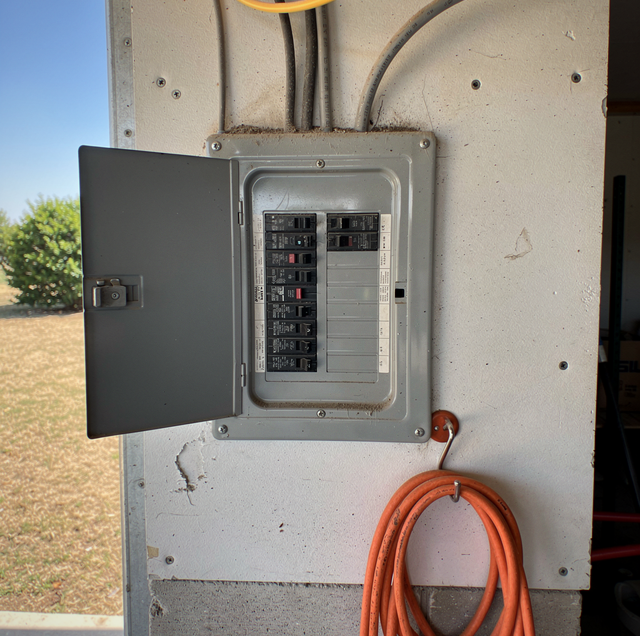
Open the panel, and the tripped breaker is easy to spot. Its handle sits off center, out of line with the row, neither on nor off. Inside that narrow body are two separate sensing mechanisms, and which one let go tells you a lot about what is happening at the opener.
A breaker is not a failed switch. It is a deliberate weak point, sized to give up before the cable in the framing gets hot enough to matter. One internal mechanism reacts to heat generated by excessive current over seconds or minutes. The other opens almost instantly when current spikes hard.
So an opener that keeps killing the power is not yet an opener problem or a panel problem. What matters is which mechanism fired, and what changed in the garage to make it fire.
Three Different Faults Trip the Same Breaker
One handle out of position represents three distinct electrical events.
Overload: The circuit carries more current than the breaker is rated for, with everything still connected correctly. The wire warms, the thermal element warms with it, and the breaker opens after a delay. That delay is the tell, and two motors starting at once is the usual cause.
Short circuit: a hot conductor comes into direct contact with a neutral or a grounded surface. Current climbs to whatever the supply can push through that path, and the magnetic element opens the breaker almost immediately, often leaving an odor or a mark.
Ground fault: Current leaks from the circuit and returns through ground, and even a small amount can be dangerous because that path can run through a person. Protection in the receptacle or the breaker watches for a mismatch between what leaves on the hot and what returns on the neutral.
Note which device actually tripped: a receptacle with test and reset buttons, or a breaker with a test button on its face, points at leakage rather than load.
| What you notice | What it points toward |
|---|---|
| Trips partway through travel, at the same spot | A binding door loading the motor |
| Motor hums, door barely moves, then the trip | A failing start capacitor on an AC opener |
| Holds until a freezer or compressor cycles on | A shared circuit carrying more than it can |
| Trips after rain, or the cord looks damaged | A ground fault at the outlet or in the cord |
| Trips again within seconds, or trips with the door untouched | A fault in the wiring itself |
The Benign Case Is a Circuit Already Doing Other Work
Garage receptacles rarely serve only the opener. A chest freezer, an air compressor, a battery charger, or a table saw can share one cable run back to the panel.
Motors are why that becomes a trip. A motor pulls a surge of current the moment it starts, larger than what it settles into once turning. When the opener begins its lift as the freezer compressor kicks on, the two surges stack and the thermal element sees a total it was never sized for. Nothing is faulty, and manufacturers commonly specify a dedicated circuit for the opener.
You can check this part safely: when the breaker goes, note what else lost power at that moment. If a freezer, a wall of outlets, or a bank of shop lights died with it, you have a shared circuit rather than a broken opener.
Note when the trip lands: the instant the motor starts, partway through travel at the same spot, or with the opener sitting idle. Each of those three patterns points in a different direction.
A Binding Door Makes the Motor Draw Locked-Rotor Current
The mechanical load sets the current draw of a motor. Turning freely, it draws modestly, and resistance makes the current climb to match. At the limit, where the rotor is commanded to turn but physically cannot, the motor enters a locked-rotor condition, drawing the maximum current it can and dissipating nearly all of it as heat in the windings.
A garage door offers several routes there: a roller seized in its stem, a bent section of track, a door out of square so one side drags, a cracked hinge. The opener meets resistance it cannot overcome, and current rises until the breaker or the motor's thermal protector opens.
The more serious version is a counterbalance problem. Because the opener is sized to move a door the counterbalance is already holding, a weakened lifting force leaves it hauling dead weight on every cycle and spending the trip near its limit.
Watching is safe. Does the trip land at the same point in travel each time, does the door strain first, does one side sit higher when it stops? Balance is something a technician tests.
A Failing Start Capacitor Leaves the Motor Stalled Under Load
An AC opener motor needs help getting started. A start capacitor releases stored energy to give the rotor its initial push, and once the motor turns, that job is done.
When the capacitor weakens, that push is no longer enough to break the door free of the standstill. The motor energizes, hums, and either sits there or crawls. Electrically, it is a stalled motor: full current, no rotation, heat piling into the windings with nothing accomplished, and it is usually worse when the opener has been sitting cold.
The start capacitor is located inside the opener housing and can retain a dangerous charge long after the unit is unplugged. Discharging or replacing it is not homeowner work, and the housing should stay closed.
Water at the Outlet or a Damaged Cord Sends Current to Ground
Electricity leaks where insulation stops doing its job, and a garage offers more ways for that than most of the house: a roof leak reaching the receptacle box, water running down a wall behind a surface-mounted outlet, heavy condensation in an unconditioned space.
The opener's cord is another common leak point, hanging where ladders are set down, where storage is shoved against the wall, and where rodents find it. A cord pinched, crushed, rubbed on a metal bracket, or chewed can lose enough insulation for current to reach the frame or the concrete, which can read as a short if severe and as leakage if not.
Report timing against weather: trips after rain or once the sprinklers have run point toward moisture rather than mechanics. Looking at the cord and photographing it is safe. Opening the receptacle, the box, or any part of the house wiring is not.
A Motor or Wiring Fault Is the One You Never Reset Again
The windings inside a motor are wire coated in thin insulating varnish, and years of heat, especially from the stalled conditions above, break that coating down. When turns of wire touch each other, the motor draws more current for the same work, which generates more heat and damages the insulation, ultimately causing a hard short inside the housing. Look for a burnt-varnish odor, browning on the housing, and trips that come faster each time.
House wiring fails in its own ways: a staple driven too tight through a cable, a splice worked loose in a junction box, a conductor pushed into the back of a receptacle instead of clamped under a screw. These faults arc, and arcing puts heat where the wiring is already compromised, in a space full of dust and insulation.
The breaker can also be the failed part. One that has interrupted fault after fault, or aged in a hot panel, may start opening below its rating, and replacing one is work for an electrician at the panel.
That is why the reset is the dangerous part. Each push of the handle re-energizes a fault nobody has fixed and sends full current back into damaged insulation or a loose connection. Interrupting a fault also erodes the breaker's contacts, so one asked to do it repeatedly may not open as reliably. In every other case, the breaker is not the broken part; it is the only piece of that circuit still doing its job. A breaker that goes again within seconds is holding back a live fault, and there is only one right move: leave it off, leave the opener alone, and have the circuit tested before anything on it is used again.
An opener whose logic board has been cooked by heat is a different failure, usually going dead or acting erratically without disturbing the breaker at all.
How to Describe the Fault Accurately When You Call
What you observed safely beats a guess at the cause and determines whether the right parts are on the truck. Have these ready:
- Which device tripped: The panel breaker, or a reset button on the receptacle or breaker face.
- Which of the three timing patterns above the trip follows, and whether it is the same every cycle.
- What else lost power at the same time, and what else is normally plugged in there.
- What you smell, see, or hear: A burnt odor, a hum with no movement, a scrape at one side of the door.
- What the opener is: The brand on the housing, chain, belt, screw, or wall-mounted, and its rough age.
A photograph of the label covers that last one, and a trip that follows the opener to a different outlet is a different call than one that stays with the circuit.
Frequently Asked Questions
Openers fitted with a battery backup keep running on stored power while the circuit is dead, which is what makes it confusing. The door cycles normally, nothing feels urgent, and the fault goes unaddressed until the battery drains. Treat the breaker, not the door, as the real event.
No. Photo-eye sensors, the wall control, and any keypad run on low-voltage wiring stepped down inside the opener, and a fault there carries nothing like the current needed to open a household breaker. A pinched or shorted sensor wire shows up differently: the door refuses to close, reverses on its own, or the indicators behave oddly.
It is not a good idea, and it can make a marginal circuit worse. The motor ends up drawing more current for the same work, and on a circuit already sitting close to its rating, that rise is what reaches the breaker's threshold. The cord warms up on its own account too, so an opener should reach the receptacle directly.
It changes what to suspect first. DC openers run through a control board that ramps the motor up with a soft start rather than slamming it to full speed, so the startup surge is largely engineered out and there is no start capacitor of the usual kind to fail. A DC unit that trips points toward its power supply section, a short, or a badly binding door.
It can be undersized for the work it is given. An opener matched tightly to a heavy door runs near the top of its capability on every cycle, which leaves no margin for anything that adds drag. That rarely trips a breaker on its own, but one stiff roller can push the motor toward a stall, and stall current is what the breaker answers.
Yes, and it is worth acting on quickly. A breaker that is warm to the touch, discolored, buzzing, or giving off a hot plastic odor indicates trouble at the panel: a loose connection at the bus contact or a conductor that is not seated. Have an electrician look first, because none of the opener work matters if the fault is upstream.
Stop resetting the breaker and have the circuit and the opener tested together — a technician can determine whether the fault lies in the motor, the cord, or the house wiring before it causes further damage. Arnold's Garage Door & Gates serves Fort Worth, Alvarado, and the DFW metroplex. Call Arnold: 682-337-7220.
