
Why Commercial Roll-Up Doors Get Harder to Open Over Time
Quick Answer: A commercial roll-up or sectional door that feels progressively heavier, without ever fully failing, is usually showing cumulative wear rather than a single fault. High daily cycle counts wear rollers, bearings, and tracks faster than on a residential door; torsion springs can lose lift gradually as they approach the end of their cycle life; and true coiling doors add curtain and slat wear on top of that. Routine cycle testing catches this pattern months before it becomes a door that will not open at all.
A commercial bay door rarely goes from fine to frozen overnight. Long before a loading dock door refuses to move at all, it tends to send a string of quieter signals first: a slightly longer travel time, a faint scrape partway through the cycle, an opener that seems to work a little harder than it did a few months ago. None of that stops the door from functioning, which is exactly why it gets ignored. But a door that is slowly getting harder to open is telling you something specific about how it is wearing, and catching that pattern early is what keeps a routine service call from turning into a shut-down dock.
"Roll-up" covers both true coiling curtain doors and the overhead sectional doors common on loading docks, and the wear pattern below applies to both, since either style rides on rollers, bearings, and track. True coiling doors carry an additional wear point of their own, covered further down.
How Cycle Count Wears Rollers, Bearings, and Tracks Faster on Commercial Doors
A dock door rarely cycles just once or twice a day. Between inbound trucks, outbound loads, and however many partial openings happen for staging and inspection across a shift, the same rollers, bearings, hinges, and track surfaces do far more work in a week than a lightly used bay door does in a month. Every one of those cycles puts a small amount of wear into each component.
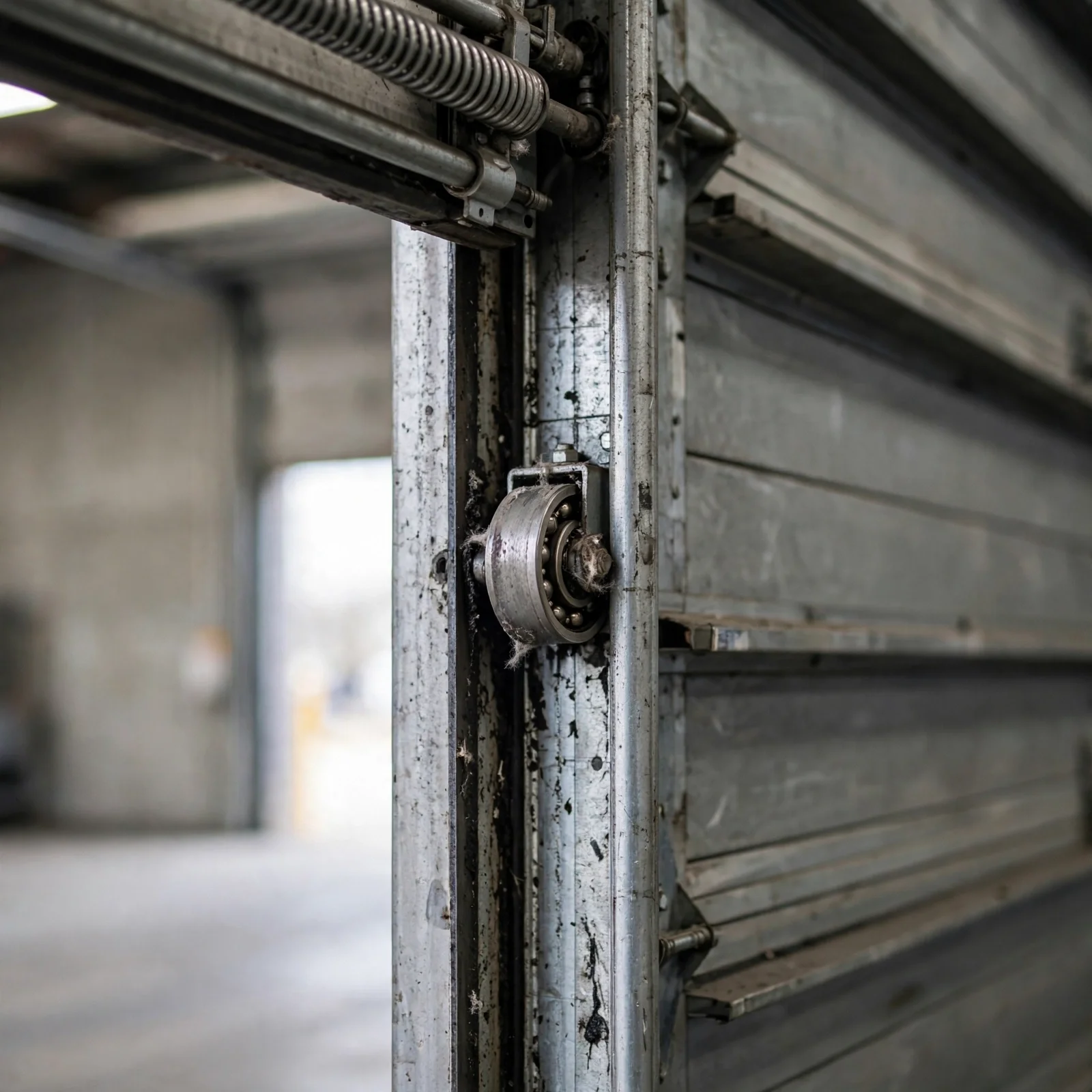
The components reach their practical wear limit sooner simply because they're doing so much more work in the same span of time. Rollers can develop flat spots or uneven wear on the bearing race, so instead of turning smoothly, they start to drag slightly against the track. Hinges connecting the door sections loosen at their pivot points. Track surfaces that once had a clean, even bearing surface can develop light corrosion or debris buildup from the higher traffic around a dock door.
What it looks like: the door still opens and closes completely, but the opener seems to take a bit more effort, a bit more time, or runs a shade louder than it used to. Nothing has failed. The door is simply carrying more friction through its cycle than it was built to run against, and that friction adds up gradually, cycle after cycle.
Tracking Spring Life by Cycle Count Instead of Waiting for a Symptom
A spring nearing the end of its rated cycle life can lose some lift before it fails outright, which is why the door gradually feels heavier rather than stopping all at once. What's often missed on a busy dock is that this decline can be tracked ahead of time rather than caught after the fact.
Because a spring's expected life is rated in cycles rather than years, a facility that logs roughly how many times its door cycles per shift can estimate where a given spring sits in its service life well before it starts showing symptoms. A door on three shifts a day is burning through that rating far faster than one used only during a single daytime shift, even if both doors were installed the same year. Some maintenance contracts build a scheduled spring inspection around that estimated cycle count rather than waiting for the door to start feeling heavy, which catches the fatigue curve on a planned visit instead of a reactive one. Because a commercial torsion spring and the shaft it's mounted on hold a meaningful amount of stored energy, assessing how much life a spring has left and adjusting or replacing it is work for a trained technician rather than something to test or tension yourself.
Track Wear and Misalignment That Builds Over Months of Heavy Use
A single hard impact from a forklift or a truck backing into a jamb is an obvious, sudden event. Gradual track misalignment is the opposite: it is the slow result of months or years of heavy cycling, dock traffic vibration, and ordinary building movement, none of which look dramatic on any given day.
Over time, mounting brackets can loosen slightly, track sections can shift out of parallel by a small margin, and fasteners can back off from repeated vibration every time the door runs. None of that misalignment happens all at once, and none of it necessarily traces back to a specific incident anyone remembers. It just accumulates.
The door usually keeps working through this, which is part of what makes it easy to miss. What changes is that the door tends to bind or hesitate at roughly the same point in its travel every time, or the rollers start producing a light scraping sound as they pass through a section of track that has drifted slightly out of true. Left alone, that uneven wear tends to accelerate, because a roller riding against a misaligned track wears faster than one riding true, which is one more reason this kind of drift is worth catching early rather than letting it run.
Curtain and Slat Wear on True Coiling Roll-Up Doors
True roll-up doors, the coiling style built from interlocking steel slats that wind onto a drum above the opening, wear differently than sectional doors because the entire curtain is doing the flexing, not just the joints between panels.
Each cycle flexes every interlock in the curtain slightly as it coils and uncoils. Over a high number of cycles, those interlocks and the end locks that guide the curtain edges can wear enough that the curtain no longer feeds into the side guides as smoothly as it once did. In some cases, uneven wear across the guides lets the curtain develop a slight bow or wave along its width, which is not usually visible when the door is fully open but shows up as extra friction and noise partway through the cycle.
Because a coiling curtain has more moving joints than a sectional door's panels, this kind of wear is worth checking specifically on true roll-up equipment rather than assuming a sectional door's wear pattern applies. A curtain that starts to bind against its guides tends to get slower to feed, cycle after cycle, until it needs attention.
Catching the Pattern Early With Routine Cycle Testing
None of this wear announces itself with a single alarming event. It shows up as a trend: a little more sound, a little more resistance, a slightly longer cycle time, month after month. That is exactly the kind of change a scheduled inspection is built to catch, and exactly the kind of change that is easy to miss if the only time anyone looks closely at the door is after it has already stopped working.
A routine visit typically includes watching a full open-and-close cycle rather than a partial one, listening for any change in sound compared to the last inspection, checking how long the cycle takes, and visually inspecting rollers, tracks, and (on coiling doors) the curtain for early wear signs. Keeping a simple record of cycle time and any unusual sounds from one visit to the next makes it much easier to spot a trend before it becomes a stalled door on a busy shift.
Framed this way, the goal is not to decide between fixing something and living with it. It is to catch a gradual, predictable wear pattern early enough that a technician can address it on a planned visit, instead of your team discovering it when a loading dock door will not move, and a truck is waiting at the bay.
Frequently Asked Questions
A technician can disconnect the opener and move the door by hand to isolate where the added resistance is actually coming from, which isn't something to attempt on a door that may already be carrying reduced spring lift, since a heavier-than-expected door can drop or shift unexpectedly once it's no longer under the opener's control. Short of that test, watching whether the added effort shows up consistently across the whole travel or only right as the opener engages is a useful clue: wear in rollers, tracks, or springs tends to make the door feel heavier throughout the cycle, while an opener-specific issue often shows up as hesitation or stalling only at the start or a particular point tied to the motor's drive.
Yes, and it's one of the more common reasons a maintenance schedule falls behind reality. A facility that adds a shift, or starts running a dock harder during a seasonal peak, pushes a door through months of extra cycles that an annual inspection schedule set up for the original single-shift usage never accounted for. Revisiting the inspection interval whenever throughput changes keeps the schedule matched to actual wear instead of a fixed calendar date.
Yes. Lubrication on rollers, hinges, and tracks tends to stiffen in colder temperatures, which can temporarily add resistance on top of whatever wear is already present. If a door that has been getting slightly heavier all year suddenly feels much worse during a cold stretch, some of that jump may be seasonal rather than a sign the underlying wear has suddenly accelerated. However, it is still worth having it checked.
Not necessarily. Sound travels along a track and a curtain, so a grinding noise you hear near one end of the door does not always mean the wear is located there. Pinpointing whether the sound is coming from a roller, a track section, a hinge, or a curtain interlock generally takes an on-site inspection rather than a guess based on where the noise seems loudest.
You can generally keep operating it, but continuing to run a door under higher friction day after day tends to put extra load on the opener's drivetrain as well, not just the door itself. A door that already feels noticeably heavier is often better scheduled for a closer look sooner rather than later, so the added strain does not spread to the opener.
No. Lubrication reduces friction between moving parts and can make a door feel a little smoother in the short term, but it does not restore metal that has already worn on a roller bearing, a track surface, or a fatigued spring coil. It buys some time and eases day-to-day operation, but it is not a substitute for a technician assessing how much life those components actually have left.
Schedule a commercial cycle inspection — catch gradual roller, spring, track, and curtain wear before your bay door stops moving during a shift. Arnold's Garage Door & Gates serves Fort Worth, Alvarado, and the DFW metroplex. Call Arnold: 682-337-7220.
