
Garage Door Opener Gear Material: Why Nylon Wears First
The button goes in, the motor runs its full cycle overhead, and the door sits exactly where it was. What comes out of the powerhead is a fast whirr with nothing behind it, and the chain hangs still on the rail while the motor works. Press it again, and the run is the same length, with the same nothing at the door.
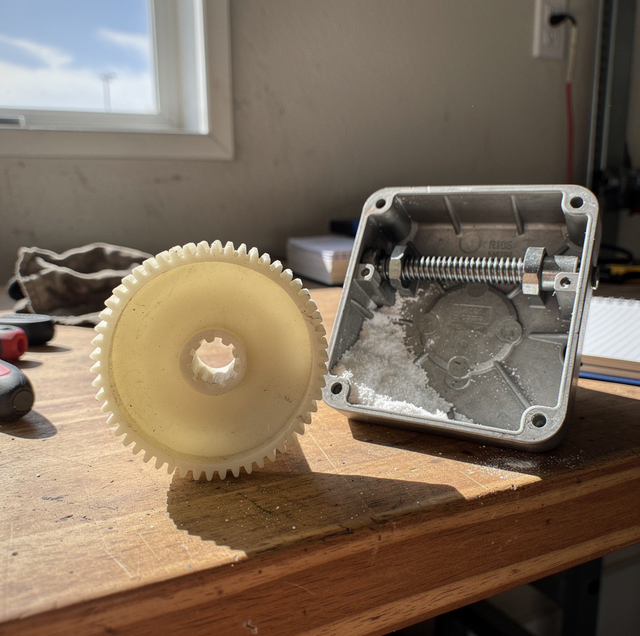
On a bench, with the powerhead down and the case open, the drive gear explains itself. A run of teeth has rounded over on one flank while the opposite flank of those same teeth still carries a crisp edge. In the bottom of the case sits a drift of white powder, dry and fine, packed into the corners where the grease used to be. The steel worm that ran underneath is untouched: threads bright, leading faces unmarked, nothing for a fingernail to catch. One member of that pair gave up everything, and the other gave up nothing.
That the softer wheel is the part meant to go has been covered in work you may already have read, so take it as settled and move to what it leaves open: why a polymer was chosen for the part that carries the entire output of the motor, and what changes in a machine built around metal instead.
Hardness Sets Which Member of the Pair Gives Up First
A trolley opener turns a motor that spins fast at low torque into a door that moves slowly under high torque, and a worm meshing with a wheel does that reduction in one stage inside a case small enough to hang from a ceiling. The price is the contact it uses: the worm thread wipes across the wheel tooth along its length instead of rolling over it, and sliding contact generates heat and, by definition, causes material loss. Something in that mesh is going to wear, and the choice of material determines which member.
The steel worm is the end you cannot easily replace. It couples to the motor shaft and sits in bearings located by the case. The wheel sits outboard of that on the output shaft and comes in a bag. Making the wheel the softer member puts the wear where a replacement is a component rather than a whole powerhead.
Put two hard members in the same mesh, and the wear rate at the flanks drops. The forces do not. Every spike once absorbed by a tooth face deforming slightly now travels through the shaft, into the bearings, into the armature, and into the case bosses that hold everything in position. A bearing that has been hammered runs rough and stays rough, and armature end play that has opened up does not close again. Neither one comes in a bag.
The white powder at the bottom of the case is the wheel's own material giving way as designed. Metallic glitter worked through the grease is different evidence: steel is shedding too, and the worm and the shaft become part of the finding.
Grease Carries Half the Job in a Worm Mesh
Because the contact slides rather than rolls, the film between the flanks does a share of the work the teeth cannot do alone. The case is packed at assembly and holds that charge, and for most of an opener's life the grease keeps returning to the mesh as the wheel turns.
Three things end that. Heat and rotation throw grease off the mesh and up the case walls, and past a point it stops returning to the contact. The oil separates from the thickener that carried it, leaving a stiff residue that no longer wets the flanks. And the case is closed rather than sealed, so concrete dust, drywall grit, and insulation fiber work in and get dragged through the contact.
Once the flank runs dry, the polymer heats at the contact, and the hot polymer deforms under pressure. The tooth face rolls over instead of sliding clean, which is the rounding that shows on any wheel pulled out of a case that went dry.
A steel wheel would be far less forgiving of the same dry case. Hardened flanks sliding without a film scuff and gall, and the debris they raise is metal harder than any polymer dust, still cutting once it is loose in the grease. Grease belongs to the load path the same way the teeth do, and the polymer version of losing it is a part that wears out quietly rather than a case full of abrasive.
Shock Loads Land on the Softest Member of the Train
A door in good condition asks the drive for steady pull. Plenty of doors ask for something else. A roller seized in its stem drags rather than rolls. A track pinched or bent makes the door bind at that point on every pass. Hinges out of line cock the sections, and a door whose springs have lost tension leaves the drive doing work the counterbalance used to do.
What those have in common is that they turn a smooth demand into a spike at the same point in the travel cycle. Add the reversals at each end of travel, where the drive stops turning one way and starts the other, and the mesh sees repeated peak loading that has nothing to do with how many hours the motor has run.
Under one of those spikes, a polymer tooth deflects at the root and gives the load back. The movement is too small to see, but it spreads the peak across a longer moment of contact and across more than one tooth in mesh. A hardened tooth deflects far less, so the spike keeps its shape and passes to whatever is next in line. That is what a yielding wheel protects: the output shaft, the bearings, the armature and the case that locates all three. A higher horsepower class does not remove those spikes. It feeds them more energy.
An intact worm drive holds the door wherever travel stopped. With the wheel stripped, the springs alone carry it, so treat a door left partway open as unsupported and keep people and vehicles out from under it.
Damping Is Why the Drive Stays Quiet While the Teeth Are Good
A powerhead hangs from framing, and in plenty of houses that framing is the floor of a bedroom. Whatever the drive puts into its mounting goes into the building, and two hard members meshing produce a tone that carries well through structure.
A polymer wheel converts a portion of each tooth-to-tooth impact into heat within the material rather than into sound in the case. Damping like that is one of the properties the polymer is there to supply. It is also why a change in drive noise matters: a powerhead that was quiet and has become a whirr or a grind is worth reading at the mesh before the rail.
A Steel-Geared Opener Is a Different Machine Around the Gear
When a listing or a neighbor mentions a steel-geared opener, the phrase usually refers to a different class of machine rather than the same machine with a metal wheel. Commercial and industrial-duty operators are built around metal gear trains, and everything else in them matches: larger cases, heavier bearings, motors rated for the duty, and mounting sized for what a hard train passes along.
Other architectures move the hard member elsewhere in the load path. A screw drive turns a steel screw the full length of the rail, and the trolley rides on it, so the load spreads differently than with a worm-and-wheel powerhead turning a sprocket.
The makers say much the same in their own words. Chamberlain publishes a support note explaining that the nylon in its motor units is chosen because in this application it outperforms steel and lasts longer, which is a claim about how the pair works together rather than about the raw material on its own. The wheel and the worm are sold as a kit for the same reason: mesh geometry is a specification for the pair, not for either piece alone.
What does not follow is dropping a metal wheel into a residential case designed around a polymer one. The shaft, the bushings, the bearings, the motor and its mounting were specified on the assumption that the wheel is the compliant member of the pair. Remove that assumption and every part around it is working outside what it was sized for, whatever an aftermarket package says.
Nylon Earns Its Place by Being the Member That Gives
The material question comes out smaller than the aftermarket listings make it look. A worm mesh needs one compliant member, and the machine is better off when that member is the inexpensive one, sitting where a spike is absorbed rather than passed along to bearings and an armature that no bag on a shelf will replace.
The worn wheel then carries a second kind of information, and it still points back at the material choice. Wear spread evenly across every tooth, and both flanks belong to an opener that used itself up doing the job it was built for. Wear concentrated over a short arc of the circumference belongs to a door that fought the drive at the same point of travel over and over, and a harder wheel would only have moved that fight into the bearings behind it. Teeth glazed and smeared rather than powdered belong to heat, either a mesh that ran dry or a motor pushing against resistance long enough to cook the contact.
In each of those, the polymer did what it was chosen for and reported the condition of the machine around it. A drive that ate a wheel in a short span of service is describing a door heavier, rougher, or more out of true than the powerhead was sized for, and that reading is the useful part of the material argument.
Frequently Asked Questions
Often. A wheel rarely surrenders every tooth at once, so the door starts stalling partway through a run and then finishes on a second press of the button, and a run that used to sound identical every time develops a stretch where the note changes. Both of those show up while the drive is still moving the door.
Nylon absorbs moisture from the air, and its stiffness and toughness change as it does. A gear that has spent years in a damp, unconditioned garage is not in the same condition as that part in a dry one at the same number of cycles, which is one reason two identical openers on identical doors do not always reach the same point of wear together.
No. A maker like LiftMaster, Genie or Chamberlain uses more than one gear-and-worm set across its lineup, and generations within one product family can differ as well. The model number on the powerhead's label is what identifies the correct kit, which is why it is the first thing a technician writes down.
Grease stiffens as temperature falls and does not flow back into the mesh as readily on the first turn of the wheel. The drive works harder for a cycle or two until motion warms the case and the charge softens. Noise that settles after a couple of runs is temperature; noise that stays put once the case has warmed is not.
No. A wall-mount, or jackshaft, opener sits beside the door and drives the torsion shaft directly rather than pushing a trolley along an overhead rail, so its reduction hardware is laid out for a different job, and its internal parts are not interchangeable with a trolley powerhead's gear kit.
Usually not, because within a single model line, the belt and chain drive versions typically share the same powerhead and worm-and-wheel set. What changes is what the output sprocket or pulley turns once motion leaves the case. The belt buys quieter running and the chain a different maintenance profile, and neither alters the gear material inside the housing.
A drive-gear diagnosis that names what stripped the gear — the replacement then lasts, because whatever loaded the first one gets found and corrected at the same visit. Arnold's Garage Door & Gates serves Fort Worth, Alvarado, and the DFW metroplex. Call Arnold: 682-337-7220.
