
Commercial Roll-Up Door Won’t Open? What’s Really Going On
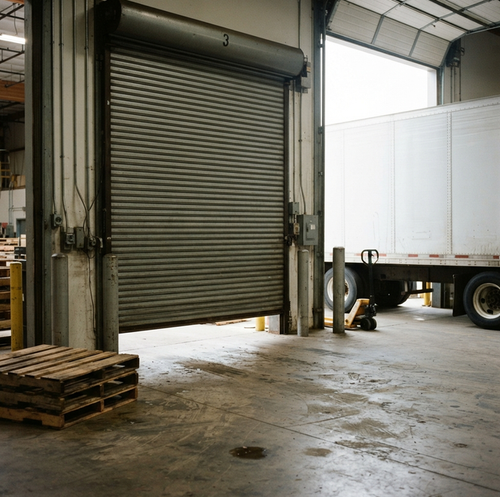
A delivery truck sits backed up to bay three with its engine idling, and the roll-up door in front of it will not budge past the first foot of travel. Your driver is on the dock radioing that he's got a full pallet jack and nowhere to put it. Somewhere behind the wall switch, a torsion spring the size of your forearm, a jackshaft operator wired into three-phase power, or a sensor eye the size of a quarter is the reason your whole receiving schedule just backed up. Figuring out which one it is, fast, is the difference between a fifteen-minute fix and a half-day of trucks stacking up outside.
Commercial roll-up and sectional doors are not oversized residential doors. The steel is thicker, the torsion spring is rated for tens of thousands more open-close cycles, and the operator is often a jackshaft unit bolted directly to the torsion shaft rather than an overhead trolley opener. That heavier hardware means a "door won't open" call has more possible causes than it does on a house, and several of them look identical from where you're standing at the wall station. Below are the questions a technician actually works through, in the order they matter, and the mechanism behind each answer.
Quick Answer: A delivery truck sits backed up to bay three with its engine idling, and the roll-up door in front of it will not budge past the first foot of travel. Your driver is on the dock radioing that he's got a full pallet jack and nowhere to put it. Somewhere behind the wall switch, a torsion spring the size of your forearm, a jackshaft operator wired into three-phase power, or a sensor eye the size of a quarter is the reason your whole receiving schedule just backed up. Figuring out which one it is, fast, is the difference between a fifteen-minute fix and a half-day of trucks stacking up outside.
Does the Motor Hum, or Is It Silent?
This is the first thing worth checking because it splits the problem in half immediately.
A humming motor that doesn't move the door usually means the operator is receiving power and trying to turn, but something downstream is stopping the shaft. On a commercial door, that is almost always the torsion spring. Commercial torsion springs are wound heavier than residential ones and rated for a far higher cycle count, often several times what a house door spring sees, because a warehouse bay can cycle dozens of times a day instead of two or three. When that spring breaks, the operator is suddenly trying to lift the full dead weight of a steel door on a motor rated for the light duty of moving an already-balanced one, not for lifting it from a standstill. It will hum, strain, and go nowhere. Do not keep hitting the button; repeated attempts on a dead spring can burn out the motor windings or strip the gear reducer inside a jackshaft operator, turning a spring job into a spring-and-operator job.
A completely silent motor points somewhere else entirely: the door is getting no power at all. Check the breaker panel and the motor starter's overload relay before assuming the operator itself is dead. A dead contactor, the relay that actually switches power to the motor, produces exactly that silence and is a common failure point on operators that run heavy daily cycles. Note that a lost phase is not silent: a three-phase motor running on two legs will buzz and draw heavy current without turning, which sounds much like a motor straining against a broken spring rather than a dead one. Sorting those two apart is where the manual-disengage check further down earns its keep.
Did It Stop Mid-Cycle, or Never Move at All?
Stopped mid-cycle, especially if it reverses on its own, almost always means a safety device did its job. High-traffic commercial bays are normally equipped with photo-eye sensors, a pair of small transmitter and receiver eyes mounted a few inches off the floor, or a safety edge along the bottom of the door, or both. If a forklift, a stray pallet, dust buildup on the lenses, or even direct sunlight hitting the receiver interrupts that beam, the operator reads it as an obstruction and stops or reverses the door. This is not a malfunction; it's the system working as designed. Wipe the lenses, check that nothing is blocking the beam path, and confirm the two eyes are still aimed at each other, since a forklift clipping the mounting bracket can knock them out of alignment without anyone noticing until the next cycle.
Never moved at all from the very first press of the button, the likely cause shifts toward the limit switches or the control board. Every commercial operator has limit switches that tell it where "fully open" and "fully closed" are. If the up-limit switch has drifted out of adjustment or its cam has slipped on the shaft, the operator can think the door is already at its open position and refuse to run, even though the door is sitting shut. This looks exactly like a dead motor from the wall station, but the fix is a limit adjustment, not a motor swap.
Any Burning Smell or a Tripped Breaker?
This question rules a lot in or out fast, and it's one homeowners with a residential opener rarely have to ask, since a quarter-horsepower trolley opener doesn't draw enough current to trip a breaker under normal strain the way a commercial motor can.
A burning smell around the operator housing points to windings that have been overheating, usually from the motor working against resistance it shouldn't have to fight: a spring that's lost tension, tracks that have racked out of square, or rollers seized from years without lubrication. A motor that's been straining against any of those for weeks will run hotter with every cycle until something gives. If you smell it, shut the door down at the disconnect and don't run it again until a technician has checked why the motor was working that hard.
A tripped breaker with no smell is more often a plain electrical fault: a short in the motor windings, a failed capacitor on a single-phase unit, or a contactor that's welded partially closed and drawing excess current on start-up. Reset the breaker once. If it trips again immediately, stop resetting it and call it in, because repeated resets on a genuine short can damage the motor beyond repair.
Does the Door Feel Balanced When You Move It by Hand?
If the operator is disengaged (most jackshaft units have a manual disconnect, and chain-hoist backup is common on larger commercial doors) and you can lift the door partway by hand, pay attention to how it feels. A properly balanced commercial door, even one weighing several hundred pounds, should move with noticeably even resistance and hold roughly still when you let go partway up. A door that feels light in your hands near the bottom and heavy toward the top, or one that wants to slam down the moment you release it, is telling you the torsion spring has lost tension even if it hasn't fully snapped. A partially fatigued spring can still let the operator run the door, just poorly, straining the motor and gears with every cycle until it fails, usually at the worst possible moment.
This is also where a commercial door differs most from a residential one. A homeowner's door cycles a handful of times a day; a warehouse bay door might cycle fifty or more. That cycle count is why commercial torsion springs are built and rated differently in the first place, and why a spring nearing the end of its rated life deserves attention before it fails mid-shift, not after.
Is This One Door, or Every Door on That Circuit?
If a single bay door won't open and the others on the dock work fine, the fault almost certainly lives at that door: its spring, its limit switches, its sensors, or its operator. If every door fed from the same electrical panel or subpanel stopped at once, look at the panel itself, a tripped main breaker, a building-wide power blip, or a control circuit fault upstream of the individual operators. Facilities with older three-phase distribution sometimes lose one leg of power building-wide without losing all three, which can leave every door on that circuit humming uselessly at the same time. That pattern is worth mentioning to whoever you call, because it changes where the technician starts looking.
Why a Wrong Guess Escalates Faster on a Commercial Door
A residential garage door blocking a driveway is an inconvenience. A commercial bay door blocking a loading dock is a business problem: idle trucks, delayed shipments, a crew standing around a dock that can't move product. That's the real reason the diagnostic questions above matter more on a commercial door than on a house door. Guessing wrong and running the operator against a failed spring or an unaligned sensor doesn't just delay the fix; it can turn a same-day repair into a multi-day one if the gear reducer strips or the door comes off its track under load. Heavier equipment means a wrong guess escalates faster, both in downtime and in the size of the repair that follows.
What to Do While You're Waiting on a Technician
Kill power at the disconnect if you smelled anything burning or the breaker won't hold after one reset. Otherwise, leave the door where it is. Don't force it up by hand against a suspected broken spring, and don't keep cycling the operator hoping it clears itself, since that's how a fixable fault turns into a replaced motor or a bent door section. If you have a manual chain hoist and the door needs to move for an urgent load, two people and slow, even pressure beats one person yanking on a chain against dead weight.
Frequently Asked Questions
Yes. Many jackshaft-style commercial operators are available in single-phase versions for buildings without three-phase service, and they still deliver far more torque than a residential trolley opener because they drive the torsion shaft directly instead of pulling a chain or belt overhead. The failure modes for humming-but-silent versus tripped-breaker still apply the same way on single-phase units, just without the phase-loss scenario.
In a warehouse with forklift traffic, dust and exhaust residue can film over the lenses within a few weeks, faster near loading areas where cardboard dust or grain dust is present. A quick wipe with a dry cloth during a weekly walk-around catches most of it before it causes a nuisance reversal.
A misadjusted limit switch just needs its position reset, a quick field adjustment. A stripped or broken limit gear, an internal component that translates shaft rotation into the operator's sense of door position, means the unit loses track of where the door is entirely and may need to be opened up for repair or replacement, not just readjusted. A technician can usually tell which one it is by whether the limits hold consistently after a manual reset or drift again within a few cycles.
A little warmth after normal operation is expected on any motor working under load. What's not normal is a motor too hot to hold your hand on, or one that stays hot for an extended period after the door has been idle. That level of heat usually means the door is still out of balance even after a repair and the motor is compensating for it, which is worth a callback rather than assuming it will settle on its own.
Yes, and it's one of the trickier calls to make from the wall switch alone. A failing run capacitor on a single-phase motor can leave it humming and drawing current without generating enough starting torque to move the door, which looks identical to a spring straining against full door weight. The way to tell them apart without opening the operator is the manual disengage: if the door moves freely and balances evenly by hand with the operator disconnected, the spring is fine, and the fault is electrical.
Generally yes. A safety edge, the rubber-encased sensor strip along the door's bottom rail, takes physical impact every time something brushes it on the way down, while the photo-eyes are stationary and only fail from misalignment, wiring, or a dirty lens. On a busy dock, the edge tends to wear out or get punctured well before the photo-eyes need attention, so a technician checking one during a service call should check the other independently rather than assuming they age at the same rate.
Getting the Bay Back in Service
Most commercial roll-up door failures trace back to one of a handful of causes, but which one it is changes both how urgently you should treat it and what it takes to fix it correctly. A door that hums against a broken spring and a door that's silent from a lost motor phase can look the same from the wall station and require completely different repairs, which is exactly why walking through these questions before a technician arrives saves time once one is on-site. The goal isn't to diagnose it yourself with a wrench in hand; it's to describe the symptom accurately enough that the right parts and the right technician show up on the first visit instead of the second.
Get a commercial door tech out today — describe the symptom (humming, silent, tripped breaker, or stopped mid-cycle) when you call, and Arnold will come prepared for torsion spring, jackshaft operator, or sensor work on the first trip. Arnold's Garage Door & Gates serves Fort Worth, Alvarado, and the DFW metroplex. Call Arnold: 682-337-7220.
