
Wood Garage Door Springs: Why a Steel Spec Falls Short
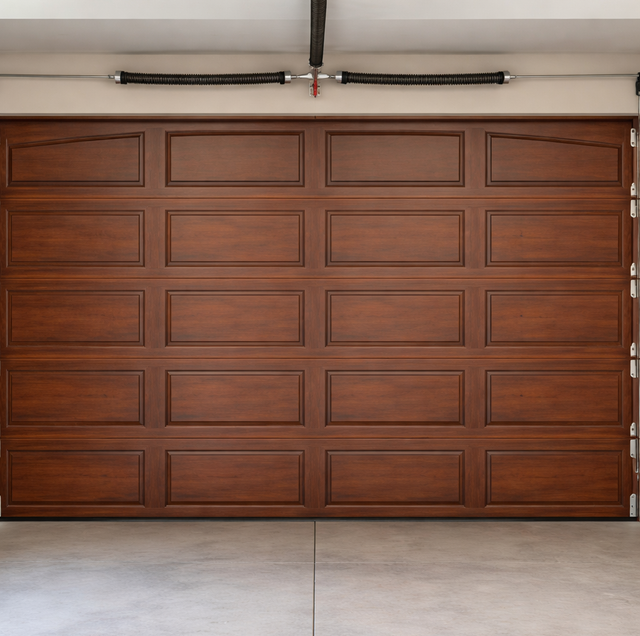
The sections come off the truck crated face down, cardboard between them, and somebody reaches for one end to slide it clear. Cedar stiles and rails, raised panel inserts, finish on both faces. That one section takes two people. The door it replaces was steel, and one installer walked it across the driveway.
That moment is where a wood door project quietly reaches the springs. The spring, shaft, cables, and drums above the opening all exist to cancel one number: what the door weighs. When the door on those cables was built to a drawing, that number didn't exist until somebody weighed the finished door.
Steel doors let the trade get away with shorthand. Say sixteen by seven and a technician can picture the weight inside a narrow band, because a steel door that size is built the same way in every plant. Wood offers no shortcut.
What Puts the Extra Pounds in a Wood Door
A steel sectional door is mostly air. Each section is a formed skin in 24- through 27-gauge steel, sometimes with a second inner skin, and between them sits polystyrene board, injected polyurethane, or nothing. A double steel door weighs around 150 to 250 pounds, depending on gauge and construction; a single door weighs around 100 to 150 pounds.
A wood door has material all the way through. A stile-and-rail door is a frame of solid lumber, cedar, hemlock, redwood, or mahogany, with panel inserts filling the openings, joined and glued the way furniture is. A large one can run well past the top of the steel bands above.
Then there is the version that fools people most often: the carriage-house overlay. Underneath is an insulated steel or composite base door with a published weight in the manufacturer's literature. Onto its face go cedar or composite planks, trim boards, and decorative hardware. That published weight covers the base door alone. What actually hangs on the cables is the base door plus everything bonded and screwed to its face.
Custom Openings Break the Standard Size Chart
Mass-produced steel doors exist because openings were framed to match them. Eight by seven, nine by seven, sixteen by seven: a short list of sizes covers most of the housing stock, and that is what makes a lookup chart possible.
Custom wood doors run the opposite direction. The opening comes first, often on a shop building, a barn-style garage, or a remodel that moved a header, and the door gets built to fit it. A ten-foot width. A nine-foot height. An arched top section carrying a run of material a flat door does not have. None of that lands on a chart keyed to standard sizes.
Height counts too, in a simpler way than width does. Added height adds sections, and each section is more steel or more solid wood on the shaft, so a nine-foot-tall custom door carries more weight than an otherwise identical seven-foot one before anything about width enters the picture.
Why a Single-Width Wood Door Sometimes Needs a Pair
On steel doors, the pattern is easy to carry in your head. Single-car width usually gets one torsion spring, double-car width gets two, and on mass-produced doors it holds up well enough. A nine-foot wood door can outweigh a sixteen-foot steel one, and once that is true the pattern stops meaning anything.
Reaching the required torque with a single spring means going up in wire diameter, up in body length, or both, and each has a ceiling. One coil heavy enough for a solid wood door can run out of shaft space, run out of headroom, or exceed what a stock winding cone is rated to transmit without slipping under load, which is where a wood door forces a pair sooner than a steel one of the same width would.
Two springs also change what happens when one of them fails. The survivor keeps feeding torque into the shaft, so the door keeps moving on every attempt to run it. That is the more dangerous version of a spring failure, since a door that keeps limping through cycles gets tried again and again, and each attempt loads the opener, the cables, and the top section with weight none of them were built to carry.
What Else Gets Sized Alongside the Spring
The spring is the part everyone names, but it belongs to an assembly that all sees the same load. Start with the torsion shaft. A one-inch hollow tube handles a typical residential door, while a heavy custom build often moves to a solid shaft, since the shaft transmits the spring's torque along its full length and twist under load is real on a wide door. The end bearing plates and the center bearing that carries that shaft come in heavier-duty versions for the same reason.
Lift cable diameter is worth asking about on a heavy door. Residential doors commonly run 1/8-inch galvanized aircraft cable, and a heavy custom build often moves up to 5/32-inch, which also requires drums to be grooved for the larger cable.
Hinges are numbered by which joint in the door they sit at, and each number is made in heavier gauges. Track gets thicker with more brackets along the vertical run, and the header hardware anchoring the spring's stationary end is matched to the load it now carries. Skip any of it and the spring can be sized correctly while everything around it runs past what it was picked for.
On a wood door, the bottom brackets thread into a wooden stile, and those fasteners carry the full cable load on every lift. A bracket that has worked loose, or wood that has softened around the screws, is a stop-using-the-door condition.
Wood Door Weight Keeps Moving After Installation
One more thing separates a wood door from a steel one. Wood takes on and gives up moisture with the surrounding air, and its weight changes with it. A steel door does not. What it weighed the day it was hung is what it weighs ten years on, minus whatever hardware somebody added since. So a wood door earns a balance check as a recurring maintenance item; a steel door gets by on a longer interval.
Getting the Finished Weight on Paper Before the Door Goes Up
The useful moment in a wood door project comes earlier than most people expect. Once the door exists as a finished assembly, crated in the driveway or already hanging, it can be weighed, and every decision above the opening follows from that reading. What is worth keeping afterward is the number. A wooden door does not announce its weight. Nothing is stamped on it, no model number resolves to a spec sheet, and nobody can tell from a ladder. A weight written down, with the wire diameter, the count of springs, and the drum size that went with them, means the second conversation about that door starts where the first one ended rather than starting over with a scale.
Frequently Asked Questions
Crated sections can be weighed individually on a floor scale before assembly, with the hardware included. On a shop-built door, the fabricator's build ticket often lists a finished or per-section weight, letting the spring and shaft be worked out while the opening is still being prepped.
It depends on what it is made of. Cast-iron strap hinges, pull handles, and clavos across a wide door add real pounds, while the injection-molded and magnetic look-alikes sold for steel doors add close to nothing. Placement counts too: hardware concentrated on the top section rides on the same bracket the opener arm pulls from.
They can, and older ones sometimes do, but matching one to a heavy custom door is trial and error. Extension springs ship in fixed lift-capacity steps, identified only by a painted color code on the coils, and a wood door built to a one-off drawing rarely lands on one of those steps exactly. Most wood and overlay doors end up on torsion, where the spring gets built to the door's own number.
A little, in two ways. Several coats of stain or paint across both faces of a large door add a few pounds of solids, small but real on a door already at the heavy end. The larger effect is the back face: a door finished only on the outside takes on moisture through the unsealed side, so its weight shifts more than that of one sealed on every face and edge.
Usually. The stem and the bearing inside a roller carry the door's weight against the track flange, so a heavy door gets a heavier-duty sealed-bearing roller in place of a light nylon tire. A light-duty roller under a heavy door shows up as flat spots on the tire and scoring inside the track long before anything fails.
Often, this saves a return trip. Once the finished weight, door height, and drum size are known, the torque and turn count can be calculated and the springs sourced before install day. Heavy wire diameters and long spring bodies are not typical truck stock, so a door needing them can sit waiting on parts.
Have a wood or custom garage door weighed and sprung to what it actually carries — spring work and hardware sized to the door already on your opening. Arnold's Garage Door & Gates serves Fort Worth, Alvarado, and the DFW metroplex. Call Arnold: 682-337-7220.
