
Why Is My Garage Door So Loud? 7 Noises Decoded
Quick Answer: Most garage door noise comes from loose hardware or dry rollers and hinges, both of which you can safely handle yourself. A sudden loud bang, grinding against the track, or a door that won't move evenly points to springs, cables, or an off-track door, which are high-tension repairs for a professional. Match the sound to the cause below before you touch anything.
You pull into the driveway, hit the button, and the whole thing announces itself to the neighborhood. A door that used to open quietly now rattles, squeals, or lets out a bang that makes you wince. The good news is that a garage door is one of the more honest machines you own. It rarely fails silently. The sound it makes is usually pointing straight at the part that needs attention, and a lot of the time the fix is simple.
Your door is basically a stack of hinged panels riding on wheels. Before we go noise by noise, it helps to know the moving parts, because each one has its own voice.
How A Garage Door Actually Moves
Once you understand the mechanics, the sounds start to make sense.
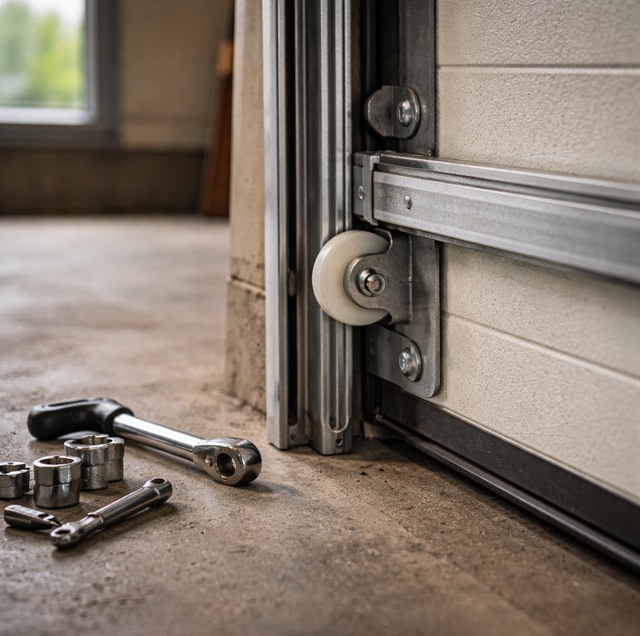
Rollers and tracks: Each panel has small wheels, called rollers, that ride inside a metal track on both sides. The rollers guide the door up and over as it opens. When they're worn or dry, they scrape and grind instead of rolling smoothly.
Hinges: The panels are joined by hinges that flex as the door bends around the curved part of the track. Dry hinges squeak. Hinges with worn pin holes clunk and pop.
Springs: Above the door or along the tracks sits the spring system, either a torsion spring on a bar over the opening or a pair of extension springs running alongside. These springs are wound under enormous tension and do the real lifting. Your opener just guides the door. The springs carry the weight.
Cables: Steel cables connect the bottom of the door to the spring system. Like the springs, they're under high tension whenever the door is up.
The opener: The motor unit on the ceiling pulls the door along using a chain, a belt, or a screw drive. It's the part most people blame for noise, though often it's just reacting to a problem somewhere else on the door.
Now, the sounds.
Rattling And Vibrating: Usually Just Loose Hardware
A door that rattles and shakes as it runs is the most common complaint, and often the easiest to cure. A garage door goes up and down thousands of times a year, and every cycle sends a little vibration through dozens of nuts, bolts, and brackets. Over months, they work themselves loose.
Grab a socket set and a wrench, put the door down, and snug up the nuts on the hinges, the roller brackets, and the bolts holding the tracks to the framing. Don't crank them like you're changing a tire. Firm is enough, since over-tightening can strip the hole or crack a bracket. Nine times out of ten, the rattle quiets right down.
One caution: the bolts at the very bottom of the door, where the cable attaches to the bottom bracket, are under spring tension. Leave those alone. That bracket is a pro-only zone.
Squeaking And Grinding: Dry Parts Begging For Lube
A high squeak or a dry grinding sound almost always means metal is rubbing metal without lubrication. Rollers, hinges, and spring coils all need a light film of the right lube to run quietly.
Reach for a garage-door lubricant, a silicone or lithium spray made for the job, not WD-40. WD-40 is a solvent and cleaner, not a lubricant, so it cuts old grease and dries up, leaving the parts drier than before and the door louder a week later. With the door down, spray each hinge pivot, the roller stems, and the spring coils, then wipe the drips.
With the door down, spray a little on each hinge pivot, on the roller stems where they enter the hinge, and along the spring coils. Wipe the drips. Run the door a few times to work it in. A dry door and a freshly lubed one sound like two different machines.
A Loud Bang: Treat This One Seriously
A single sharp bang, loud enough to make you jump, is the noise you don't want to ignore. More often than not, it's a torsion spring snapping. Those springs hold hundreds of pounds of tension, and when one breaks, it releases all of it at once, which is where the noise comes from.
After a spring breaks, you'll usually notice the door feels impossibly heavy, the opener strains or refuses to lift it, or you can see a visible gap in the spring coil above the door. Do not try to lift the door, and do not keep hitting the opener button hoping it'll catch.
A single sharp bang is usually a torsion spring snapping, releasing hundreds of pounds of stored tension at once. After it goes, the door feels impossibly heavy and the opener strains or cannot lift it. Do not try to lift the door or keep hitting the opener button, and do not attempt the repair yourself. Springs and cables are the one area of a garage door that can truly injure you, so call a technician every time.
Popping And Clunking: Flexing Panels Or Tired Rollers
A rhythmic pop or clunk as the door travels, especially around the curve in the track, usually comes from one of two things. The door sections can flex and pop as they bend, common on older or lighter doors. Or the rollers have worn down and are shifting in their brackets instead of rolling cleanly.
Watch the door run with the light on. If a specific roller wobbles or the sound tracks a particular panel, that roller is likely worn. Nylon rollers are quieter than the old steel ones, and swapping them is a reasonable job, but only the rollers held by a standard hinge. Any roller near the bottom bracket ties into the cable and tension system, so those get left for a pro.
Scraping: The Door Is Fighting The Track
A harsh scraping or metal-dragging sound is a warning to stop and look. It usually means a track is bent or a roller has jumped out of the track. A door that's rubbing where it shouldn't is a door under stress, and forcing it makes the damage worse.
If you see a roller sitting outside its track, or a track that's visibly kinked or pulling away from the wall, don't run the opener. A door coming off its track can bind, drop, or jam hard, and getting it back on line safely is a pro job because the tension in the system can shift suddenly. Disconnect the opener using the manual release cord, leave the door where it is, and make the call.
A Straining Or Humming Opener: Look Past The Motor
When the opener grunts, hums, or strains and the door crawls up slowly, it's tempting to blame the motor. Usually the motor is the messenger. An opener is sized to guide a door that its springs are already balancing. When the springs weaken, the opener suddenly has to fight the full weight of the door, and it strains.
There's a quick test. With the door down, pull the manual release cord to disconnect the opener, then lift the door by hand. A properly balanced door lifts with two fingers and stays put around waist height. If it slams down or takes real muscle to raise, the balance is off, and that traces back to the springs rather than the opener. A worn opener does exist, but check the balance first. Reconnect the opener when you're done by running it through one cycle.
Rumbling That Travels Into The House
Some doors run fine but send a rumble through the ceiling into the bedroom above the garage. That's less about a broken part and more about how the vibration travels. A chain-drive opener is the loudest by design, since a metal chain slapping along a rail carries sound through the framing. A belt-drive opener runs noticeably quieter, and it's the usual upgrade when the room above the garage is a bedroom.
You can also cut rumble without replacing the opener by adding rubber isolation. Vibration-dampening pads between the opener bracket and the ceiling, along with rubber grommets on the mounting bolts, stop a lot of sound from ever reaching the framing. Small parts, real difference.
What You Can Safely Do Yourself Versus What To Leave Alone
Keep the split simple. The safe jobs are the low-tension ones: tightening the hinge, track, and bracket hardware, lubricating the rollers, hinges, and spring coils with proper garage-door lube, and wiping the tracks clean of grit and old grease. Do all of it with the door fully down and, for anything near the opener, disconnected.
The pro-only list is short and firm: springs, cables, the bottom brackets they attach to, a door that's off its track, and any bent or damaged track. These involve stored energy that can let go without warning, and they cause serious injuries. If the fix is on that list, or you're just not sure, that's the moment to hand it off.
Frequently Asked Questions
Every three to six months for a door in regular use. A once-a-year lube is common but leaves parts dry for months in between, which is when the squeaks return. Doors near a dusty driveway or a gravel road need it more often, because grit collects on the lubricant and turns into a grinding paste that wears rollers faster than no lube at all.
It can, in both directions. Cold stiffens the lubricant and makes the metal contract, so a door often runs louder and rougher on a cold morning and quiets as the day warms. Heat and humidity do the opposite, thinning the lube so it runs off the parts sooner. Neither is the root cause of a loud door, but they explain why the same door sounds different across the year, so judge a genuine problem by whether the noise persists once temperatures even out.
Yes, meaningfully. A chain drive uses a metal chain along a steel rail, and that metal-on-metal contact transmits sound into the framing. A belt drive uses a reinforced rubber belt that absorbs much of it and runs several decibels quieter. A screw-drive opener sits in between, quiet when well maintained but prone to getting loud if its rail lubricant dries out. For a garage under a living space, belt drive is the usual pick.
Direction-specific noise is a useful clue. On the way down, gravity plus the springs can let a worn or slightly off-track roller drop into a bad spot, producing a thump or scrape you don't hear on the smoother, spring-assisted trip up. It can also be a bottom-panel roller riding hard against a track that's slightly out of alignment. Since down-travel issues often sit near the bottom bracket and cable area, have those inspected rather than probed by hand.
Only briefly, if the roller itself is worn out. Lube quiets a dry but healthy roller. Once the bearings inside a roller have gone or a nylon roller has flat spots, lubricant just masks the grind for a few cycles before it comes back. A worn roller has visible play when you wiggle it and often wobbles as the door runs. At that point it needs replacing, not more spray.
A shudder, where the door hesitates and lurches rather than gliding, points to uneven roller movement or a spring that's losing its balance on one side. On a two-spring door, one weakening spring makes one side lag, and the door racks slightly as it moves, which reads as a jerk. Cables that have started to fray or unseat from their drums cause the same stutter. Because all of those live in the tension system, a shudder is a signal to have a technician look rather than a DIY tweak.
Track down that noise before it becomes a breakdown — a quick tune-up keeps your door quiet and safe. Arnold's Garage Door & Gates serves Fort Worth, Alvarado, and the DFW metroplex. Call Arnold: 682-337-7220.
