
Why Your Driveway Gate Needs Wind Bracing to Hold Up
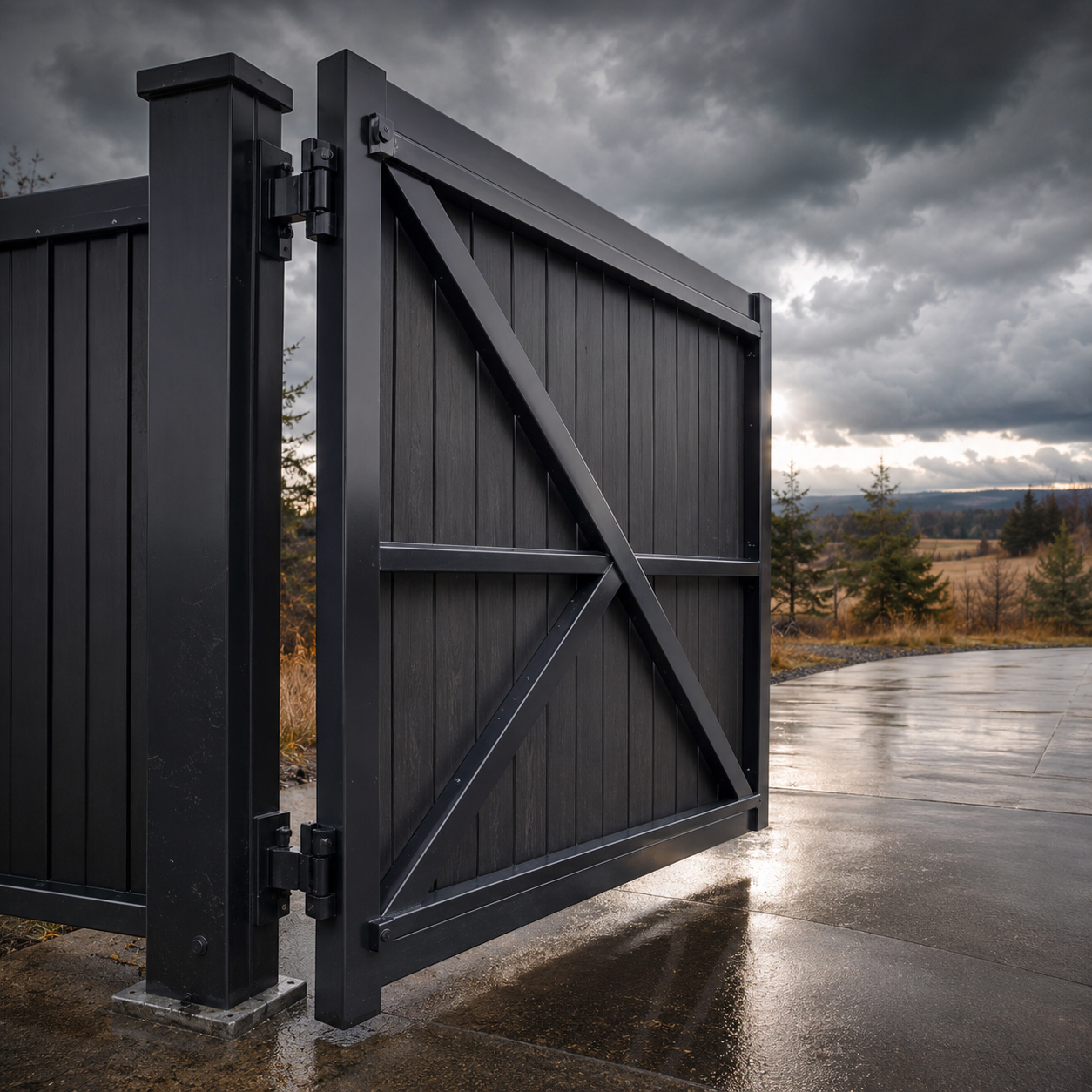
Quick Answer: A driveway gate acts like a sail when wind catches it broadside, and that force lands well away from the hinge, turning into real torque on the frame, the hinges, and the post footing. A solid-infill panel catches far more of that load than an open ornamental design of the same size. Internal cross-bracing keeps the panel from twisting under lateral load, and the hinge-side post and footing have to be sized for the twisting force of the whole panel, not just its static weight.
A gust catches the gate mid-swing, and for a second everything about it changes: the panel takes the wind full in the face, and the hinge-side post absorbs a shove it wasn't necessarily built for. That moment loads the hinges and post in a way ordinary opening and closing never does, and it's why a gate that sits solid and level when closed can still develop a lean, a twist, or a slam problem once the wind starts working on it.
Wind Puts Real Structural Load on a Gate
A closed gate resting on its hinges is mostly carrying its own static weight, a load a well-built gate handles without strain. Wind changes that: a gust hitting the panel broadside, whether the gate is open, mid-swing, or closed against a fence run, treats it like a sail, presenting a wide, flat surface for moving air to push against, with that push landing across the whole face of the panel instead of at the hinge.
That distance from the hinge is what turns a gust into torque, the same reason a long wrench turns a bolt more easily than a short one. Every square foot of surface wind pushes against adds to how hard the panel twists against the hinge hardware, the frame, and the post footing, and that's the load case that determines how the gate, posts, and footings need to be built.
Surroundings matter too. A driveway strung along a long, open fence line, with few trees or structures to break the wind, catches more sustained pressure than one tucked behind windbreaks, which is why gates on acreage properties tend to see harder loads.
Open Designs Versus Solid Panels
An ornamental gate, wrought iron pickets, spaced boards, or any design with real gaps in the material lets a good portion of wind pass through instead of catching it, so even a wide ornamental panel puts comparatively modest load on its hinges and posts.
A solid-infill panel doesn't get that relief. Solid wood, solid metal, or infill added for privacy presents its entire face to the wind, so a solid gate the same size as an open design can see more load meaningfully in the same gust, and needs a frame, hardware, and posts sized for that load. Assuming both styles can share the same post and footing spec just because they're the same size is a common way a gate ends up under-built.
What Internal Bracing Does
Wind load doesn't just push a gate against its hinges. It also tries to twist the panel out of square, a movement called racking, and once a panel has racked even slightly, it rarely settles back into true on its own.
Cross-bracing, or a truss-style brace running diagonally through the frame, resists that skew by tying the panel's corners together instead of relying on the outer rails and fastener joints alone. Bracing matters more as a panel gets wider, since more unsupported frame between the hinge and latch sides gives wind more mechanical advantage to work the panel out of square, and a heavier-gauge frame or an added truss rod earns its keep on wider or solid-infill panels most of all.
Posts and Footings Carry the Load
Every bit of torque a gust generates has to go somewhere, and where it goes is the hinge-side post, which carries the accumulated rotational load the whole panel generates. That's why a post's gauge and diameter, and its footing's depth and width, matter more for a wide or solid gate than for a narrow ornamental one carrying a fraction of the load.
Soil plays its own part: a footing that holds firm in dense, well-compacted soil can work loose over time in sandy or loose fill, since its grip depends on how much surrounding soil resists being pushed sideways. A depth adequate in one soil condition can be under-built in another, which is why footing specs need to account for the ground the post actually sits in, not a generic depth pulled from a lighter gate installed elsewhere.
Signs Your Gate Is Already Under-Built for Wind
A gate absorbing more wind load than its posts and bracing were built for usually tells on itself before anything fails outright: a post that's begun to lean, a panel no longer square and flush the way it once was, hinges working loose faster than seems reasonable, or a gate that swings hard into its stop, or worse, into a parked vehicle, in more than a light breeze. Each one means the same thing: nothing is stopping that force early enough to matter.
A leaning post or a panel no longer carrying evenly on its hinges isn't just cosmetic. A gate leaf can weigh several hundred pounds, and one that comes off a compromised hinge or post doesn't ease down; it falls. If a post is visibly leaning or a panel is no longer square and carrying evenly, keep people and vehicles clear of it and stop cycling the gate until it's been assessed. Any one of these signs is worth acting on; more than one usually means the load has been building for a while.
What a Proper Assessment Covers
A gate that's leaning, twisting, or slamming is carrying more load than its structure was built to handle, and that's worth addressing before a bigger gust turns a cosmetic problem into a broken post or a panel torn off its hinges. Re-hanging the panel or tightening the hinges is a natural first instinct, but none of that addresses why the gate moved out of true. If the real weak point is an undersized post, a footing too shallow for its soil, or a frame that never had internal bracing, redoing the same gate the same way just resets the clock.
A proper assessment looks at the post, the footing, and the panel's internal frame together, identifies where the structure is falling short, and reinforces that specific point instead of patching the symptom.
Frequently Asked Questions
Width matters more, since a wider panel has more unsupported frame between the hinge and latch sides for wind to twist against, while extra height mostly adds surface area without the same racking risk. A tall, narrow gate's bracing often centers on an added horizontal member partway up the panel rather than a heavier diagonal brace.
Internal bracing is easiest to build into a new frame, but a cross brace or truss rod can often be added to an existing panel with enough sound material to anchor it to. Retrofitting versus building new comes down to the existing frame's condition; bracing added to a frame already racked out of square won't pull it back into true.
Somewhat. A gate swinging into the wind tends to get slowed or pushed shut by a headwind, while one swinging with the wind at its back can accelerate through its arc and hit its stop harder than the hardware anticipated, which is useful to know when a stop, hinge, or post is being specified.
An open ornamental design catches less load than a solid panel the same size, but it isn't immune, especially on a wide double-leaf gate or one with larger decorative elements, scrollwork, or a solid center medallion that add surface area back in. Bracing needs scale with surface area and width, not style alone.
Generally yes. A closed gate is latched or resting against a stop on both ends, sharing the load between two fixed points, while an open gate is supported only by its hinges, with nothing but the operator or a hold-open device resisting a gust on the full panel face. Gate operators are built for normal operating loads, not as the gate's primary wind restraint.
Not on its own, and it can work against you if the posts and footing weren't sized to match. Wind load comes from the panel's surface area and design, not its weight, so a heavier gate the same size as a lighter one catches essentially the same wind force. Added weight only increases static load on the hinges and footing and does nothing to resist the lateral push of wind. Weight and wind resistance are separate properties; sizing a gate heavier isn't a substitute for proper bracing.
Get your gate's wind bracing assessed — a technician can check your posts, footings, and panel frame before a gust turns a minor lean into a real repair. Arnold's Garage Door & Gates serves Fort Worth, Alvarado, and the DFW metroplex. Call Arnold: 682-337-7220.
