
Swing Gate vs. Slide Gate: What Your Driveway Decides
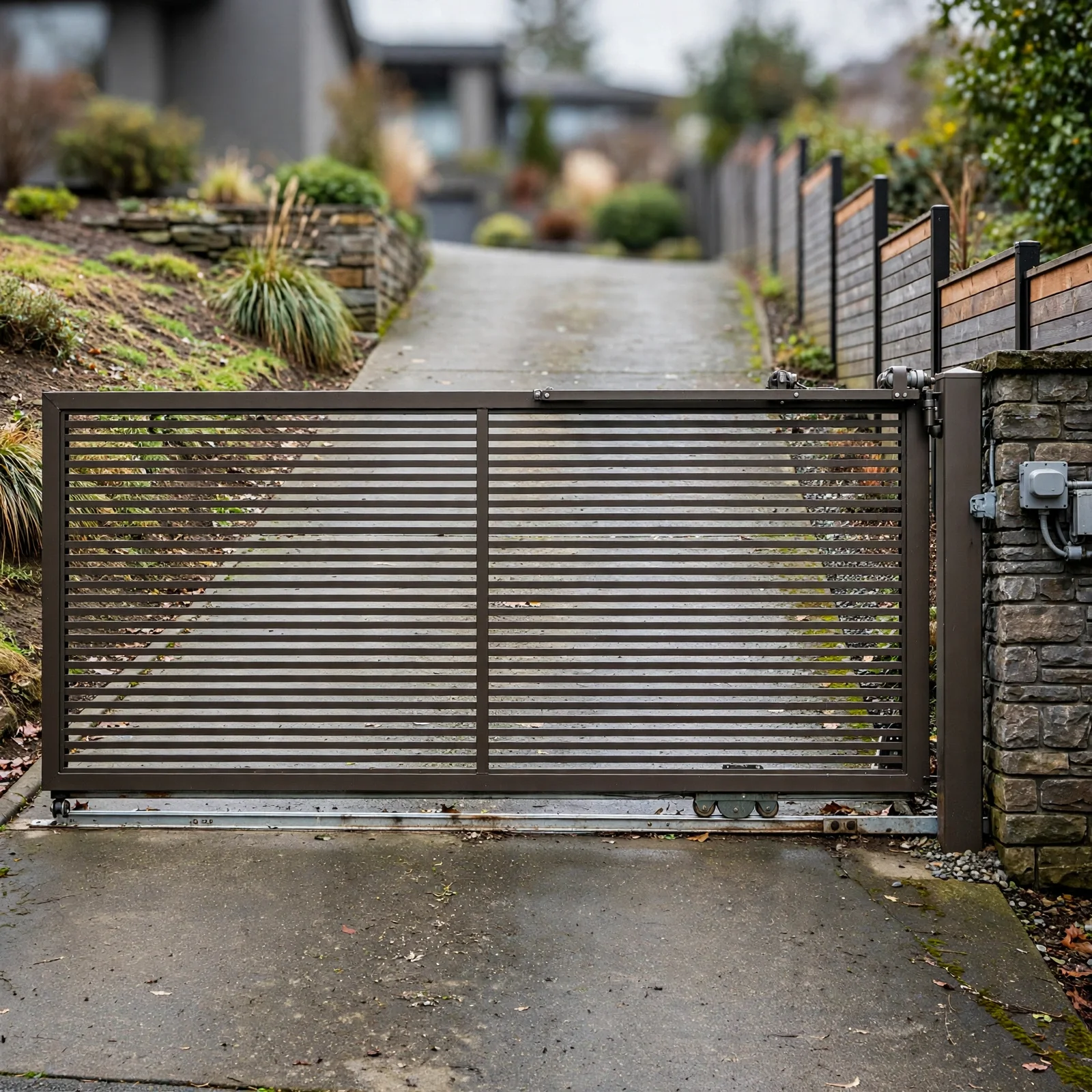
Most people picture the choice between a swing gate and a slide gate as a style question: a swing gate reads as traditional; a slide gate reads as more modern. Looks matter less than most people assume, though. What actually determines whether a swing gate or a slide gate belongs on your driveway is the ground itself: how much level room sits on the side the gate would swing into, how much grade the driveway carries near the entrance, and how wide the opening needs to be to let a vehicle through comfortably. Get those measurements right first, and the choice mostly makes itself. Ignore them, and even a well-built gate will fight your driveway every time it opens.
Both gate types can be automated with an operator from a manufacturer like US Automatic or LiftMaster, in wall-mounted or solar-powered versions, so power source isn't usually the deciding factor either. What separates them is how each one physically moves.
Where a Swing Gate Excels
A swing gate needs a clear, roughly level path to travel through on whichever side it opens into, called the swing radius, kept clear of parked vehicles, landscaping, fence lines, and any real change in grade, since the bottom edge needs consistent ground clearance through the whole arc. That clearance requirement is also where a swing gate earns its reputation: on a flat pad with open ground on the swing side, it gives you the classic, symmetrical entrance most people picture when they think "driveway gate." Wide openings usually split into a double-leaf swing, two panels meeting in the middle, since a single panel long enough to cover the same width would make the operator work much harder to move and hold it against wind.
Direction matters as much as the gate style. Opening inward needs enough clear driveway between the posts and whatever the vehicle needs to clear, a garage door, a parked trailer, a curve in the drive. Opening outward needs clear ground beyond the property line, which isn't always available, and puts the panel closer to road traffic for the few seconds it takes to swing. Where the ground is level, and there's genuine room on one side, a swing gate handles both security and the traditional look without much compromise.
Where a Slide Gate Excels
A slide gate never leaves the plane it travels in, so it doesn't need a swing radius on either side, only a straight run of level fence line roughly equal to the gate's width for it to slide into when open. That single difference makes it the better fit wherever a swing gate would struggle: a sloped approach where a swinging arc would cross changing grade, a narrow entrance boxed in by trees or a retaining wall with no room for an arm, or a wide opening where a single swing panel's arm would need to be impractically long. A slide gate also covers a wide opening as one continuous panel rather than splitting into two leaves, useful if equipment, a boat, or a long trailer regularly needs to pass through without a center gap to line up.
The real trade-off is what a slide gate asks of the ground it travels over. Its track, or the roller carriages on a track-free cantilever design, sit at or near grade for the gate's entire length rather than at one hinge point, so the running gear is more exposed to whatever the driveway surface throws at it: mud after rain, dust and grit tracked in during a dry stretch, or leaves and gravel working into the channel. None of that rules out a slide gate on acreage or a gravel approach, but the track needs to stay clear, while a swing gate's hinges, set higher up and off the ground, mostly shrug that same debris off.
Matching the Gate Type to Your Driveway
Three scenarios cover most of what actually shows up on a homeowner's property, and each one tends to point toward one design pretty clearly.
Steep sloped approach: A driveway that climbs or drops noticeably right at the entrance is hard on a swing gate, because the arc has to hold consistent ground clearance across changing grade, which usually means added post work or a custom-cut panel to keep the bottom edge from catching. A slide gate sidesteps that by running along a section of fence line that can be graded level for the track's length, independent of what the driveway itself is doing. It's not a gate that ignores grade entirely; a very steep run still needs real site work, but a slide gate gives you more flexibility to find or build a level path than a swing gate's arc does.
Narrow opening with no side clearance: Some driveways are boxed in on both sides, close to tree lines, a retaining wall, a neighbor's fence set close to the property line, with no ground to spare for a swinging arm in either direction. That's a clear-cut case for a slide gate, since its only requirement is fence-line length to slide into, not open ground beside the entrance. A swing gate here would need site prep, grading and setback room, to create the clearance the arc needs, prep a slide gate never asks for.
Wide flat opening with room to spare: When the ground is level, and there's space on both sides, either design works, and the decision comes down more to how you use the driveway and how you want the entrance to look. A double-leaf swing gate gives a traditional, symmetrical entrance and keeps each arm at a manageable length. A slide gate gives you one continuous, unobstructed opening, useful if wide vehicles or trailers pass through regularly, and it stays visually flush with the fence line rather than becoming a focal point when open.
Maintenance follows the same pattern as installation. A swing gate's operator has fewer wear points overall, mainly the hinges and the arm's pivot connections, and lubricating those with a dry PTFE or silicone-based lubricant, rather than a heavy grease, usually keeps it moving well. A slide gate's chain or gear-rack drive has more length to maintain, since the whole track and every roller along it can wear or collect debris, so it tends to need more frequent attention to keep the running surface clean and aligned. Neither difference is a reason to avoid a slide gate where the ground calls for one; it's simply what you're signing up to maintain.
Choosing Before You Design Around Looks
Once slope and clearance rule a type in or out, the remaining decisions, single or double leaf, panel style, ornamental versus solid infill, become the fun part rather than the deciding one. Walking the actual entrance with a tape measure and a level, before falling in love with a picture of a gate style online, saves the redesign that happens when a swing gate gets specified for a driveway that never had the side clearance to support it.
Frequently Asked Questions
Rarely without modification. A swing gate's posts are set to carry the hinge load and resist the twisting force of the panel swinging open, while a slide gate's end post has to anchor a roller carriage or track terminus and resist a sideways pull instead. Most conversions end up resetting at least one post in a new location, which usually means new site prep for the track's starting point.
Plan for extra room past the gate's measured width, not just a match to it, and how much depends on the design. A track-style slide gate typically needs the gate's own width plus a modest allowance, often around a foot or so, for the roller carriage and end-of-track stop to fully seat. A cantilever gate needs noticeably more: because the design counterbalances the gate with a steel tail that runs back over the fence line behind the opening, that overlap section needs roughly half the opening's width again in clear fence line, well beyond what a track-style gate requires.
Not quite. A slide operator has to maintain steady pull across the gate's entire travel distance rather than working hardest at just one point in an arc, so it typically draws more continuous current than a comparable swing operator. Solar systems sized for a slide gate often specify a larger panel and a higher-capacity deep-cycle battery than a swing gate of similar size and weight would need.
Yes, a cantilever slide gate. Instead of riding in a track cut into or set on the driveway surface, the gate hangs from an internal steel frame supported by roller carriages mounted higher on the fence posts, so nothing sits at grade to catch mud, gravel, or ice. It uses more steel than a track-style slide gate, but it's worth asking about on a driveway prone to standing water or heavy debris.
A track set without any drainage gap can hold standing water after rain and rust from the inside out well before the visible surface shows it. Tracks installed with a slight pitch or a drainage notch at the low end let water run off instead of pooling, which is worth confirming during installation rather than after the track has already started to corrode.
Not cleanly. Swinging both ways is a manual-gate habit that doesn't carry over well to automation: an automated operator is set up around a single arc, with its travel limits, stop position, and safety sensing all configured for one direction, so building in the other direction means doubling that setup rather than just unlatching a hinge by hand. It also still needs clear ground on both sides to work. For most driveways, it's simpler and more reliable to commit to one swing direction based on whichever side actually has the room.
Get help sizing the right gate for your driveway — a technician can walk your fence line and check slope, clearance, and post placement before you commit to a design. Arnold's Garage Door & Gates serves Fort Worth, Alvarado, and the DFW metroplex. Call Arnold: 682-337-7220.
