
Garage Door Beyond Repair? 4 Signs It's Time to Replace
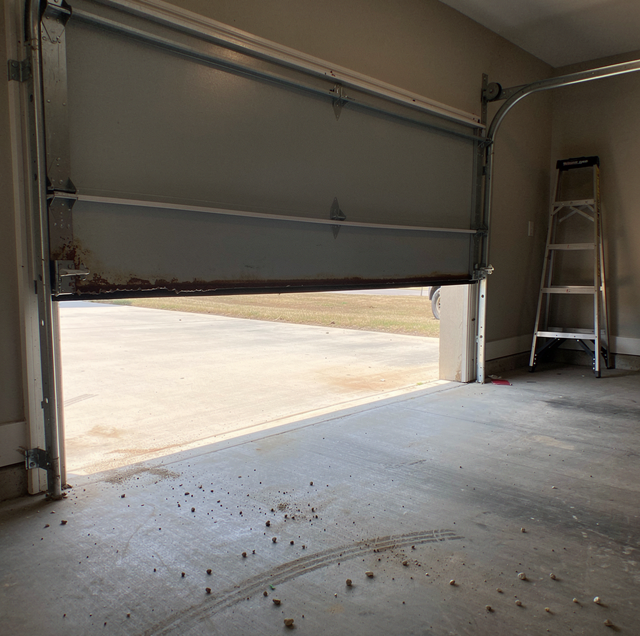
A garage door rarely fails as one clean event. It wears down as a string of small compromises: a track that's drifted a little out of true, a seam where the coating has broken and rust has begun to form, and a spring nearing the end of its rated cycles. Any single one of those, taken alone, is an ordinary repair. The harder question arises when several of them show up on the same door within the same year, or when the same fix keeps needing to be redone. That's when the question changes from "what's broken this time" to "is fixing this still the right move?"
There's no single number that answers that for every door. But there are four patterns that, together or on their own, reliably separate a door that's worth another repair from one that isn't.
Recurring Misalignment That Returns After a Proper Fix
A track that gets bumped once, by a car mirror or a dropped ladder, is a one-time repair: a technician resets it, and it holds. A door that keeps drifting out of square every few months, even after the tracks and opening have been professionally re-squared, is telling you something different. In homes where the slab shifts slightly with seasonal moisture changes, that movement can pull the garage opening itself out of true over and over, so the door frame is chasing a moving target rather than settling into a fixed one.
This is not a job to chase with shims and a level on your own. Re-squaring a track system, and any adjustment that touches how the door frame sits in the opening, involves the same hardware that's under spring tension, and it needs to be done by someone who can also check whether the springs and cables are still matched to the door's actual working geometry once it's reset. If the door keeps needing that adjustment on a repeating schedule, closer to every few months than every few years, the underlying opening has become an unreliable base to keep repairing against. A repair fixes the door. It can't fix a shifting foundation, and repeating the same fix on a moving target is a losing race.
Rust at the Bottom Seam That's Eaten Into the Metal, Not Just the Surface
The bottom section of a garage door takes more punishment than any other panel. It sits closest to the ground, catches splashback from rain, and holds moisture against its underside longer than a section higher up ever will. On steel doors, that section is also where the factory coating is most likely to have a weak point, since the panel was trimmed to width somewhere along its bottom edge, and a cut edge doesn't carry the same protective coating as the rest of the surface.
Surface rust, the kind that shows up as an orange stain or light pitting you can knock off with a wire brush, is cosmetic and doesn't change the door's structure. The distinction that matters is whether the rust has gone all the way through the metal rather than just discoloring it. Hold a flashlight at a low angle along the bottom seam and look for a seam that's actually thinner or flaking away rather than just stained. Once rust has eaten through the panel itself, instead of just sitting on top of it, there's no longer solid steel for the bottom brackets to anchor into, and those brackets are what the lift cables pull against on every single cycle. A patch panel or a coat of paint covers the hole. It doesn't restore the metal the hardware needs to bite into.
When Repairs Start Stacking Up Across Different Systems
One repair on an otherwise sound door is normal wear, not a warning sign. Doors run for years, need a roller or a cable replaced, and then run fine for years more. What changes the calculation is a pattern: a roller replaced last spring, a cable that slipped off its drum over the summer, and now a spring nearing the end of its rated cycles, all inside the same twelve or eighteen months, on the same door.
It's a lot like a car that needs the same transmission repair for the third time. Each individual fix might be reasonable taken on its own, but three unrelated systems failing in close succession on the same unit usually means the whole thing is reaching the end of its working life together, not coincidentally falling apart part by part. A technician who's been out to the same door twice in a year is often the best judge of whether this is one more isolated fix or the start of a longer string of them, since they've already seen how the earlier repairs held up.
Parts That Are Getting Harder to Source
Doors undergo model changes, panel style changes, and hardware runs that manufacturers eventually stop producing. Rollers, hinges, and standard cable are largely universal and stay available for decades. Panel skins, end caps, and window inserts are a different story: they're specific to a model and a production run, and once a manufacturer discontinues a style, a matching replacement section may no longer exist.
If your door is old enough, or unusual enough, that a technician has to hunt for a compatible part rather than order it off a standard list, that's worth weighing on its own, separate from whatever brought on this particular repair call. A door built on discontinued hardware can be fixed today and will be much harder to fix the next time something fails, which means a repair now doesn't necessarily buy you the years of reliable use a repair usually implies.
Weighing the Repair Against the Replacement
Put those four signs together, and a rough rule takes shape. Repair tends to be the sound call when the door shows a single isolated failure on newer hardware, when parts are still standard and easy to source, and when the panels and frame are structurally sound even if they're a little worn. Replacement earns its place when misalignment keeps recurring despite a proper professional fix, when rust has actually perforated a panel or bracket anchor point rather than just staining it, when repairs are stacking up across unrelated systems within a short window, or when the specific parts a repair requires are no longer reliably available.
None of this has to be decided from a driveway glance. A technician doing a real assessment checks the door's balance, looks closely at the bottom seam and the bracket points rather than just the visible face of the panel, and can tell you plainly whether what's failing is contained to one part or spread across the system. That assessment is also a natural fit for a rental property between tenants: a landlord isn't watching the door day to day the way an owner-occupant is, so a vacancy is often the first real chance anyone's had to look closely at balance, seals, and hardware wear since the last tenant moved in, before handing the door off to someone new.
Frequently Asked Questions
A one-time bump usually shows up as an isolated gap or a roller riding rough on one side. To check the opening itself rather than just the track, a technician measures corner-to-corner across the diagonals of the frame: a square opening produces two matching diagonal measurements, and a gap of more than about a quarter inch between them points to the frame itself having racked out of true rather than a track that simply got knocked loose.
Yes, though it's a step that's skipped more often than it should be. Brushing a zinc-rich touch-up compound onto the bottom edge at install time restores some of the protection lost when the panel was cut to its final width, and it takes only a few minutes. It's worth asking specifically if you're only having the bottom section replaced rather than the whole door, since that fresh-cut edge is exactly where the next round of rust would otherwise start.
A steel sectional door's skin and frame are typically rated for a service life of 20 to 30 years under normal conditions, well beyond the usual lifespan of the hardware riding on it. That gap matters: a door well inside that structural window can still be a poor repair candidate if it's failing for the other reasons above, and a door past that window can still be structurally sound if it's been maintained and the panels show no rust-through.
Ask whoever comes out to note the date and the specific part on the invoice every time, even for something as small as a roller or a remote battery, and keep those invoices together instead of filing them by whatever project they came with. A written record across two or three unrelated systems gives a technician the actual sequence to weigh, instead of reconstructing it from a rough memory of "it's been having a lot of problems."
Yes: turnover is a good moment to test and document the auto-reverse safety feature specifically. Setting a block in the door's path during a close cycle, confirming it reverses immediately, and noting the date it was verified creates a written record that the safety system was working before the next tenant moved in. That kind of documentation matters more for liability between tenants than almost anything else checked at turnover.
Yes, and specifically the sections nearest the ground on both sides, not just the one with visible staining. Moisture wicking happens wherever a bottom corner sits closest to standing water or splashback, so a rusted seam on one side is a reasonable prompt to check the opposite bottom corner and the center bottom bracket as well, even if nothing looks obviously wrong there yet.
Get an honest read on whether your door still has repair life left in it — Arnold checks the balance, the bottom seam, and the hardware history before making a recommendation. Arnold's Garage Door & Gates serves Fort Worth, Alvarado, and the DFW metroplex. Call Arnold: 682-337-7220.
