
Bent Garage Door Top Section: What the Opener Arm Reveals
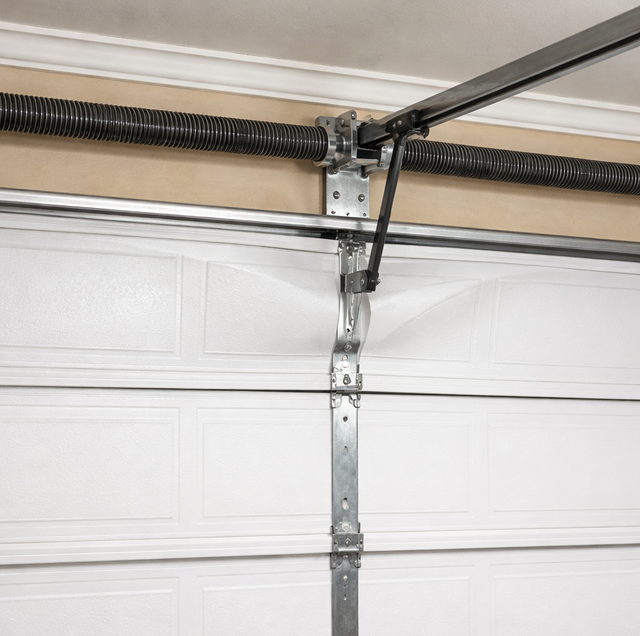
Low afternoon light across a steel garage door turns every ripple in the skin into a shadow. On a door running on a tired spring, the shadow that matters sits across the top section: a shallow dish, or a hard horizontal line, centered a few inches from where the opener's arm bolts on.
That location is no coincidence. The bracket holding the arm is the one point where the opener's pull enters the door, so a panel folding there is reporting on the counterbalance behind it. Reading that report means following the pull from the overhead trolley down to the two or three bolts that hold a bracket to formed sheet metal.
The Only Section the Opener Actually Pulls
A sectional door is four or five hinged panels stacked in a track, and the opener touches exactly one of them. An arm drops from the trolley to a bracket fastened to the inside face of the top section, and every section below comes along because the hinges drag it there. The top section is the locomotive. The rest of the door is the train behind it.
Pull leaves the trolley, crosses a clevis pin, enters the bracket, and transfers into the panel through a small cluster of bolt holes. From there it runs through the top section's hinge line into the sections below.
None of that is stressful as long as the counterbalance is doing its job. A double door weighing 150 to 250 pounds, or a single at 100 to 150, hangs nearly weightless off the torsion spring above the opening. The opener overcomes friction and stops the door at its limits, and the bracket carries a small share of that weight through bolts sized for it.
What a Fatigued Spring Changes About That Load Path
A torsion spring is a consumable. The common residential rating is 10,000 cycles, which at four or five cycles a day works out to roughly six years of service. It does not hold full tension until the final cycle and then quit. It loses turns as the steel takes a set, and the door creeps heavier while the counterbalance falls behind.
Whatever weight the spring stops carrying still has to be carried, and on a door with an opener the arm supplies it. Everything the arm applies lands at one bracket.
Three versions produce the same result. A spring undersized for the door from day one never matched it. A spring near the end of its cycle life has surrendered part of its lift. On a two-spring setup with one broken, the survivor holds roughly half the door while the opener covers what it can of the difference every cycle; a lighter door may still finish its travel this way, while a heavier one is more likely to stall or trip the force limit partway up. Either version loads the bracket hard, and it is often the quieter failure, since the door does not stop working outright.
Reading the Bow, the Crease, and the Bracket Play
Close the door and stand inside with the light behind you. Sight along the top section from one end, eye close to the surface, and its shadow line shows whether it runs straight. A dish centered on the bracket that fades toward the end stile is the early stage.
A crease is the later stage: a sharp horizontal line in the skin, usually within a hand's width of the bracket plate, sometimes with paint flaking along it. Once a fold exists, that line is where the panel moves every time it takes load.
Then the fasteners. A bright ring of bare metal around a hole, or rust-colored dust smeared below one, means the bolt has been working in its hole, and a hole that started round begins to go oval under repeated pull.
From outside, the seam between the top two sections should stay even end to end with the door closed. When the middle has bowed, that joint opens wider at the center, and on a bright day daylight shows through. A knock at the same point in travel every cycle is often the bracket taking up slack in an elongated hole before it pulls.
Photograph the bracket area straight on and again from a low angle before anything gets touched. A bow reads clearly in a raking-light photo, and it gives you a fixed reference for judging whether the section is still moving.
The Strut and Reinforcement Bracket That Spread the Load
Opener manufacturers treat the top section as the weak link, which is why their installation instructions call for reinforcing it before attaching the arm. Two pieces of hardware do that job.
The operator reinforcement bracket is a plate between the arm bracket and the panel, spreading the pull across more skin than a bare bracket touches. The strut is the larger fix: a horizontal U-channel or angle bar running the full width of the section, fastened along the inside face and tied into the end stiles, turning a floppy sheet-steel panel into a beam. Where a strut exists, the arm bracket should fasten through it so the load enters that beam.
Single-layer steel doors depend most on this: with no insulation core and no back skin, a section derives its stiffness from its formed shape and any added bracing. Insulated doors with a polystyrene or polyurethane core resist bending better, though they weigh more, which raises what the bracket holds once the spring falls behind.
On a retrofit, reinforcement is the step that gets skipped. An existing strut is worth checking too: those end screws back out on a door that cycles daily, and a strut loose at one end has stopped spreading anything.
Force Adjustment Masks the Same Problem
Openers with automatic force learning make the entire sequence quieter than before. The unit calibrates to whatever load the door presents, so as the bracket takes on more of the counterbalance's job, the opener simply learns a heavier setting with nobody deciding anything or turning a screw. What used to announce itself as a stall or a reversal now passes as normal operation, right up until the bracket itself gives out.
A top section already folding at the bracket can tear loose while the door is moving. If the arm pulls through the skin mid-travel, the panel swings inward on its hinges with the sections below still hanging from that seam.
Deciding Whether the Section Needs Replacing
A shallow dish with round bolt holes and a bracket sitting tight usually survives. Correcting the counterbalance removes the overload, and a strut plus a reinforcement bracket gives the panel the stiffness it should have had.
A sharp crease across the skin, bolt holes worn oval, or fasteners torn out of the panel put the section past that point. Panel replacement is the route, and matching is the constraint: profile (raised panel, long panel, or flush), surface embossment, and color all have to match the sections staying on the door. Older and discontinued models limit what is available; a top section carrying window inserts adds a second matching problem, and a factory-correct new section still reads brighter than sun-faded neighbors.
Putting a fresh section under an uncorrected spring returns new steel to the load that bent the old one, and the crease comes back in the same place.
Frequently Asked Questions
Steel that has folded once work-hardens along the fold, so pushing a crease back out leaves a weakened line that folds again on the next heavy cycle. A dished section that has not creased is different, and a full-width strut often stops the movement. Aluminum full-view doors carry their strength in extruded stiles and rails, so damage there shows first at the corner joints.
A hand-operated door will not develop this pattern, because nothing pulls on the top section at a single point. A weak spring there announces itself elsewhere: heavy at waist height, drifting down from half-open, wear landing in the top roller bracket and the hinges. Jackshaft openers are the exception worth knowing. They mount beside the torsion shaft and drive that shaft directly, with no arm on the top section at all.
The bolts clamp fine. The hole in the skin has elongated, so the bracket shifts inside it before the clamp takes hold, and tightening harder only dishes the metal under the washer. Fender washers on the inside face spread the clamp over more skin, a stopgap on a section already deformed. Carriage bolts also back off on a door that vibrates daily, and nylon-insert lock nuts replace plain nuts that loosen.
It can. The top section carries the header seal in a retainer along its top rail, and a bow at the middle moves that edge relative to the header, opening a gap that shows as daylight, blown dust, or wind noise at the center while the ends still seal. The bottom astragal is unaffected, which is why people chase the wrong seal.
Placement is usually the deciding factor. The arm bracket belongs high on the section, near the top rail where the structure is, and a bracket set low gives the arm more mechanical advantage against thin steel, so a fatigued spring that a correctly placed bracket tolerated for years can fold a low-mounted one within weeks of a new opener's fresh force calibration.
Anywhere from days to years, depending on how far off the counterbalance is. A door run with both springs gone can crease in a handful of cycles. A door limping on one working spring of a pair can hold a steady overload on that bracket for months before anything shows, which is why the damage often turns up with no memorable event behind it.
Schedule a look at the top section and the spring behind it — broken spring repair plus panel replacement matched to your door's profile and color when the section is past saving. Arnold's Garage Door & Gates serves Fort Worth, Alvarado, and the DFW metroplex. Call Arnold: 682-337-7220.
