
Can You Replace Just the Opener Motor and Keep the Rail?
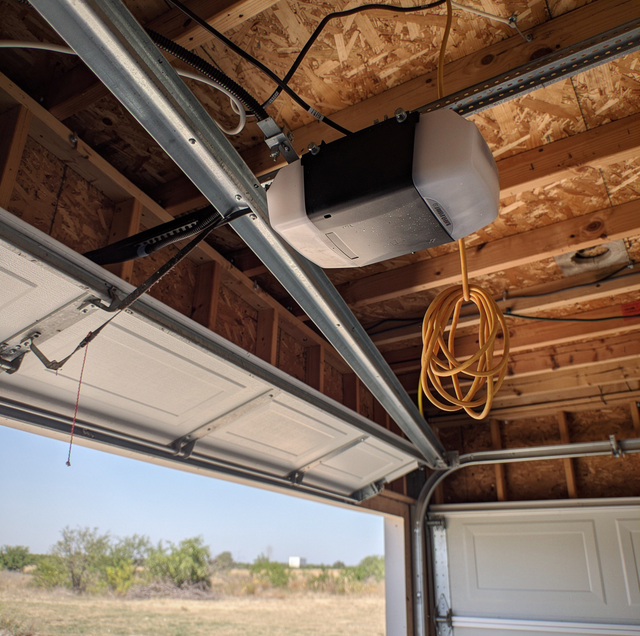
Can the motor unit come down and a new one go up while the rail stays where it is? Usually not. On a replacement, the rail comes down with the head as a single assembly, and that is the default; every other decision is measured against it. The exception is narrow and specific: a pairing of head and rail that the manufacturer itself supports, inside one product line and one generation.
The instinct behind the question is sound. The rail is the long, awkward, physically installed part of an opener, and the powerhead is the part that fails. When the motor is finished, but the rail is straight, the chain intact and the trolley still sliding, taking down the whole assembly to replace the one piece that quit feels like more work than the job needs.
Gear material, cycle-count aging, the one-or-both decision on a two-door garage and the wider repair-or-replace call each belong to their own discussion; what follows is what has to line up before that exception applies.
Manufacturers Build the Rail and the Powerhead as a Matched Set
An opener is sold as an assembly, and its internal interfaces belong to the manufacturer. The output sprocket, the way the rail's end casting mates to the head, the width and profile of the rail channel, and the trolley that rides inside it are all decided at once when a product line is drawn up. None of those interfaces are standardized across the industry, and none are guaranteed to carry over when a manufacturer revises a line. Older units were built on rail profiles current lines no longer use at all.
That is why a head from one line rarely mates to another line's rail even under the same badge. A brand may run several lines at once, and each line may span more than one generation of powerhead. The rail hanging in your ceiling belongs to a line and a generation, and the fit question runs line against line.
Where a manufacturer supports the pairing, the support is explicit: the head is offered in a configuration that accepts that rail, or the pairing appears in the manufacturer's own published fitment information. That published support is the whole of the exception. Where nothing says so, the rail comes down.
In practice, the availability question usually arrives first. If the line that produced the rail is discontinued and the heads that mate to it are no longer built, there is nothing left to check compatibility against.
Rails rarely carry a label of their own. The model information that identifies a rail usually lives on the powerhead being removed, which means the old unit's data plate has to be read before it ever comes down.
The Trolley Has to Match the Drive Medium and the Head's Sprocket
A chain, a belt, and a screw are three different ways to move a trolley along a rail, and each requires its own hardware at both ends. A chain rail runs the chain over a drive sprocket on the powerhead and around an idler at the door end, with the trolley clamped to the chain. A belt rail uses a reinforced belt over a pulley cut for that belt's tooth profile. A screw rail carries a threaded steel shaft turned directly by the motor, and the trolley rides a driver that engages the thread.
The head has to be built for the medium it is asked to move through. A powerhead with a belt pulley will not turn a chain, and a head built to spin a screw shaft has no sprocket at all. From the floor, a chain rail and a belt rail read as nearly interchangeable, which makes it an easy point to miss.
The trolley matters as much as the medium does. It is matched to the medium it grips, the channel it slides in, and the arm that reaches down to the door. A rail can be the right length and profile and still carry a trolley the new head's arm geometry was never drawn around.
A Rail That Ran a Failing Opener Carries That Wear Forward
Rails wear where things slide and turn. The trolley travels the channel every cycle, the chain or belt runs over the idler at the door end on its own bearing, and the medium itself takes the load each time the door starts and stops. That wear records the conditions the rail has been running under.
A motor on its way out was not failing quietly. A worn gear, a slipping coupling, or a unit fighting a door out of balance puts loads through the rail a healthy installation never sees. Reusing the rail imports whatever produced that wear, and the new head inherits it on its first cycle. On this point, Chamberlain is direct in its support material: rails and hardware from an older opener should not be carried over onto a new one, because the older construction ran metal against metal where current construction does not.
Two conditions in particular undo the point of the exercise. A channel worn out of shape lets the trolley rock rather than track, and the new unit reads it as resistance. On a rail assembled in sections, a loosened seam leaves a step for the trolley to cross twice per cycle, which shows up as a knock and further opens the joint.
A rail hangs overhead under the load of a door in motion. If a hanging strap is loose or a seam has opened, leave the assembly alone and keep the door closed until someone qualified can properly support it.
The Mounting and the Length Were Set for the Unit Coming Down
The rail is only half of what holds an opener up. At the door end it lands on a header bracket fixed to the framing above the opening, and along its length it hangs from the ceiling structure on straps or angle. Every one of those points was located for the unit being removed.
A new powerhead is a different casting. Its case may be longer, shorter, or deeper, and may sit at a different height, moving where the rail lands relative to the door and where the hanging points want to be. A head compatible on paper can still put the rail out of position for the brackets already in the ceiling.
Length is its own constraint. A rail is sized for a door height, and manufacturers publish rail extension pieces for taller doors as line-specific accessories. Keeping a rail at its length means whatever head goes on it has to work within the travel that length allows.
The Control Side Belongs to the New Head Regardless
Nothing about the rail decision reaches the control side, which catches people who assume that reusing the rail means reusing more of the installation than it actually does. The low-voltage terminals are on the new logic board. The photo eyes report to that board and pair to the unit they are wired to. The wall control is the new head's control, communicating on the new head's terms.
The same holds for everything that talks to the opener without a wire. Remotes, keypads, and in-car buttons pair to the receiver inside the new powerhead, so every accessory in the household follows it, and whether an older accessory is supported at all is the new head's question to answer.
Keeping a rail changes the material and labor for the mechanical half of the job, but leaves the electrical half where it was.
A Rail That Has Served One Opener Is Being Asked to Serve a Second
Everything on a rail that can wear has already served a full term. The trolley bushings, the channel, the idler bearing at the door end, and the drive medium itself reached the end of one opener's working life at the same moment the motor did, and keeping them renewed does none of them any good. Straightness is the easiest thing to see from the floor and tells you the least, because the parts that decide whether a rail has another service life in it only report under load.
That does not make every older rail unusable. It does mean the age of the rail is a separate question from the age of the head, and a rail has to clear it on its own before it can be part of the exception rather than part of what comes down.
A Rail Records Where It Came From and What It Has Been Through
A model number narrows the field. It does not close it. Two units under the same family designation can differ in the generation of the rail interface, and a rail that has hung for years may not be the one the original carton contained, because openers get repaired and parts get substituted along the way.
The rail keeps its own record, and the record is readable. The end casting shows the profile and interface it was built to. The channel carries a wear pattern where the trolley has run, and a rail that has been rocking marks one wall rather than both evenly. The header bracket and ceiling angle hold the holes drilled for whatever hung there before, and a second set of holes says the rail has been changed out once already. The drive medium indicates its condition at the idler end, where loading is concentrated.
Read together, that evidence answers what a model number only opens. Most of the time, it confirms the default: the rail belongs to the opener being removed, and it leaves the ceiling with the opener. Now and again it says the opposite: that the line is current, the generation matches, the manufacturer publishes the pairing, and the rail has service left, and that narrow case is where the rail stays. Getting that read before anything is disturbed beats finding out halfway through.
Frequently Asked Questions
That is the reverse of the question most people ask, and it is often the better-supported path. Manufacturers list rail assemblies and replacement trolleys as service parts for the lines they currently support, so a sound powerhead with a damaged rail has a clearer route to a repair than a new head looking for an old rail does.
Usually not. The curved and straight arm sections and the bracket they bolt to on the door are their own parts, and they normally arrive in the carton with a new opener. The arm's geometry is set by where the new trolley sits and how the head is positioned.
The release lever, its cord, and its handle are part of the trolley, not the powerhead, so keeping the rail means keeping the release mechanism already there. That mechanism is the manual disconnect that lets the door be moved by hand when there is no power, so its condition matters. Only ever pull it with the door fully closed.
Manufacturers publish warranty terms that cover the parts they supplied, and a head running on a rail that came from elsewhere falls outside the assembly those terms describe. It does not automatically void anything, but it can change how a manufacturer treats a failure as covered. Ask the question before the installation rather than after a claim.
It is, because on a screw rail the drive medium and the rail are the same component. The threaded steel shaft is what moves the trolley, and manufacturers specify a particular grease for it rather than a general-purpose lubricant. A reused screw rail brings its lubrication history and mechanical wear along, and the two are hard to separate.
It tends to arrive as a dry chirp or squeal whose pitch rises and falls with the door rather than holding steady, loudest in the middle of its travel, where the door moves fastest. A dragging trolley sounds lower and rougher, and it repeats in the same spot on the rail every cycle. Letting the door run one full cycle from inside the garage usually tells you which of the two you have.
A compatibility check on the existing rail and powerhead — you find out before anything comes down whether the rail overhead can carry a new head or whether it comes down with the old one. Arnold's Garage Door & Gates serves Fort Worth, Alvarado, and the DFW metroplex. Call Arnold: 682-337-7220.
